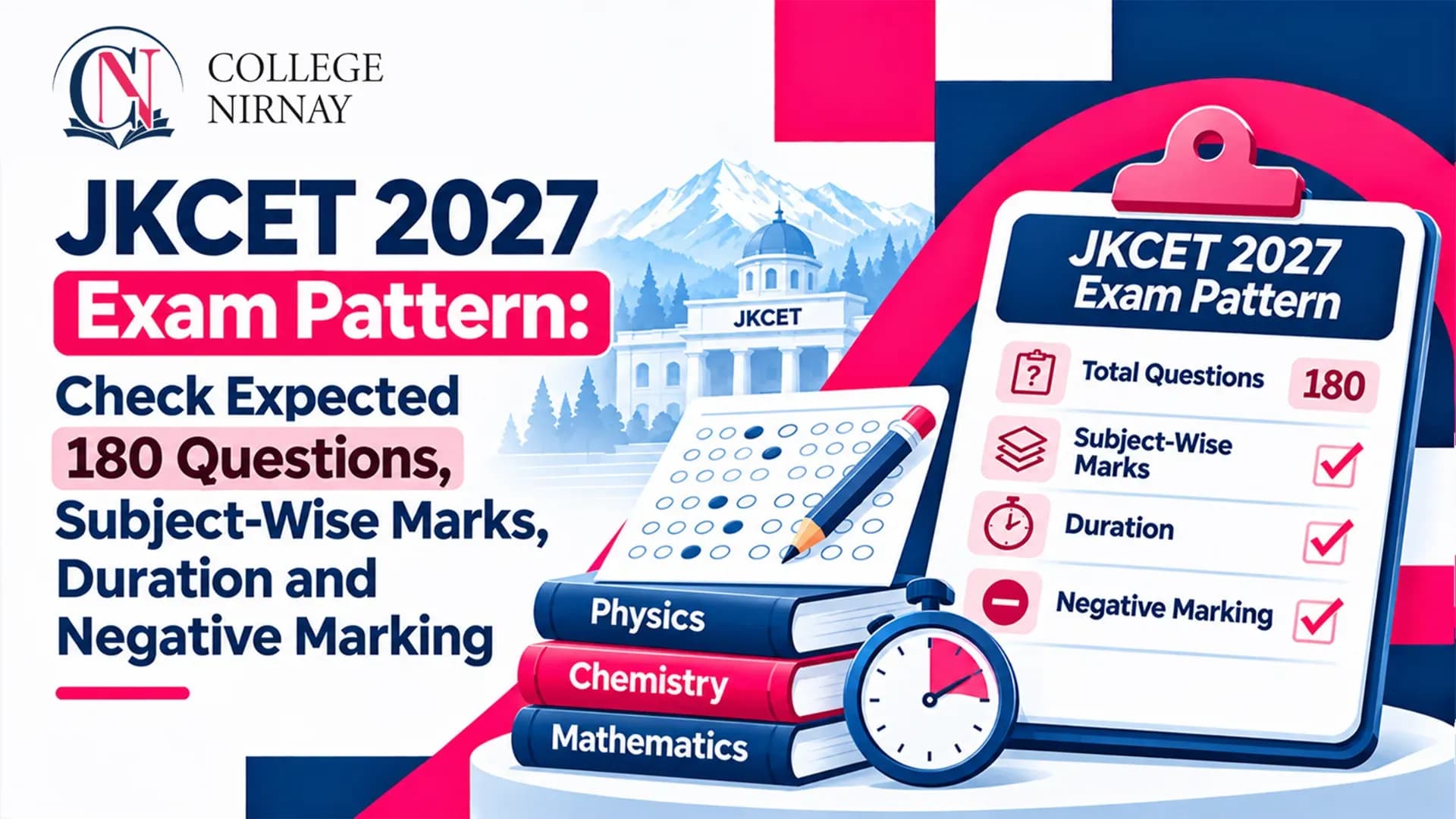
JKCET 2027 Exam Pattern: Check Expected 180 Questions, Subject-Wise Marks, Duration and Negative Marking
Candidates preparing for B.E. and B.Tech engineering admission in Jammu and Kashmir should understand the expected JKCET 2027 exam pattern before beginning their entrance examination preparation. The Jammu and Kashmir Board of Professional Entrance Examinations (JKBOPEE) conducts the Jammu and Kashmir Common Entrance Test for engineering courses in participating government and private institutions. As of November 13, 2026, JKBOPEE has not released the official 2027 Information Brochure. Therefore, the 2026 entrance examination pattern provides the latest confirmed reference for the JKCET 180 questions format, scoring rules and examination duration.
Under the latest JKCET question pattern, the entrance examination consists of one paper containing Physics, Chemistry and Mathematics. The JKCET subject wise marks distribution provides 60 questions and 60 maximum marks for each subject, making a total of 180 questions carrying 180 marks. The JKCET exam duration is three hours. The JKCET marking scheme awards one mark for a correct response, while JKCET negative marking deducts 0.25 marks for each incorrect response. Understanding these rules can help candidates improve accuracy, manage time and develop an effective examination strategy.
Key Highlights — JKCET 2027 Exam Pattern
- JKCET 2027 exam pattern — Official 2027 rules are awaited; JKBOPEE's 2026 engineering examination scheme provides the latest confirmed reference.
- JKCET 180 questions — The examination contains 180 objective-type multiple-choice questions across Physics, Chemistry and Mathematics.
- JKCET subject wise marks — Physics, Chemistry and Mathematics contribute 60 questions and 60 maximum marks each.
- JKCET exam duration — Candidates receive three hours to complete the full question paper.
- JKCET negative marking — Each incorrect answer results in a deduction of 0.25 marks from the candidate's score.
- JKCET marking scheme — One mark is awarded for a correct response, while an unanswered question receives zero marks.
- JKCET question pattern — The question paper contains objective-type MCQs with four options and one correct response.
- The latest engineering examination is conducted offline through an OMR-based pen-and-paper format.
- The question paper is provided in English, with Physics, Chemistry and Mathematics forming the three subject sections.
- The 2026 reference pattern does not prescribe independent time limits for each section, allowing candidates to manage their three-hour examination time across the paper.
Explore This: Check JKCET 2027 Exam Pattern
What Is the Expected JKCET 2027 Exam Pattern?
The final JKCET 2027 exam pattern will be confirmed when JKBOPEE publishes the new engineering entrance examination Information Brochure. Based on the latest published examination structure, candidates should prepare for the following major features:
- Physics section — 60 objective questions carrying 60 maximum marks;
- Chemistry section — 60 objective questions carrying 60 maximum marks;
- Mathematics section — 60 objective questions carrying 60 maximum marks;
- Examination format — one combined question paper containing 180 multiple-choice questions;
- Maximum examination duration — three hours, or 180 minutes, for the complete paper;
- Marking rules — +1 mark for a correct answer, −0.25 marks for a wrong answer and zero for a question left unanswered.
The latest examination is conducted using an OMR answer sheet, requiring candidates to mark their chosen options according to the instructions printed in the question booklet and admit card. Candidates can review the JKCET general examination pattern and important instructions.
JKCET Subject-Wise Question Distribution: Physics, Chemistry and Mathematics
The latest JKCET subject wise marks distribution gives equal numerical weight to Physics, Chemistry and Mathematics. Each section contains 60 objective questions worth one mark each. Consequently, the complete entrance examination has 180 questions with a combined maximum of 180 marks.
| JKCET Subject or Paper Component | Number of Questions and Maximum Marks |
|---|---|
| Physics | 60 multiple-choice questions carrying 60 maximum marks |
| Chemistry | 60 multiple-choice questions carrying 60 maximum marks |
| Mathematics | 60 multiple-choice questions carrying 60 maximum marks; combined paper total: 180 questions and 180 marks |
The three sections form one engineering entrance paper rather than three independently scheduled examinations. Candidates should prepare all three subjects because a weak performance in any one section may reduce the combined entrance score and affect the candidate's position in the merit list.
JKCET Marking Scheme 2027: Correct, Incorrect and Unanswered Questions
The expected JKCET marking scheme follows JKBOPEE's latest engineering examination rules. A candidate earns one mark for every correct answer, while an incorrect response results in a deduction of one-quarter of a mark. Questions left blank receive zero marks, with no deduction for an unanswered response.
| Answer or Response Type | Marks Awarded or Deducted |
|---|---|
| Correct Response | +1 mark for each correctly answered question |
| Incorrect Response / Unanswered Question | −0.25 marks for an incorrect answer; zero marks for an unanswered question |
For example, if a candidate answers 40 questions correctly and 15 incorrectly in a 60-question subject section, leaving five questions unanswered, the score for that section is 36.25 marks. The 40 correct responses contribute 40 marks, and the 15 incorrect responses deduct 3.75 marks.
The maximum possible score in the entire examination is 180 marks, achieved by answering all 180 questions correctly. Actual entrance scores may be lower because the marking system penalises wrong answers. Candidates should evaluate mock tests using the same scoring formula instead of counting only the total number of questions attempted.
JKCET Total Questions and Maximum Marks: Why Every Subject Matters
The expected JKCET 180 questions structure distributes the maximum marks equally among Physics, Chemistry and Mathematics. Each subject represents 60 out of the available 180 marks, accounting for one-third of the total question-paper marks before any negative deductions.
Candidates should therefore avoid preparing only their strongest subject. A candidate who performs well in Mathematics but neglects Physics or Chemistry may lose a significant number of marks because all three subjects contribute to the final entrance score.
The question-paper format is based on the prescribed engineering entrance syllabus at the recognised senior secondary level. Candidates should revise relevant Class 11 and Class 12 concepts in Mechanics, Electricity, Chemical Reactions, Algebra, Trigonometry, Calculus and other officially notified areas.
The fact that each subject has equal maximum marks does not mean individual chapters within a subject have equal weightage. JKBOPEE does not guarantee that a particular Physics, Chemistry or Mathematics chapter will contribute a fixed number of questions in the 2027 examination.
JKCET Exam Duration 2027: How Much Time Is Available for 180 Questions?
The latest JKCET exam duration is three hours, equivalent to 180 minutes. Candidates must complete 180 objective-type questions within this time, making the average available time approximately one minute per question.
JKBOPEE's published reference pattern does not divide the examination into separately timed Physics, Chemistry and Mathematics sessions. Candidates can therefore allocate their time across the three sections according to their preparation, subject difficulty and examination strategy, while following any instructions printed in the final question booklet.
Students should remember that numerical Physics and Mathematics questions may require more time than shorter conceptual or factual questions. Chemistry questions may include a combination of calculations, reactions, chemical properties and theoretical concepts. A balanced time-allocation strategy can help candidates avoid leaving an entire section incomplete.
Candidates should also reserve sufficient time to record their responses correctly on the OMR answer sheet and check that their question-booklet series and identification details have been entered accurately. They can review the JKCET examination duration and time-management rules.
JKCET OMR Answer Sheet: How Should Candidates Mark Responses?
The latest JKCET examination is conducted offline using an Optical Mark Reader (OMR) answer sheet. Candidates receive a printed question booklet containing multiple-choice questions and must indicate the selected option by darkening the appropriate response circle on the answer sheet.
Candidates should use the pen type prescribed in the official examination instructions, normally a blue or black ballpoint pen. Responses must be marked clearly and completely. Partial shading, damaged response circles or other incorrect markings may interfere with automated evaluation.
The question booklet and OMR answer sheet may contain spaces for the roll number, booklet series and other identification details. Candidates should enter these details carefully, especially when multiple booklet series are used. JKBOPEE may publish different answer keys for different question-booklet series.
Candidates should check the question booklet immediately after distribution. If any page is missing, damaged, blank or incorrectly printed, the issue should be reported to the invigilator during the examination according to the Board's instructions rather than after the examination has concluded.
What Type of Questions Are Asked in JKCET 2027?
The expected JKCET question pattern contains objective-type multiple-choice questions from Physics, Chemistry and Mathematics. Each question has four possible answer options, with one correct response. Candidates must identify the correct answer and record it accurately on the OMR sheet.
Physics questions may test conceptual understanding, physical laws, calculations, graphs and applications of scientific principles. Chemistry questions may involve chemical bonding, reactions, periodic trends, thermodynamics, organic transformations and numerical problem-solving. Mathematics questions may cover algebraic manipulation, functions, coordinate geometry, calculus, vectors and probability.
The questions are based on the engineering entrance syllabus published by JKBOPEE, and candidates should use the relevant examination-year brochure to identify the official topic coverage. Previous-year papers are useful for understanding the question format and difficulty, but they do not guarantee repetition of individual questions.
Candidates can review the JKCET question types, MCQ structure and paper-format details.
Is JKCET Conducted in English, Hindi or Other Languages?
Under the latest JKCET engineering examination framework, the question-paper medium is English. Candidates should therefore be comfortable reading scientific terminology, numerical questions, instructions and answer options in English.
Although applicants may have completed their schooling through different educational boards or languages, they should not assume that Hindi, Urdu or another translated question-paper version will be available. The final language arrangement for 2027 must be confirmed through JKBOPEE's official Information Brochure.
Candidates preparing through regional-language textbooks should practise English-medium multiple-choice questions and become familiar with common terminology used in Physics, Chemistry and Mathematics. They should also read sample paper instructions carefully to avoid mistakes unrelated to subject knowledge.
Applicants can review the JKCET paper sections, examination medium and structure.
JKCET Negative Marking: How Do Incorrect Answers Affect the Score?
The JKCET negative marking system deducts one-quarter of a mark for every incorrect answer. This means four incorrect responses result in a total deduction of one mark, equivalent to the credit earned by answering one question correctly.
For example, a candidate who answers 100 questions correctly and 60 incorrectly, leaving 20 questions blank, obtains 85 marks. The correct responses contribute 100 marks, while the incorrect answers deduct 15 marks. The unanswered questions do not contribute to the score or lead to a deduction.
Candidates should avoid assuming that a higher number of attempted questions always produces a higher score. Accuracy is important because repeated incorrect responses can reduce the benefit of correctly answered questions. However, when candidates can eliminate one or more options with confidence, the decision to attempt a question may differ from pure random guessing.
Students should practise distinguishing questions they can solve confidently from those that require excessive time or uncertain guesses. They can review the JKCET negative marking and official scoring rules.
JKCET Score Calculation: Examples With Correct and Incorrect Answers
Candidates can calculate their expected raw examination score using the formula: JKCET score equals the number of correct answers minus 0.25 multiplied by the number of incorrect answers. The formula reflects the latest +1 and −0.25 marking system. Unanswered questions contribute zero.
| Example Response Distribution | Score Calculation and Result |
|---|---|
| 120 Correct, 40 Incorrect and 20 Unanswered | 120 − (40 × 0.25) = 110 marks out of 180 |
| 140 Correct, 20 Incorrect and 20 Unanswered | 140 − (20 × 0.25) = 135 marks out of 180 |
| 150 Correct, 30 Incorrect and Zero Unanswered | 150 − (30 × 0.25) = 142.5 marks out of 180 |
These examples illustrate how negative marking affects the raw entrance score. They do not represent a guaranteed cutoff, qualifying mark, percentile or rank. JKBOPEE determines examination results and merit positions according to the applicable answer key, evaluation rules and admission regulations.
How Should Candidates Prepare Physics, Chemistry and Mathematics for JKCET?
Candidates should develop a balanced preparation plan because all three subjects contribute 60 questions each. Physics requires conceptual understanding and numerical application, Chemistry requires a combination of theory, calculations and reaction knowledge, and Mathematics requires regular problem-solving and formula application.
In Physics, candidates should revise Mechanics, Work and Energy, Thermodynamics, Electrostatics, Current Electricity, Magnetism, Optics and Modern Physics according to the official syllabus. They should practise diagrams, calculations, graphs and conceptual questions to improve accuracy.
Chemistry preparation should include Chemical Bonding, Equilibrium, Thermodynamics, Electrochemistry, Chemical Kinetics, Inorganic Chemistry and Organic Chemistry. Mathematics candidates should focus on the prescribed topics in Algebra, Trigonometry, Coordinate Geometry, Calculus, Matrices, Vectors and Probability.
Candidates should practise previous-year JKCET questions, identify weak topics and attempt full-length 180-question mock papers. During revision, they should review incorrect answers to understand whether mistakes came from weak concepts, calculation errors, misreading questions or incorrect OMR marking.
JKCET vs JEE Main: How Is the Examination Pattern Different?
Both JKCET and JEE Main are relevant to engineering admission preparation, and both cover Physics, Chemistry and Mathematics. However, candidates should not assume that the two examinations have identical question-paper formats, marks distribution, examination modes or scoring rules.
The latest JKCET reference contains 180 questions carrying 180 marks in a three-hour offline examination. Correct responses earn one mark, while incorrect responses deduct 0.25 marks. JEE Main Paper 1 follows a separately prescribed National Testing Agency examination scheme, including its own question types, computer-based format and marking rules.
Candidates who are already preparing for JEE Main may benefit from overlapping Physics, Chemistry and Mathematics concepts. However, they should practise JKCET-specific objective papers and OMR answer marking instead of relying exclusively on computer-based mock tests.
Students should also verify the official JKCET syllabus rather than assuming that every topic included in a national-level engineering entrance test is automatically included in the state examination. Preparation should follow JKBOPEE's published syllabus and examination pattern for the relevant admission year.
Will JKBOPEE Change the JKCET 2027 Exam Pattern?
As of November 13, 2026, JKBOPEE has not published the official JKCET 2027 Information Brochure or confirmed a change to the engineering question-paper format. The 2026 examination structure therefore remains the latest reference for preparing the expected examination.
Candidates should avoid treating unverified claims about a computer-based examination, removal of negative marking, increased questions or a revised examination duration as confirmed. Any change must be supported by a JKBOPEE notification or the new information brochure.
The Board may also issue separate notices concerning examination dates, centres, reporting times, admit-card instructions and answer-key procedures. Such administrative changes do not necessarily mean the question count, marking scheme or syllabus has been revised.
Candidates should regularly monitor the official Board website and can review the JKCET exam pattern changes and official updates.
Category-Wise JKCET Exam Pattern and Marking Rules
The latest engineering entrance examination pattern generally applies uniformly to candidates appearing in the same paper, regardless of their admission category. Reserved-category eligibility, PCM qualifying-marks relaxation and counselling benefits are separate from the ordinary number of entrance questions or marks awarded for correct responses.
- Open Merit and EWS candidates — follow the standard 180-question Physics, Chemistry and Mathematics examination and the prescribed +1/−0.25 marking rules;
- SC, ST-I and ST-II candidates — take the same engineering entrance paper, while eligibility for academic marks relaxation and reserved seats depends on the applicable category provisions;
- RBA, ALC/IB and OBC candidates — follow the standard question-paper structure, with any category-based admission benefit subject to recognised eligibility and certificate verification;
- Sports, Defence, Police and Other Special-Category Applicants — must follow the applicable examination rules and separately verify the documents and admission benefits associated with the selected claim.
Candidates should not assume that the 40% Class 12 PCM qualifying threshold available to certain reserved categories reduces the number of entrance questions or changes the negative marking rules. Academic eligibility, entrance performance, category entitlement and final seat allotment are distinct requirements.
Any authorised examination assistance or accommodation for eligible candidates must be confirmed through the current JKBOPEE instructions. Candidates can review the JKCET category-wise examination pattern and marks comparison.
JKCET Entrance Examination Marks vs Final Engineering Admission Merit
Candidates should distinguish the raw examination score from final engineering admission eligibility. JKCET performance determines the candidate's entrance-test marks and contributes to the merit list, while admission also depends on valid residential status, recognised Class 12 PCM qualifications, reservation rules, counselling preferences and available institutional seats.
| Examination or Admission Requirement | Latest Examination Pattern | Final Admission Consideration |
|---|---|---|
| Physics | 60 questions carrying 60 maximum marks | Physics performance contributes to the overall engineering entrance score and merit consideration |
| Chemistry | 60 questions carrying 60 maximum marks | Chemistry performance contributes to the overall score, with wrong responses attracting the prescribed negative marking |
| Mathematics | 60 questions carrying 60 maximum marks | Mathematics performance contributes to the entrance score and must be considered alongside the other PCM sections |
| Final Engineering Admission | Combined entrance score out of 180, calculated using +1 for correct answers and −0.25 for wrong answers | Final selection depends on JKBOPEE merit rules, domicile, Class 12 eligibility, category verification, counselling choices and seat availability |
Common JKCET 2027 Exam Pattern Mistakes
- Assuming that the official JKCET 2027 exam pattern has already been released by JKBOPEE;
- Preparing for 150 questions instead of the 180 questions prescribed in the latest engineering examination pattern;
- Believing Physics, Chemistry and Mathematics have different maximum marks despite each contributing 60 marks;
- Confusing JKCET's +1 and −0.25 marking scheme with entrance examinations that use +4 and −1 or no negative marking;
- Assuming that each subject has a separately prescribed one-hour section limit instead of managing the combined three-hour paper;
- Ignoring the need to practise offline OMR response marking and correctly recording the question-booklet series;
- Guessing answers without considering the 0.25-mark penalty for incorrect responses;
- Preparing exclusively from JEE Main mock tests without practising the JKCET paper structure, language and scoring formula;
- Confusing entrance examination marks with final engineering admission eligibility, reservation benefits or a guaranteed counselling seat.
Candidates can review the JKCET question and marks distribution table for a quick examination-pattern comparison.
???? JKCET 2027 Exam Pattern Preparation Checklist
✅ Check Before Starting Preparation
- Confirm that JKBOPEE has published the official JKCET 2027 Information Brochure and examination instructions.
- Prepare the prescribed Physics syllabus for the 60-question section.
- Revise the relevant Physical, Inorganic and Organic Chemistry syllabus for the 60-question Chemistry section.
- Prepare Algebra, Calculus, Coordinate Geometry and other officially notified Mathematics topics for the 60-question section.
- Remember that the complete reference question paper contains 180 objective questions carrying 180 maximum marks.
- Practise completing a full-length question paper within three hours.
- Use the +1 correct-answer and −0.25 incorrect-answer rules when evaluating mock-test scores.
- Develop a method for identifying confident answers, eliminating incorrect options and avoiding unnecessary negative marks.
- Practise shading OMR responses correctly and entering the roll number and booklet-series details.
- Review previous-year papers and identify subjects or chapters where calculation errors and incorrect answers are common.
- Check the final 2027 examination date, reporting time, permitted materials, question pattern and marking instructions through JKBOPEE.
???? Accuracy and Time Management Both Affect the Score
Under the expected JKCET 2027 exam pattern, candidates must complete 180 Physics, Chemistry and Mathematics questions within three hours. The JKCET marking scheme awards one mark for a correct response and deducts 0.25 marks for an incorrect response. Candidates should practise both speed and accuracy, while treating the published 2026 structure as a reference until JKBOPEE confirms the 2027 rules.
Candidates can use the JKCET 2027 exam pattern and marking guide for quick reference.
FAQs
Q1. What is the expected JKCET 2027 exam pattern?
Based on JKBOPEE's latest engineering examination pattern, JKCET is conducted offline through a three-hour objective-type paper containing 180 questions. Physics, Chemistry and Mathematics contribute 60 questions each. The maximum score is 180 marks, with one mark for a correct response and 0.25 marks deducted for an incorrect answer. The final 2027 structure remains subject to official confirmation.
Q2. How many Physics, Chemistry and Mathematics questions are asked in JKCET?
Under the latest reference pattern, Physics contains 60 questions for 60 maximum marks, Chemistry contains 60 questions for 60 marks and Mathematics contains 60 questions for 60 marks. The combined engineering entrance paper therefore consists of 180 objective questions carrying 180 maximum marks.
Q3. Is there negative marking in JKCET 2027?
The latest JKCET marking scheme awards one mark for each correct answer and deducts 0.25 marks for an incorrect answer. Questions left unanswered receive zero marks. For example, 120 correct answers and 40 incorrect answers produce a score of 110 marks. Candidates should verify the final scoring instructions when JKBOPEE releases the 2027 Information Brochure.
Q4. What is the duration of the JKCET 2027 examination?
The latest JKCET engineering examination duration is three hours, or 180 minutes, for the combined Physics, Chemistry and Mathematics paper. There is no separately prescribed one-hour time limit for each of the three sections in the reference pattern. The final 2027 reporting and examination timings will appear in the official notification and admit card.
Q5. Is JKCET 2027 conducted online or offline, and in which language?
Based on the latest published examination scheme, JKCET is an offline, pen-and-paper-based test conducted using an OMR answer sheet. The question-paper language is English. Candidates must mark answers using the prescribed pen and follow the official instructions for entering their roll number, booklet series and selected responses. The 2027 examination mode and language will be confirmed by JKBOPEE.
Candidates can also review the JKCET exam pattern frequently asked questions.
Stay with College Nirnay for all JKCET 2027 exam pattern, JKCET 180 questions, JKCET subject wise marks, JKCET exam duration, JKCET negative marking, JKCET marking scheme, and JKCET question pattern updates.