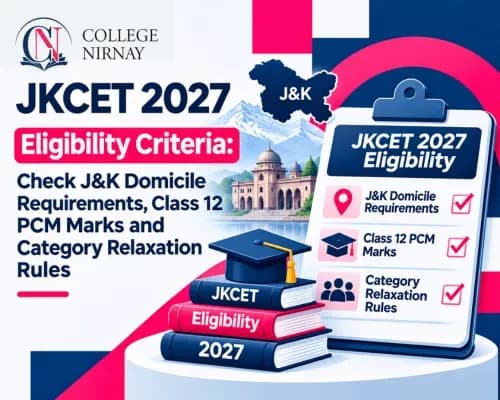
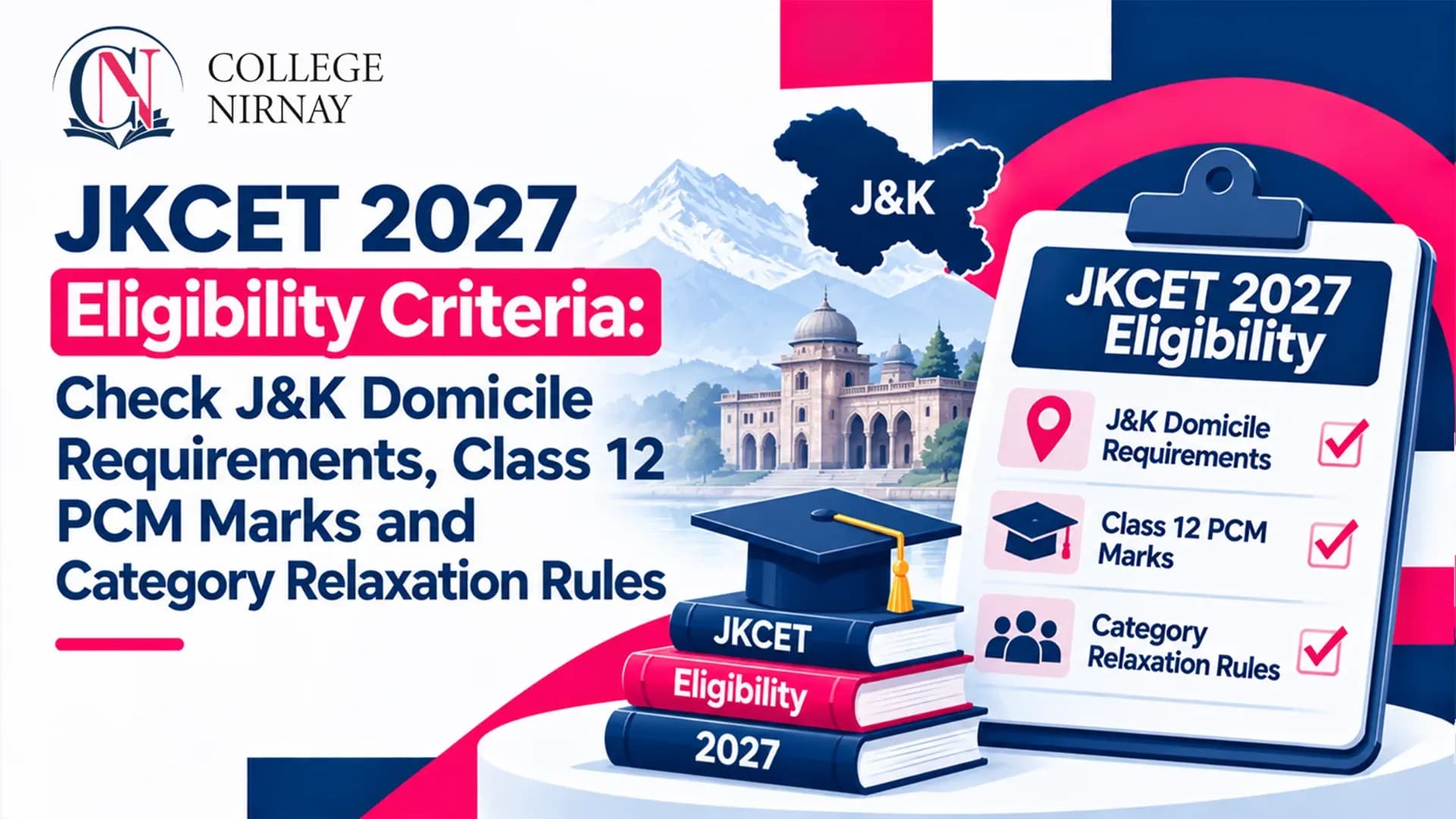
JKCET 2027 Eligibility Criteria: Check J&K Domicile Requirements, Class 12 PCM Marks and Category Relaxation Rules
Candidates planning admission to B.E. and B.Tech engineering programmes in Jammu and Kashmir should understand the expected JKCET 2027 eligibility criteria before applying. The Jammu and Kashmir Board of Professional Entrance Examinations (JKBOPEE) conducts the Jammu and Kashmir Common Entrance Test for admission to participating government and private engineering institutions. As of November 13, 2026, the official JKCET 2027 admission notification has not been released. Therefore, JKBOPEE's 2026 engineering admission notification and applicable admission regulations provide the latest confirmed reference for academic qualifications, residential eligibility and category-based relaxation.
The JKCET domicile requirements recognise candidates with valid residential documentation from the Union Territory of Jammu and Kashmir and specified applicants from the Union Territory of Ladakh. The JKCET Class 12 PCM marks requirement is 45% for Open Merit candidates, including EWS, and 40% for eligible specified reserved categories under the latest notification. Candidates should check the JKCET category relaxation provisions, JKCET minimum marks, JKCET qualification requirements and other JKCET eligibility rules before registering.
Key Highlights — JKCET 2027 Eligibility Criteria
- JKCET 2027 eligibility criteria — The official 2027 requirements are awaited; JKBOPEE's 2026 engineering admission notification provides the latest confirmed reference.
- JKCET domicile requirements — Applicants need a valid J&K domicile certificate or the prescribed Ladakh eligibility document accepted by JKBOPEE.
- JKCET Class 12 PCM marks — Candidates must have studied Physics, Chemistry and Mathematics as compulsory subjects in a recognised Class 12 or equivalent examination.
- JKCET category relaxation — Eligible SC, ST-I, ST-II, RBA, ALC/IB and OBC candidates receive the prescribed reduction in qualifying PCM marks.
- JKCET minimum marks — The latest requirement is 45% in PCM taken together for Open Merit candidates and 40% for the specified reserved categories.
- JKCET qualification requirements — A candidate must pass Higher Secondary Part-II, Class 12 or an equivalent examination from a recognised statutory board or university.
- JKCET eligibility rules — Class 12 appearing candidates may apply provisionally but must satisfy the complete qualification conditions before the prescribed selection stage.
- Open Merit candidates, including EWS, Tuition Fee Waiver applicants and specified defence, police and sports categories, must satisfy the 45% academic requirement.
- The latest notification specifies no upper-age bar for engineering admission in participating government and private engineering colleges.
- Application acceptance, examination participation and a valid entrance rank do not guarantee admission without verification of domicile, academic qualifications and category documents.
Explore This: Check JKCET 2027 Eligibility Criteria
Who Is Eligible for JKCET 2027?
The final JKCET 2027 eligibility criteria will be determined by JKBOPEE's official 2027 notification. Based on the latest engineering admission provisions, applicants should satisfy the following essential requirements:
- Possess a valid domicile certificate of the Union Territory of Jammu and Kashmir or meet the specifically recognised documentary provisions for eligible Ladakh candidates;
- Have passed or be appearing in Higher Secondary Part-II, Class 12 or a recognised equivalent examination;
- Have studied Physics, Chemistry and Mathematics as compulsory subjects in the qualifying examination;
- Obtain at least 45% aggregate marks in PCM for Open Merit or at least 40% for an eligible specified reserved category;
- Submit accurate personal, academic, residential and category information during the application process;
- Satisfy the applicable counselling, document-verification, reservation and institutional admission requirements before final seat allotment.
Candidates can review the JKCET eligible-candidate conditions and engineering admission requirements.
JKCET Domicile Requirements: Are J&K and Ladakh Candidates Eligible?
The JKCET domicile requirements are a central part of engineering admission eligibility. JKBOPEE's 2026 notification recognises candidates possessing a domicile certificate of the Union Territory of Jammu and Kashmir. It also specifies that an ST certificate issued by the competent authority of the Union Territory of Ladakh is treated as domicile proof for eligible Ladakh candidates.
| Candidate Background | Domicile Eligibility Under 2026 Rules |
|---|---|
| Union Territory of Jammu and Kashmir | Candidate must possess a valid J&K domicile certificate issued by the competent authority under the applicable rules |
| Union Territory of Ladakh | An ST certificate issued by the competent Ladakh authority is accepted as domicile proof for candidates covered by the notified provision |
| Candidates From Other States Without Recognised Domicile | Do not automatically satisfy the regular JKCET domicile condition; any separately authorised institutional or management-quota route must be checked independently |
Candidates should distinguish a valid domicile certificate from general proof of residence. A school identity card, temporary address, hostel certificate or place-of-birth record does not automatically replace the prescribed domicile documentation. For Ladakh, applicants should specifically confirm the ST-certificate arrangement and other applicable requirements rather than assuming that any ordinary residence document will be accepted.
JKCET Class 12 PCM Marks: Is 45% or 40% Required?
The latest JKCET Class 12 PCM marks requirement is based on Physics, Chemistry and Mathematics taken together. JKBOPEE's 2026 notification specifies 45% for Open Merit candidates and 40% for the designated reserved categories. The relevant percentage is calculated from the compulsory PCM subjects, rather than automatically using the candidate's overall Class 12 percentage across every subject.
| Candidate Category | 2026 Minimum Aggregate PCM Marks |
|---|---|
| Open Merit, Including EWS, TFW and Specified Defence, Police and Sports Categories | 45% in Physics, Chemistry and Mathematics taken together |
| Eligible SC, ST-I, ST-II, RBA, ALC/IB and OBC Candidates | 40% in Physics, Chemistry and Mathematics taken together |
For example, if a candidate's Physics, Chemistry and Mathematics marks are 50, 45 and 40 out of 100 respectively, the combined PCM score is 135 out of 300, or 45%. Such a candidate satisfies the 2026 Open Merit percentage threshold, provided the qualifying examination is recognised and all other eligibility conditions are fulfilled.
Similarly, an eligible reserved-category candidate with 120 marks out of 300 across PCM obtains 40% and satisfies the corresponding minimum aggregate threshold. However, the candidate must possess the appropriate category documentation and meet the remaining admission requirements. Meeting the minimum percentage alone does not guarantee admission.
Candidates can review the JKCET Class 12 PCM marks and minimum percentage requirements.
Are Physics, Chemistry and Mathematics Compulsory for JKCET 2027?
Yes. Under JKBOPEE's latest engineering eligibility rules, Physics, Chemistry and Mathematics are compulsory qualifying-examination subjects. The candidate must pass Class 12 or an equivalent examination from a recognised statutory board or university with the prescribed PCM combination.
Students who studied Physics, Chemistry, Biology and Mathematics may qualify if their academic record includes all three required PCM subjects and they satisfy the aggregate marks condition. However, a candidate who studied only Physics, Chemistry and Biology without Mathematics does not fulfil the standard compulsory-subject requirement for JKCET engineering admission.
Candidates should not confuse the qualifying-examination subjects with the subjects used in the entrance test. The latest JKCET paper covers Physics, Chemistry and Mathematics, while admission eligibility also depends on the candidate's Class 12 academic qualification, residential status and applicable category rules.
Candidates can review the JKCET compulsory PCM subjects and engineering qualification rules.
Can Class 12 Appearing Students Apply for JKCET 2027?
Yes. The latest JKBOPEE engineering admission notification allows candidates appearing in or awaiting the results of their qualifying Class 12 examination to apply and participate in the entrance test provisionally. This is important for students whose board examination results are declared after the application window opens.
However, candidates must pass the qualifying examination with the required compulsory PCM subjects and minimum marks before the deadline prescribed by the Board. The 2026 notification required such candidates to satisfy eligibility by the result or admission stage notified by JKBOPEE and provide the necessary qualifying-examination documents.
???? Important
Class 12 appearing candidates may register provisionally, but they cannot obtain final admission without passing the required examination and producing valid academic records within the Board's deadline. An application confirmation, admit card or entrance rank does not replace the prescribed qualifying-examination marksheet.
Studied Outside Jammu and Kashmir: Can Domicile Holders Apply?
Students who completed their schooling outside Jammu and Kashmir may still satisfy the JKCET residential eligibility requirements if they possess the domicile documentation recognised under the applicable notification. The 2026 eligibility provisions require a domicile certificate of J&K or the specified Ladakh document; they do not independently prescribe that every applicant must complete Class 12 within J&K.
For example, an applicant who completed Class 12 in Delhi, Punjab or another state but holds a valid J&K domicile certificate may qualify, provided the candidate studied Physics, Chemistry and Mathematics, meets the applicable marks threshold and satisfies all other admission conditions.
However, merely studying in J&K or having relatives who live in the Union Territory does not automatically establish domicile. The candidate must satisfy the applicable residential definition and produce the recognised certificate during the verification process.
✅ Outside-State Schooling and Domicile
A recognised J&K domicile certificate is more important than the geographical location of a candidate's Class 12 school for the standard domicile condition. Applicants must still satisfy the required PCM qualifications, minimum marks and original-document verification.
JKCET Qualification Requirements: Recognised Boards and Equivalent Examinations
The JKCET qualification requirements recognise Higher Secondary Part-II, Class 12 or an equivalent examination from a statutory board or university. Candidates should confirm that their educational qualification is recognised for engineering admission and includes the prescribed Physics, Chemistry and Mathematics subjects.
| Qualification Background | Eligibility Consideration |
|---|---|
| JKBOSE Class 12 | Recognised qualifying examination; Physics, Chemistry and Mathematics must be compulsory subjects, with the prescribed aggregate marks |
| CBSE, CISCE or Other Recognised Boards | Candidates may qualify through a recognised Class 12 or equivalent examination with the required PCM combination and valid domicile documentation |
| Equivalent or Alternative Qualifications | Recognition, subject equivalence and marks requirements must be established under the applicable JKBOPEE and engineering admission rules |
Candidates should ensure that their marksheet clearly establishes the required PCM performance. Applicants who studied through an alternative recognised board, improvement examination or equivalent qualification should verify whether additional equivalence documentation is required. They should not assume that possessing a general Class 12 passing certificate automatically fulfils the engineering subject and percentage requirements.
Do EWS, Tuition Fee Waiver, Defence and Sports Candidates Get 40% Relaxation?
No. Under the 2026 notification, Open Merit candidates must obtain at least 45% aggregate marks in Physics, Chemistry and Mathematics. This requirement also applies to applicants claiming the Economically Weaker Section (EWS), Tuition Fee Waiver (TFW), Children of Defence Personnel, Children of Para-Military Forces, Children of Police Personnel and outstanding sports categories.
These categories may be relevant to reservation, fee-waiver consideration or seat allocation, but their admission benefits should not be confused with the reduced academic percentage provided to the specified social reservation categories. The 2026 notification explicitly identifies TFW applicants as Open Merit candidates for the purpose of qualifying eligibility.
Therefore, an EWS or TFW applicant securing only 40% in PCM should not assume eligibility merely because the applicant possesses a valid EWS or fee-waiver certificate. The candidate must satisfy the 45% Open Merit academic threshold unless a subsequent official notification expressly provides a different rule.
Candidates should separately verify category eligibility, reservation entitlement, certificate validity and the documents required for fee-waiver or other special claims. The final 2027 provisions will be confirmed through the new JKBOPEE notification.
JKCET 2027 Age Limit: Is There a Minimum or Maximum Age?
JKBOPEE's 2026 engineering notification specifically states that there is no upper-age bar for appearing in the entrance test for admission to engineering courses in government and private colleges. Therefore, candidates should not assume that they become ineligible solely because they are older than a particular age.
The 2026 engineering notification does not separately prescribe a universal 17-year minimum age for JKCET engineering applicants. Some older examination guidance or admission regulations may contain age conditions for other professional courses. Candidates should avoid applying those older or course-specific provisions to the current B.E./B.Tech examination without checking the controlling notification.
Applicants must still meet the recognised Class 12 PCM academic conditions and applicable residential eligibility requirements. Any age-related amendment introduced for the 2027 engineering cycle must be verified through an official JKBOPEE or competent regulatory authority notice.
Candidates can review the JKCET age-limit requirements and engineering eligibility conditions.
Is There a Limit on JKCET 2027 Attempts?
The latest JKCET engineering admission notification does not prescribe a universal fixed number of lifetime examination attempts. Candidates who satisfy the required academic qualifications, PCM marks, domicile conditions and other eligibility provisions may seek admission according to the rules applicable to the relevant examination year.
However, a candidate should not assume that a previous year's entrance rank remains valid for an entirely new admission cycle. Entrance results, seat allotments and counselling are governed by the relevant admission-year notifications. Applicants who participated in an earlier counselling process should check any current restrictions or special provisions that might apply.
The absence of a stated lifetime attempt limit is also separate from academic eligibility. Candidates who have not passed the required Class 12 PCM examination or cannot establish valid domicile do not become eligible merely because they are appearing for JKCET again.
Candidates can review the JKCET attempt-related rules and repeat-candidate eligibility guidance.
JKCET Category Relaxation: SC, ST-I, ST-II, RBA, ALC/IB and OBC
The JKCET category relaxation under the 2026 notification reduces the qualifying PCM aggregate requirement from 45% to 40% for eligible candidates belonging to specified reserved categories. The notification identifies SC, ST-I, ST-II, RBA, ALC/IB and OBC among the categories covered by the relaxed academic threshold.
- Open Merit and EWS — require at least 45% aggregate PCM marks; EWS status does not independently provide the 40% academic threshold;
- SC, ST-I and ST-II — eligible candidates may qualify with 40% aggregate PCM marks, subject to valid category documentation;
- RBA, ALC/IB and OBC — eligible candidates may use the prescribed 40% threshold under the applicable reservation rules;
- TFW, Defence, Para-Military, Police and Sports Claims — must satisfy the Open Merit 45% academic requirement unless a later official notification expressly changes it.
The Jammu and Kashmir reservation framework has been amended over time, so applicants should use the category names and benefits specified in the current JKBOPEE notification. A category certificate must be valid, issued by a competent authority and accepted under the relevant admission rules.
Candidates holding more than one category certificate should also check the rules governing category selection and claims. They should not assume that multiple certificates can be combined to obtain additional relaxation or that an incorrectly entered category can always be changed after the application deadline.
Candidates can review the JKCET category-wise minimum marks and reservation relaxation.
Can Foreign Nationals, NRIs or Candidates From Other States Apply for JKCET?
The regular JKBOPEE engineering entrance framework requires recognised J&K or Ladakh domicile eligibility. Therefore, foreign nationals, NRIs or applicants from other Indian states who do not satisfy the prescribed residential condition should not assume automatic entitlement to JKCET seats simply because they have passed Class 12 with Physics, Chemistry and Mathematics.
Jammu and Kashmir's professional engineering college admission regulations provide for separate management-quota and NRI-related admission arrangements in private engineering institutions. These arrangements are distinct from the regular JKBOPEE entrance-test eligibility route and may have their own academic, documentary and seat-category requirements.
A foreign-national, NRI or non-domicile applicant should therefore consult the relevant institution and admission authority about a separately authorised admission route. Such candidates should not assume that an independent institutional route guarantees participation in the regular JKCET merit list or government-quota counselling.
Candidates can review the JKCET non-domicile, foreign-national and NRI admission eligibility guidance.
Which Documents Are Needed to Prove JKCET Eligibility?
Candidates should keep their Class 10 and Class 12 academic documents, domicile certificate and applicable reserved-category certificates ready for the application and counselling process. The exact documents to be uploaded during registration or produced during physical verification will depend on JKBOPEE's examination-year instructions.
Academic documentation should establish the candidate's recognised qualifying examination, Physics, Chemistry and Mathematics subjects and aggregate PCM marks. Candidates who appeared in Class 12 during the examination year must provide the final marksheet and passing documents within the deadline specified by the Board.
J&K applicants should present their valid domicile certificate, while eligible Ladakh applicants should follow the specific ST-certificate arrangement recognised in the notification. Reserved-category applicants should prepare their competent-authority category certificates and any additional supporting documents required for the particular claim.
Candidates claiming a sports category or another special benefit may have to complete a separate verification procedure with the designated authority. They should preserve application records, payment confirmation, entrance documents and counselling communications because these may be required later in the selection and admission process.
JKCET Entrance Examination Eligibility vs Final Engineering Admission
Candidates should distinguish permission to appear in JKCET from the final right to admission. The JKCET eligibility rules establish the minimum academic and residential qualifications, but final selection also depends on entrance merit, applicable reservation provisions, seat availability, institution preferences and verification of original documents.
| Requirement | Entrance Examination Participation | Final Admission and Counselling |
|---|---|---|
| Class 12 Appearing Status | Qualifying-examination appearing candidates may participate provisionally under the notified conditions | Must pass the qualifying examination with the required subjects and marks before the prescribed verification or selection deadline |
| PCM Academic Requirement | Candidates claim recognised Class 12 Physics, Chemistry and Mathematics qualifications with the relevant minimum aggregate | Original marksheets and academic records must establish the applicable 45% or 40% threshold |
| Domicile and Reserved Category | Applicants declare valid J&K or recognised Ladakh domicile eligibility and any applicable category claim | Competent-authority certificates must be verified; unsupported or invalid claims can affect admission eligibility |
| Entrance Merit and Seat Allocation | Successful application and examination participation permit consideration under the examination rules | Final admission depends on entrance merit, counselling preferences, available approved seats and compliance with all academic and documentary conditions |
Common JKCET 2027 Eligibility Mistakes
- Assuming JKCET 2027 eligibility requirements have already been officially announced by JKBOPEE;
- Believing that candidates from any Indian state can claim regular JKCET engineering admission without the required J&K or recognised Ladakh domicile documentation;
- Confusing the Ladakh ST-certificate arrangement with a blanket acceptance of any ordinary residential document;
- Calculating the qualifying percentage using all Class 12 subjects instead of checking the prescribed PCM aggregate;
- Assuming that EWS and Tuition Fee Waiver candidates receive the 40% reserved-category academic relaxation;
- Applying for engineering admission without Mathematics as a compulsory qualifying-examination subject;
- Believing that appearing in the Class 12 examination is sufficient for admission even without passing before the prescribed selection deadline;
- Relying on outdated 50% Open Merit or universal 17-year age claims without checking the latest engineering notification;
- Assuming successful application submission, a rank card or a claimed reservation category guarantees admission without documentary verification.
Candidates can review the common JKCET eligibility mistakes and admission precautions.
???? JKCET 2027 Eligibility Checklist
✅ Check Before Applying
- Confirm that JKBOPEE has published the official JKCET 2027 engineering admission notification.
- Verify that you possess the recognised J&K domicile certificate or qualify under the applicable Ladakh documentary provision.
- Check that your Class 12 or equivalent qualification is recognised by the relevant admission authority.
- Confirm that Physics, Chemistry and Mathematics were compulsory subjects in your qualifying examination.
- Calculate your PCM aggregate percentage separately from your overall Class 12 percentage.
- If applying under Open Merit, EWS or TFW, verify that you satisfy the required 45% PCM aggregate.
- If claiming an eligible reserved category, verify the 40% academic threshold and your category certificate.
- If appearing in Class 12, ensure you can pass and produce the final marksheet within the Board's prescribed deadline.
- Check the official age provisions rather than relying on older or unrelated professional-course criteria.
- Prepare the required domicile, academic, identity and category documents for registration and counselling verification.
- Read the complete JKCET 2027 information brochure and confirm all eligibility conditions before final application submission.
???? Domicile and PCM Qualifications Must Both Be Satisfied
The JKCET domicile requirements and JKCET qualification requirements are separate admission conditions. Candidates must possess recognised J&K or qualifying Ladakh residential documentation and satisfy the prescribed Class 12 PCM academic requirements. The final 2027 rules, including category relaxation and document-verification procedures, must be confirmed through JKBOPEE's official notification.
Candidates can use the JKCET 2027 eligibility summary and admission checklist for quick reference.
FAQs
Q1. What are the JKCET 2027 eligibility criteria for engineering admission?
The official 2027 notification is awaited. Under JKBOPEE's 2026 rules, candidates must possess recognised J&K or qualifying Ladakh domicile documentation and pass Class 12 or an equivalent examination with Physics, Chemistry and Mathematics as compulsory subjects. Open Merit candidates require 45% aggregate PCM marks, while eligible specified reserved-category candidates require 40%.
Q2. Are Ladakh candidates eligible for JKCET 2027?
Under the latest notification, an ST certificate issued by the competent authority of the Union Territory of Ladakh is treated as domicile proof for candidates covered by that provision. Such applicants must also satisfy the recognised Class 12 PCM qualification, minimum marks and other admission requirements. The final Ladakh documentation rules for 2027 must be verified through the new notification.
Q3. Is 45% or 40% required in Class 12 for JKCET engineering admission?
JKBOPEE's 2026 eligibility rules require 45% aggregate in Physics, Chemistry and Mathematics for Open Merit candidates, including EWS and TFW applicants. The minimum is 40% for eligible specified reserved categories such as SC, ST-I, ST-II, RBA, ALC/IB and OBC. The percentage is based on the prescribed PCM subjects, not automatically the total across all Class 12 subjects.
Q4. Is there an age limit or attempt limit for JKCET 2027?
JKBOPEE's 2026 engineering notification states that there is no upper-age bar for the entrance test. It does not separately prescribe a universal 17-year minimum age or a fixed lifetime number of attempts for engineering applicants. Candidates must nevertheless satisfy the recognised academic, domicile and admission requirements. Any changes introduced for 2027 will be governed by the new official notification.
Q5. Can students who studied outside Jammu and Kashmir apply for JKCET?
Yes, studying outside Jammu and Kashmir does not automatically disqualify a candidate who holds valid J&K domicile documentation or satisfies the specifically recognised Ladakh provision. The candidate must also pass the required Class 12 PCM examination with the prescribed marks. Applicants without qualifying residential status should not assume eligibility for the regular JKCET route and must check any separately authorised institutional admission provisions.
Candidates can also review the JKCET eligibility frequently asked questions.
Stay with College Nirnay for all JKCET 2027 eligibility criteria, JKCET domicile requirements, JKCET Class 12 PCM marks, JKCET category relaxation, JKCET minimum marks, JKCET qualification requirements, and JKCET eligibility rules updates.