Is WBJEE Mathematics Really Tougher Than JEE Main? What Previous Year Papers Reveal About Difficulty and Question Trends
Students preparing for engineering entrance examinations often ask whether WBJEE Mathematics is more difficult than JEE Main Mathematics. The answer depends on how difficulty is measured: conceptual complexity, calculation length, question volume, time pressure, or the marking scheme.
A meaningful WBJEE vs JEE Main difficulty comparison requires more than comparing a few difficult questions. Candidates should examine official papers, solve them under timed conditions, and study how the examination formats affect performance.
The WBJEE Mathematics difficulty level can feel demanding because the established examination pattern includes 75 Mathematics questions in a two-hour paper. JEE Main Mathematics, by comparison, forms one section of a combined Physics, Chemistry and Mathematics examination.
This article explores WBJEE Maths vs JEE Main Maths, explains how to conduct a reliable WBJEE Mathematics PYQ analysis, and develops a practical approach for WBJEE 2027 Mathematics preparation.
It also discusses WBJEE Mathematics question trends, the role of previous-year papers, common mistakes, and effective strategies for students attempting both examinations.
1. What Are WBJEE Previous Year Question Papers?
WBJEE previous year question papers are question papers from earlier editions of the West Bengal Joint Entrance Examination. They help candidates understand the style of questions, subject coverage, marking rules and time-management demands.
Mathematics has traditionally been conducted as Paper 1, while Physics and Chemistry are assessed in Paper 2.
Candidates comparing WBJEE vs JEE Main 2027 should remember that the two examinations serve different admission processes and use different question formats.
WBJEE Mathematics Paper Structure
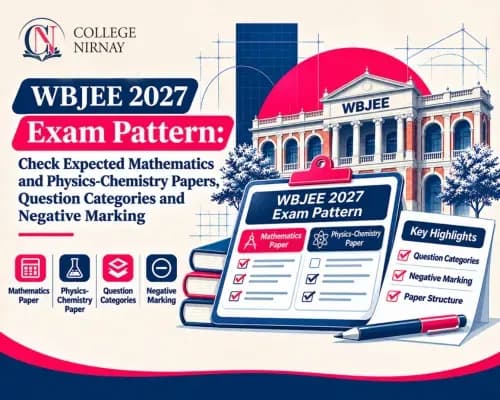
Under the established WBJEE 2027 exam pattern reference framework, Mathematics contains 75 questions carrying 100 marks.
| Category | Questions | Marks per Question | Maximum Marks |
|---|---|---|---|
| Category 1 | 50 | 1 | 50 |
| Category 2 | 15 | 2 | 30 |
| Category 3 | 10 | 2 | 20 |
| Total | 75 | — | 100 |
How Is JEE Main Mathematics Different?
Under the recent JEE Main Paper 1 structure, Mathematics has included 20 multiple-choice questions and 5 numerical-value questions, contributing 100 marks to a combined three-hour examination.
The JEE Main Mathematics marking scheme under recent rules has awarded four marks for a correct response and deducted one mark for an incorrect response in both the MCQ and numerical-value sections.
Candidates should verify the final 2027 rules rather than assume that the recent structure will remain unchanged.
| Feature | WBJEE Mathematics | JEE Main Mathematics |
|---|---|---|
| Question Count | 75 under the established pattern | 25 under the recent Paper 1 pattern |
| Maximum Marks | 100 | 100 |
| Time Arrangement | Separate two-hour Mathematics paper | Part of a combined three-hour PCM paper |
| Answer Format | Three MCQ categories | MCQs and numerical-value questions |
| Examination Mode | Historically OMR-based | Computer-based |
| Multiple-Correct Questions | Included in Category 3 | Not part of the standard recent Paper 1 MCQ structure |
The WBJEE Mathematics marking scheme requires candidates to manage different penalties and partial-credit rules, while JEE Main candidates must also practise numerical answer entry.
2. Why Compare WBJEE and JEE Main Mathematics Previous Year Papers?
A proper comparison helps candidates understand whether they struggle more with difficult concepts, lengthy calculations, multiple-correct questions, or limited examination time.
JEE Main Mathematics previous year papers can reveal how candidates handle conceptual application and numerical problems, while WBJEE papers help assess speed across a larger number of questions.
Five Benefits of Previous Year Paper Analysis
1. Understand Question Style
Identify direct, conceptual, calculation-heavy and multi-step problems.
2. Measure Speed
Check how many questions you can solve accurately within the allotted time.
3. Identify Weak Chapters
Recognise topics that repeatedly cause errors or consume excessive time.
4. Improve Accuracy
Understand the impact of negative marking and careless mistakes.
5. Develop Exam-Specific Skills
Practise WBJEE multiple-correct questions and JEE Main numerical responses separately.
Is WBJEE Mathematics Actually Tougher?
The WBJEE Mathematics difficulty level should be assessed across several dimensions rather than through a single label.
| Difficulty Dimension | WBJEE Mathematics | JEE Main Mathematics |
|---|---|---|
| Question Volume | Higher number of Mathematics questions | Lower number of Mathematics questions |
| Time Pressure | Requires fast question selection and solving | Requires balancing Mathematics with Physics and Chemistry |
| Conceptual Difficulty | Varies by year and question | Varies by year and examination session |
| Calculations | May involve many short and multi-step calculations | Can include lengthy numerical and analytical problems |
| Answer Selection | Includes multiple-correct Category 3 questions | Includes numerical-value responses |
The WBJEE vs JEE Main difficulty comparison therefore depends on individual strengths. A student comfortable with rapid problem-solving may perform well in WBJEE, while another student may prefer the smaller Mathematics section of JEE Main.
The JEE Main 2027 Mathematics difficulty cannot be predicted reliably from previous papers alone because actual difficulty can vary between sessions.
3. WBJEE Chapter-Wise Question Analysis and Trends
A useful WBJEE chapter wise question analysis records the number of questions, marks, time taken and accuracy for each chapter across several official papers.
The purpose is to identify recurring preparation needs, not to claim that the same number of questions will appear in 2027.
Mathematics Chapters to Include in Your Analysis
| Topic Group | Chapters to Review | Recommended Analysis |
|---|---|---|
| Algebra | Quadratic equations, complex numbers, sequences, matrices and determinants | Count direct and multi-step problems. |
| Calculus | Limits, continuity, derivatives, integration and differential equations | Track calculation length and accuracy. |
| Coordinate Geometry | Straight lines, circles and conic sections | Record formula-based and analytical problems. |
| Trigonometry | Identities, equations and applications | Identify common simplification errors. |
| Vectors and 3D Geometry | Vector operations and spatial geometry | Track conceptual and computational questions. |
| Probability and Statistics | Probability principles and statistical measures | Measure interpretation and calculation accuracy. |
| Other Official Units | Any additional topics included in the relevant syllabus | Verify the chapter list before categorising. |
How to Identify WBJEE Mathematics Question Trends
To evaluate WBJEE Mathematics question trends, classify each question by chapter, category, difficulty and solving time.
For example, a candidate may discover that they answer algebra questions accurately but lose time on coordinate geometry. Another may perform well in calculus but struggle with multiple-correct questions.
These observations are more useful than treating one year's chapter distribution as a fixed prediction.
WBJEE Maths Important Topics 2027
The WBJEE Maths important topics 2027 should be identified using the official syllabus, historical papers and the student's own weak areas.
Core preparation commonly includes calculus, algebra, coordinate geometry, trigonometry, vectors and probability, subject to the final 2027 syllabus.
Suggested PYQ Analysis Tracker
| Year | Chapter | Questions | Marks Available | Correct | Time Taken |
|---|---|---|---|---|---|
| Year 1 | Calculus | Record | Record | Record | Record |
| Year 2 | Algebra | Record | Record | Record | Record |
| Year 3 | Coordinate Geometry | Record | Record | Record | Record |
| Year 4 | Probability | Record | Record | Record | Record |
| Year 5 | Vectors and 3D Geometry | Record | Record | Record | Record |
This tracker can support a meaningful WBJEE Mathematics PYQ analysis without inventing chapter-wise percentages.
4. How to Use WBJEE and JEE Main Previous Year Papers Effectively
Solving WBJEE previous year question papers is most effective when candidates follow a repeatable process rather than attempting papers without reviewing their performance.
Step 1: Collect Authentic Papers
Use official WBJEEB papers and reliable answer keys wherever available. For JEE Main, use official NTA question papers, response sheets and answer keys where accessible.
Step 2: Solve Under Examination Conditions
Attempt WBJEE Mathematics within the established two-hour duration and practise the correct answer-marking method.
Use JEE Main Mathematics previous year papers to practise numerical-value questions and computer-based examination skills.
Step 3: Classify Every Question
Record whether a question is:
- Direct and formula-based.
- Conceptual and application-oriented.
- Calculation-intensive.
- Multi-step or lengthy.
- Single-correct or multiple-correct.
- Easy, moderate or difficult for your current preparation level.
Step 4: Calculate Accuracy
Accuracy (%) = (Correct Responses ÷ Attempted Questions) × 100
Example: If 48 of 60 attempted questions are correct, accuracy is 80%.
Step 5: Compare Scores Using the Correct Marking Scheme
The WBJEE Mathematics marking scheme has historically included three categories.
| Category | Correct Response | Incorrect Response |
|---|---|---|
| Category 1 | +1 | −0.25 |
| Category 2 | +2 | −0.5 |
| Category 3 | Up to +2 with partial-credit provisions | 0 if an incorrect option is selected |
The JEE Main Mathematics marking scheme under recent rules has used +4 for correct responses and −1 for incorrect responses. Candidates should verify the current official rules before calculating 2027 scores.
Step 6: Review the Cause of Every Error
Do not simply record an answer as wrong. Identify whether the mistake resulted from a conceptual gap, calculation error, time pressure, incorrect interpretation or unnecessary guessing.
Step 7: Repeat the Analysis
Compare results across multiple papers. The goal is to measure improvement in accuracy, speed and topic coverage rather than memorise old questions.
5. WBJEE Mathematics Preparation Strategy for 2027
A practical WBJEE Mathematics preparation strategy should balance conceptual understanding with timed question practice.
Strategy 1: Strengthen the Common Mathematics Foundation
Students following JEE Main WBJEE combined preparation can study common chapters together and then practise each examination's specific question formats.
Focus on algebra, calculus, geometry, trigonometry, vectors and probability according to the final official syllabi.
Strategy 2: Practise Calculation-Based Questions
WBJEE calculation based questions can consume significant time when candidates use unnecessarily long solution methods.
Practise algebraic simplification, substitutions, formula application and calculation checking.
Strategy 3: Develop Conceptual Understanding
WBJEE conceptual Mathematics questions require students to understand why a mathematical method works rather than merely memorise a formula.
Revise definitions, conditions, properties and the relationships between mathematical concepts.
Strategy 4: Improve Time Management
WBJEE Maths time management is particularly important because the established Mathematics paper includes 75 questions in 120 minutes.
That is an average of 1.6 minutes per question, although actual solving times should vary according to difficulty and marks.
| Activity | Illustrative Time |
|---|---|
| First pass: familiar questions | 45 minutes |
| Second pass: moderate questions | 40 minutes |
| Difficult and multiple-correct questions | 25 minutes |
| Final answer-sheet verification | 10 minutes |
| Total | 120 minutes |
This is an illustrative strategy, not an official examination instruction.
Strategy 5: Use a Combined Weekly Study Plan
| Day | Study Focus | Practice |
|---|---|---|
| Monday | Algebra | WBJEE timed questions |
| Tuesday | Calculus | JEE Main numerical questions |
| Wednesday | Coordinate Geometry | WBJEE Category 3 questions |
| Thursday | Trigonometry and Vectors | Mixed conceptual problems |
| Friday | Probability and Statistics | Previous-year questions |
| Saturday | Full Mathematics practice | Timed mock examination |
| Sunday | Revision and error analysis | Weak-topic improvement |
Strategy 6: Build an Exam-Specific Attempt Plan
A strong WBJEE 2027 Mathematics preparation programme should include question-selection practice and category-wise scoring analysis.
Candidates should avoid selecting uncertain options in multiple-correct questions when doing so may eliminate partial-credit opportunities.
Strategy 7: Compare Mock-Test Performance
For JEE Main WBJEE combined preparation, maintain separate score records for both examinations because their marking schemes and question formats differ.
Track:
- Marks obtained.
- Attempted questions.
- Correct and incorrect responses.
- Accuracy percentage.
- Average solving time.
- Chapter-wise weaknesses.
- Negative marks lost.
6. Common Mistakes While Preparing for WBJEE Mathematics
Students can reduce avoidable score losses by identifying recurring preparation and examination mistakes.
Mistake 1: Assuming WBJEE Is Always Easier
The WBJEE vs JEE Main difficulty comparison cannot be reduced to a universal ranking. Both examinations can be challenging in different ways.
Mistake 2: Solving Papers Without Time Limits
Untimed practice may conceal problems with WBJEE Maths time management.
Mistake 3: Ignoring Multiple-Correct Questions
Category 3 requires careful evaluation of every option. Guessing additional options may cause a candidate to lose available partial marks.
Mistake 4: Memorising Solutions
Repeatedly reading solutions without independently solving problems does not necessarily improve conceptual understanding.
Mistake 5: Treating One Year's Paper as a Prediction
A single paper cannot establish the final WBJEE Mathematics question trends for 2027.
Mistake 6: Ignoring Calculation Accuracy
Candidates may understand the method but lose marks because of arithmetic mistakes, incorrect substitutions or sign errors.
Mistake 7: Using Unverified Chapter Weightage
A reliable WBJEE chapter wise question analysis should be based on actual questions from identifiable examination years.
Mistake 8: Neglecting the Official Syllabus
Students should verify the final 2027 syllabus before spending substantial time on topics that may not be included.
Mistake 9: Ignoring the Difference Between Conceptual and Calculation Difficulty
WBJEE conceptual Mathematics questions and WBJEE calculation based questions test different aspects of preparation. Both require dedicated practice.
Mistake 10: Comparing Raw Scores Across Different Examinations
A score of 70 in WBJEE Mathematics cannot be directly equated with 70 in JEE Main Mathematics because the question formats, marking schemes and candidate distributions differ.
7. Frequently Asked Questions
1. Is WBJEE Mathematics tougher than JEE Main Mathematics?
Neither examination is universally tougher. WBJEE can be demanding because of question volume and time pressure, while JEE Main may present difficult conceptual and numerical problems.
2. How many Mathematics questions are asked in WBJEE?
The established WBJEE Mathematics paper includes 75 questions carrying 100 marks. The final 2027 pattern requires official confirmation.
3. How many Mathematics questions are included in JEE Main?
Under the recent Paper 1 structure, Mathematics includes 25 questions. Candidates should verify the final 2027 pattern through NTA.
4. Are WBJEE Mathematics questions calculation-intensive?
Some questions involve calculations, while others emphasise conceptual understanding. The mix varies by examination year.
5. Which Mathematics chapters should I prioritise for WBJEE 2027?
Prepare the official syllabus thoroughly. Common foundational areas include algebra, calculus, coordinate geometry, trigonometry, vectors and probability.
6. Are WBJEE previous year question papers useful for JEE Main?
Yes. They can strengthen mathematical problem-solving, although JEE Main-specific numerical questions and computer-based practice remain necessary.
7. Can I prepare for JEE Main and WBJEE together?
Yes. Study overlapping Mathematics chapters together and practise each examination's question format separately.
8. Does WBJEE Mathematics have negative marking?
Under the established framework, Categories 1 and 2 have negative marking. Category 3 follows different scoring rules with partial-credit provisions.
9. How much time is available for WBJEE Mathematics?
The established Mathematics paper lasts two hours. Candidates should verify the 2027 schedule.
10. How should I analyse WBJEE Mathematics previous year papers?
Record chapter, question category, difficulty, solving time, correctness and marks for every question.
11. Can previous year papers predict WBJEE 2027 questions?
No. They can reveal historical question styles and preparation gaps but cannot reliably predict exact future questions.
12. Is JEE Main Mathematics more conceptual?
JEE Main includes conceptual and numerical problems, but WBJEE also tests conceptual understanding. Difficulty depends on the specific questions.
13. Should I solve WBJEE papers before completing the syllabus?
Topic-wise questions can be practised during syllabus preparation. Full-length timed papers become more useful after substantial syllabus coverage.
14. How can I improve WBJEE Mathematics accuracy?
Review incorrect answers, strengthen weak concepts, practise calculations and analyse category-wise negative marks.
15. Where can I find WBJEE Mathematics previous year papers?
Check official WBJEEB resources and the College Nirnay WBJEE previous-year question paper guide for relevant information.
Conclusion: WBJEE vs JEE Main Mathematics Difficulty
The question of whether WBJEE Mathematics is tougher than JEE Main does not have a single answer.
WBJEE can place considerable pressure on candidates because of its larger Mathematics question count, category-specific marking rules and limited examination time.
JEE Main Mathematics also requires conceptual understanding, calculation accuracy and effective time allocation within a combined PCM examination.
For WBJEE vs JEE Main 2027, students should focus on solving authentic previous-year papers, analysing their mistakes and improving performance under timed conditions.
A consistent WBJEE Mathematics preparation strategy should combine conceptual revision, question practice, mock-test analysis and careful answer selection.
Candidates should confirm the final WBJEE 2027 exam pattern before relying on historical scoring rules.
Explore the WBJEE Previous Year Question Papers on College Nirnay for related preparation information.