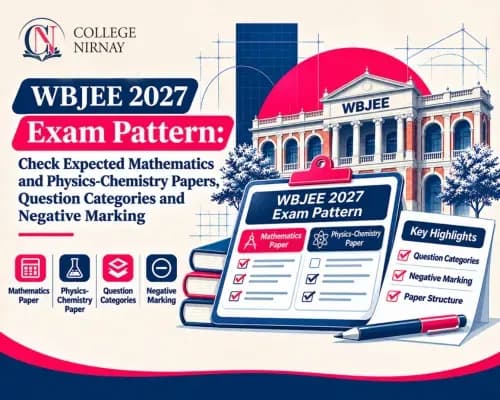
WBJEE 2027 Exam Pattern: Check Expected Mathematics and Physics-Chemistry Papers, Question Categories and Negative Marking
WBJEE 2027 exam pattern: Students preparing for the West Bengal Joint Entrance Examination 2027 should understand the expected paper structure, subject-wise question distribution, marking scheme and examination duration before planning their preparation.
The WBJEE exam pattern 2027 is expected to follow the previous-year structure consisting of two papers: Mathematics (Paper 1) and Physics-Chemistry (Paper 2). The examination traditionally includes multiple-choice questions divided into three categories with different marking rules.
Under the previous-year format, the WBJEE Mathematics paper contained 75 questions carrying 100 marks, while the combined WBJEE Physics Chemistry paper contained 80 questions carrying 100 marks. The total examination consisted of 155 questions for 200 marks.
The WBJEE question categories determine whether candidates receive one mark, two marks, partial marks or negative marks. Understanding the expected WBJEE negative marking 2027 rules can help students develop a more effective question-attempting strategy.
WBJEE 2027 Exam Pattern: General Overview and Highlights
The West Bengal Joint Entrance Examination is conducted by the West Bengal Joint Entrance Examinations Board for admission to participating undergraduate programmes in Engineering, Technology, Pharmacy and related disciplines.
The WBJEEB exam pattern 2027 is expected to retain an offline, OMR-based examination format with separate Mathematics and Physics-Chemistry papers.
The previous-year WBJEE paper pattern included 155 multiple-choice questions distributed across Mathematics, Physics and Chemistry, with a combined maximum score of 200 marks.
Mathematics and Physics-Chemistry
Previous-year format
Both papers combined
Two hours per paper
WBJEE 2027 Exam Pattern Highlights
| Particular | Expected Details Based on Previous-Year Pattern |
|---|---|
| Examination | West Bengal Joint Entrance Examination 2027 |
| Conducting Authority | WBJEEB |
| Examination Mode | Offline, OMR-based |
| Paper 1 | Mathematics |
| Paper 2 | Physics and Chemistry |
| Question Type | Multiple-choice questions |
| Question Categories | Category 1, Category 2 and Category 3 |
| Number of Questions | 155 |
| Maximum Marks | 200 |
| Exam Duration | Two hours per paper |
| Negative Marking | Applicable to Categories 1 and 2 |
| Official 2027 Confirmation | Awaited |
The WBJEE total marks 2027 are expected to remain 200 if WBJEEB retains the previous-year structure. Students should verify this after publication of the official bulletin.
Read the WBJEE Exam Pattern OverviewWBJEE 2027 Paper Pattern: Mathematics and Physics-Chemistry Papers
The expected WBJEE Paper 1 Mathematics and WBJEE Paper 2 Physics Chemistry structure separates Mathematics from the combined science paper.
Both papers contribute to the overall examination score, but the papers may be used differently for rank generation and admission eligibility depending on the course.
WBJEE Mathematics Paper
Tests Mathematics through three categories of multiple-choice questions.
100 Marks | 2 Hours
- Category 1: 50 questions
- Category 2: 15 questions
- Category 3: 10 questions
- OMR-based answering
WBJEE Physics Chemistry Paper
Contains separate Physics and Chemistry sections in one examination paper.
100 Marks | 2 Hours
- Physics: 40 questions
- Chemistry: 40 questions
- Three categories per subject
- OMR-based answering
How the Two Papers Affect Admission
| Paper Combination | Previous-Year Rank Implications |
|---|---|
| Paper 1 + Paper 2 | Eligibility for General Merit Rank consideration, subject to applicable conditions |
| Paper 2 Only | Pharmacy Merit Rank consideration, subject to applicable conditions |
| Paper 1 Only | Not sufficient by itself for a General Merit Rank under the previous-year framework |
WBJEE Question Distribution 2027: Mathematics, Physics and Chemistry
The expected WBJEE question distribution gives Mathematics the highest individual subject weightage, with 75 questions and 100 marks. Physics and Chemistry contribute 40 questions and 50 marks each.
The previous-year WBJEE number of questions was 155 across both papers.
Subject-Wise Number of Questions and Marks
| Subject | Category 1 | Category 2 | Category 3 | Total Questions | Marks |
|---|---|---|---|---|---|
| Mathematics | 50 | 15 | 10 | 75 | 100 |
| Physics | 30 | 5 | 5 | 40 | 50 |
| Chemistry | 30 | 5 | 5 | 40 | 50 |
| Total | 110 | 25 | 20 | 155 | 200 |
Subject-Wise Weightage
Mathematics — 100 Marks (50%)
Physics — 50 Marks (25%)
Chemistry — 50 Marks (25%)
What Does the Distribution Mean for Preparation?
- Mathematics accounts for half of the total examination marks.
- Physics and Chemistry together account for the remaining half.
- Category 1 contributes the largest number of questions.
- Category 2 and Category 3 carry two marks per question.
- Students should practise both single-answer and multiple-answer MCQs.
WBJEE Question Categories: Category 1, Category 2 and Category 3 Explained
The WBJEE MCQ pattern uses three question categories. Each category has its own correct-answer marks, negative-marking conditions and answer-selection rules.
Students must understand the differences between WBJEE Category 1 questions, WBJEE Category 2 questions and WBJEE Category 3 questions before attempting mock tests.
Single Correct Answer
Each question has four options, with only one correct answer.
Correct Answer: +1 mark
Incorrect Answer: -0.25 mark
Unattempted: 0 marks
110 Questions Overall
Single Correct Answer
Each question has four options, with only one correct answer.
Correct Answer: +2 marks
Incorrect Answer: -0.5 mark
Unattempted: 0 marks
25 Questions Overall
One or More Correct Answers
More than one option may be correct, requiring careful selection.
All Correct Options: +2 marks
Wrong Option Selected: 0 marks
Partial Credit: Possible
20 Questions Overall
WBJEE Category-Wise Question Rules
| Feature | Category 1 | Category 2 | Category 3 |
|---|---|---|---|
| Correct Options | One | One | One or more |
| Full Marks | 1 | 2 | 2 |
| Wrong Answer | -0.25 | -0.5 | 0 |
| Partial Marks | No | No | Yes, under specified conditions |
| Unattempted | 0 | 0 | 0 |
How Category 3 Partial Marking Works
In Category 3, full marks are awarded when all correct options and no incorrect options are selected. Under the previous-year rules, partial marks could be awarded if a candidate selected one or more correct options, selected no incorrect option and did not select every correct option.
Illustrative Partial-Marking Example
Suppose a Category 3 question has three correct options: A, B and C.
Select A, B and C: 2 marks
Select A and B only: 2 × (2/3) = 1.33 marks approximately
Select A only: 2 × (1/3) = 0.67 marks approximately
Select A and an incorrect option D: 0 marks
Examples illustrate the previous-year partial-marking formula. Official calculation and rounding rules should be verified for 2027.
WBJEE Negative Marking 2027: Expected Marking Scheme and Score Calculation
The expected WBJEE marking scheme assigns different scores to correct and incorrect answers depending on the category.
Under the previous-year format, the WBJEE negative marking 2027 is expected to involve a deduction of 0.25 mark for an incorrect Category 1 answer and 0.5 mark for an incorrect Category 2 answer.
Category-Wise Positive and Negative Marks
| Question Category | Correct Answer | Incorrect Answer | Not Attempted |
|---|---|---|---|
| Category 1 | +1 | -0.25 | 0 |
| Category 2 | +2 | -0.5 | 0 |
| Category 3 | Up to +2 | 0 if any wrong option is selected | 0 |
Example: Calculating Category 1 Marks
Illustrative Performance:
Correct answers: 30
Incorrect answers: 8
Unattempted questions: 12
Score = (30 × 1) - (8 × 0.25)
Final Category 1 Score = 28 Marks
Example: Calculating Category 2 Marks
Illustrative Performance:
Correct answers: 10
Incorrect answers: 3
Unattempted questions: 2
Score = (10 × 2) - (3 × 0.5)
Final Category 2 Score = 18.5 Marks
How to Reduce Negative Marking
- Attempt questions with a clear understanding of the answer.
- Avoid blind guessing in Categories 1 and 2.
- Use elimination techniques when appropriate.
- Read Category 3 options individually before marking.
- Practise previous-year questions using the actual marking scheme.
- Review incorrect answers after every mock test.
WBJEE Exam Duration 2027: Paper Timings and Time Management
The previous-year WBJEE exam duration was two hours for Mathematics and two hours for Physics-Chemistry.
If the same schedule is retained, candidates appearing in both papers will have four hours of examination time in total, excluding the interval between papers.
Expected WBJEE 2027 Paper Timings
| Paper | Previous-Year Timing | Duration |
|---|---|---|
| Paper 1: Mathematics | 11:00 AM – 1:00 PM | 2 Hours |
| Paper 2: Physics-Chemistry | 2:00 PM – 4:00 PM | 2 Hours |
| Total Examination Time | Two Separate Sessions | 4 Hours |
These are previous-year session timings, not confirmed WBJEE 2027 examination timings.
Suggested Mathematics Time Allocation
| Activity | Suggested Time |
|---|---|
| First Pass: Familiar Questions | 55 Minutes |
| Second Pass: Moderate Questions | 40 Minutes |
| Remaining Questions and OMR Review | 25 Minutes |
| Total | 120 Minutes |
Suggested Physics-Chemistry Time Allocation
| Activity | Suggested Time |
|---|---|
| Physics Questions | 55 Minutes |
| Chemistry Questions | 50 Minutes |
| Review and OMR Verification | 15 Minutes |
| Total | 120 Minutes |
These time allocations are preparation suggestions rather than official WBJEEB instructions. Candidates should adjust them according to their speed, strengths and accuracy.
Read More About WBJEE Exam DurationWill the WBJEE 2027 Exam Pattern Change? Expected Updates and Preparation Strategy
WBJEEB has not yet confirmed whether the 2027 examination will introduce changes to the number of questions, subject distribution, marking rules, paper timings or examination mode.
Until an official announcement is made, students can use the previous-year format for preparation while remaining alert to any changes announced in the new information bulletin.
Expected Pattern vs Officially Confirmed Information
| Feature | Previous-Year Format | 2027 Confirmation |
|---|---|---|
| Exam Mode | Offline OMR | Awaited |
| Number of Papers | 2 | Awaited |
| Total Questions | 155 | Awaited |
| Maximum Marks | 200 | Awaited |
| Question Categories | 3 | Awaited |
| Negative Marking | Categories 1 and 2 | Awaited |
| Duration | 2 Hours per Paper | Awaited |
WBJEE 2027 Preparation Strategy Based on the Expected Pattern
Prioritise Mathematics
Mathematics carries 100 marks under the previous-year format. Practise algebra, calculus, coordinate geometry and other prescribed syllabus topics regularly.
Balance Physics and Chemistry
Both subjects carry 50 marks each. Divide preparation time according to topic difficulty and individual performance.
Practise All Three Categories
Prepare for one-mark, two-mark and multiple-correct-answer questions instead of practising only conventional single-answer MCQs.
Take Timed Mock Tests
Use separate two-hour practice sessions for Mathematics and Physics-Chemistry to improve time management.
Improve Accuracy
Review errors carefully and avoid unnecessary guesses in negatively marked categories.
Practise OMR Filling
Simulate the offline answer-marking process to reduce mistakes and improve speed during the actual examination.
Suggested Weekly Preparation Routine
| Day | Preparation Focus |
|---|---|
| Monday | Mathematics concepts and practice questions |
| Tuesday | Physics theory and numerical problems |
| Wednesday | Chemistry concepts and MCQ practice |
| Thursday | Mathematics Category 2 and Category 3 practice |
| Friday | Combined Physics-Chemistry revision |
| Saturday | Full-length mock examination |
| Sunday | Error analysis and weak-topic revision |
WBJEE 2027 Exam Pattern Table: Complete Question and Marks Summary
The following table summarises the previous-year WBJEE paper pattern, including the question categories, marks and negative-marking provisions.
WBJEE Complete Pattern at a Glance
| Particular | Mathematics | Physics | Chemistry | Total |
|---|---|---|---|---|
| Category 1 Questions | 50 | 30 | 30 | 110 |
| Category 2 Questions | 15 | 5 | 5 | 25 |
| Category 3 Questions | 10 | 5 | 5 | 20 |
| Total Questions | 75 | 40 | 40 | 155 |
| Maximum Marks | 100 | 50 | 50 | 200 |
Key Takeaways for WBJEE 2027 Aspirants
- Two examination papers are expected.
- Mathematics is expected to contain 75 questions.
- Physics and Chemistry are expected to contain 40 questions each.
- The expected total is 155 questions for 200 marks.
- Category 1 carries one mark per question.
- Categories 2 and 3 carry two marks per question.
- Negative marking applies to Categories 1 and 2 under the previous-year format.
- Category 3 allows partial marks under specified conditions.
- Each paper is expected to have a two-hour duration.
Frequently Asked Questions About WBJEE 2027 Exam Pattern
1. Has the WBJEE 2027 exam pattern been officially released?
The complete WBJEE 2027 exam pattern has not yet been confirmed in the new information bulletin. Students can use the previous-year pattern for provisional preparation.
2. How many papers are there in WBJEE?
The previous-year WBJEE exam pattern included two papers: Paper 1 Mathematics and Paper 2 Physics-Chemistry.
3. How many questions are expected in WBJEE 2027?
The expected WBJEE number of questions is 155, consisting of 75 Mathematics questions, 40 Physics questions and 40 Chemistry questions, if the previous-year format continues.
4. What are the WBJEE total marks 2027?
The WBJEE total marks 2027 are expected to be 200, divided equally between Mathematics and the combined Physics-Chemistry paper. Official confirmation is awaited.
5. What is the WBJEE Mathematics paper pattern?
The WBJEE Mathematics paper previously contained 75 questions carrying 100 marks, divided into 50 Category 1, 15 Category 2 and 10 Category 3 questions.
6. What is the WBJEE Physics Chemistry paper pattern?
The WBJEE Physics Chemistry paper previously contained 80 questions, with 40 questions in each subject, for a total of 100 marks.
7. What are the three WBJEE question categories?
The WBJEE question categories are Category 1, Category 2 and Category 3. They differ in marks, negative marking and the number of correct options.
8. What are WBJEE Category 1 questions?
WBJEE Category 1 questions have one correct option and carry one mark each. An incorrect response results in a deduction of 0.25 mark under the previous-year scheme.
9. What are WBJEE Category 2 questions?
WBJEE Category 2 questions have one correct option and carry two marks each. An incorrect response results in a deduction of 0.5 mark under the previous-year scheme.
10. What are WBJEE Category 3 questions?
WBJEE Category 3 questions may have more than one correct option. Full marks require selecting all correct options without selecting an incorrect option. Partial marks may be awarded under the prescribed rules.
11. Is there negative marking in WBJEE 2027?
Under the previous-year marking scheme, negative marking applied to Category 1 and Category 2 questions. The 2027 rules must be verified when the official bulletin is published.
12. How much negative marking applies to Category 1?
Each incorrect Category 1 answer previously resulted in a deduction of 0.25 mark.
13. How much negative marking applies to Category 2?
Each incorrect Category 2 answer previously resulted in a deduction of 0.5 mark.
14. Is there negative marking in Category 3?
Category 3 did not carry the same negative deductions as Categories 1 and 2. However, selecting an incorrect option resulted in zero marks for the question.
15. Are partial marks available in WBJEE?
Yes. Under the previous-year marking scheme, Category 3 questions allowed partial marks when only correct options were selected but not all correct options were marked.
16. What is the WBJEE exam duration?
The previous-year WBJEE exam duration was two hours for Mathematics and two hours for Physics-Chemistry, making four hours of examination time in total.
17. Is WBJEE conducted online or offline?
WBJEE was conducted in offline, OMR-based mode under the previous-year format. The 2027 mode will be confirmed through the official notification.
18. Is Mathematics compulsory for WBJEE engineering admission?
Mathematics is essential for General Merit Rank consideration under the previous-year framework. Candidates seeking Engineering and Technology admission should check the requirements for both examination papers.
19. Can a candidate appear only in the Physics-Chemistry paper?
Under the previous-year rules, candidates appearing only in Paper 2 could be considered for Pharmacy Merit Rank, subject to the applicable eligibility conditions.
20. Where can students check the official WBJEE 2027 paper pattern?
Students should consult the official WBJEEB information bulletin once released. The College Nirnay WBJEE exam-pattern page also provides an organised overview of the paper structure and marking scheme.
Conclusion: What Should Students Know About the WBJEE 2027 Exam Pattern?
The WBJEE 2027 exam pattern is expected to include two offline papers covering Mathematics, Physics and Chemistry, with 155 questions carrying 200 marks in total.
Under the previous-year structure, Mathematics accounted for 100 marks, while Physics and Chemistry together accounted for another 100 marks. Candidates had two hours to complete each paper.
The WBJEE marking scheme divided questions into three categories, with negative marking in Categories 1 and 2 and partial-marking provisions in Category 3.
Students should practise subject-wise questions, take timed mock tests and understand the answer-selection rules before the examination. The final WBJEEB exam pattern 2027 must be checked against the official information bulletin.
Important College Nirnay WBJEE Exam Pattern Links
- WBJEE 2027 Complete Exam Pattern
- WBJEE Exam Pattern Overview
- WBJEE Mathematics and Physics-Chemistry Papers
- WBJEE Question Distribution
- WBJEE Question Categories
- WBJEE Marking Scheme and Negative Marking
- WBJEE Exam Duration
- WBJEE Expected Pattern Changes
- WBJEE Complete Pattern Table
- WBJEE Exam Pattern FAQs