
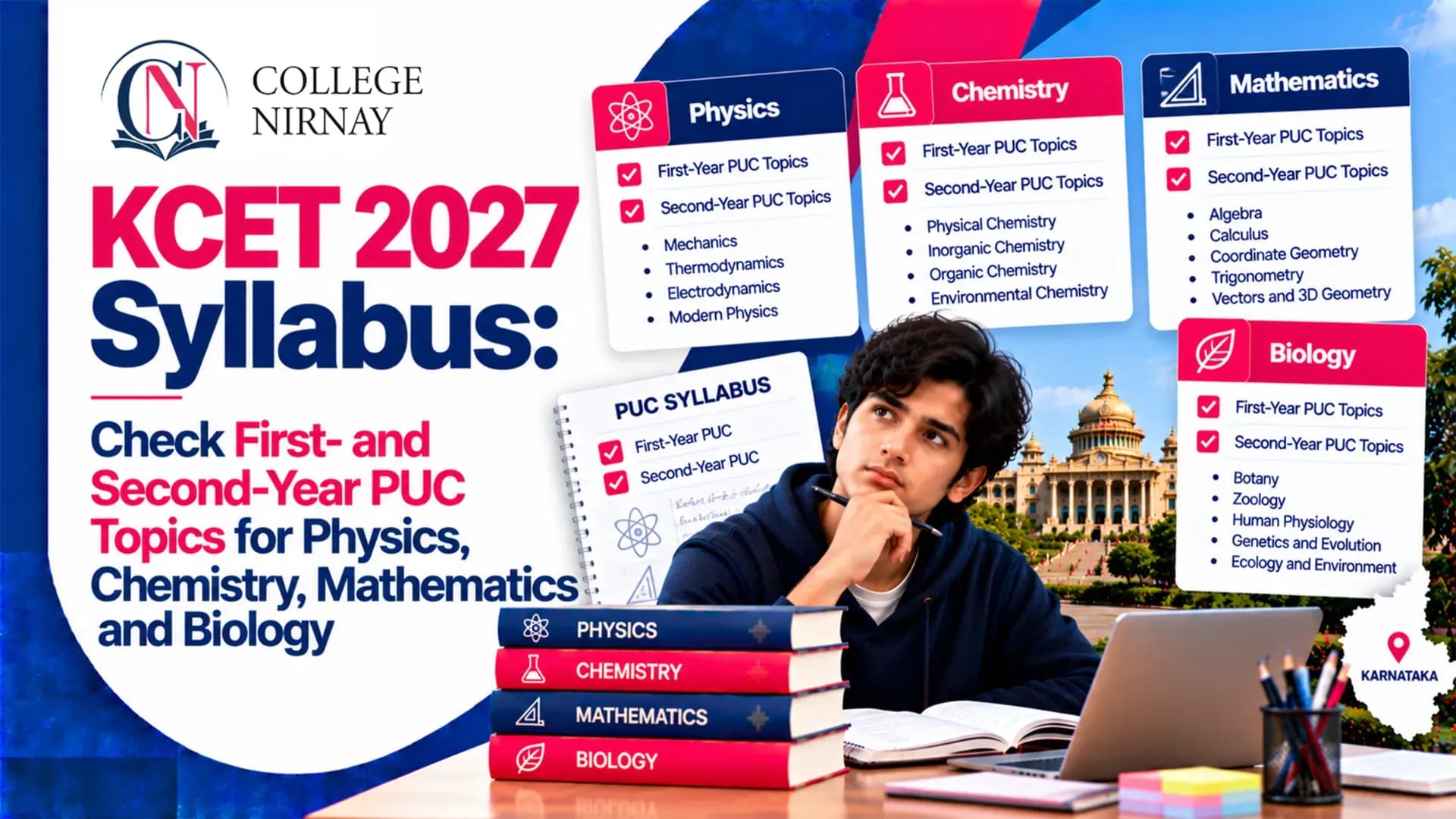
KCET 2027 Syllabus: Check First- and Second-Year PUC Topics for Physics, Chemistry, Mathematics and Biology
Candidates preparing for engineering, pharmacy, agriculture and other professional courses in Karnataka should understand the expected KCET 2027 syllabus before beginning their entrance examination preparation. The Karnataka Examinations Authority (KEA) conducts the Karnataka Common Entrance Test, also known as UGCET. As of November 2, 2026, KEA has not published the official syllabus for KCET 2027. The latest confirmed reference is the KCET 2026 syllabus, which follows the First- and Second-Year Pre-University Course (PUC) curriculum prescribed by Karnataka's Department of School Education (Pre-University).
The KCET first year PUC syllabus covers foundational Class 11 concepts, while the KCET second year PUC syllabus includes advanced Class 12 topics. The expected KCET Physics syllabus includes Mechanics, Thermodynamics, Electricity and Modern Physics. The KCET Chemistry syllabus covers Physical, Inorganic and Organic Chemistry, while the KCET Mathematics syllabus includes Algebra, Calculus and Coordinate Geometry. The KCET Biology syllabus focuses on Cell Biology, Physiology, Genetics, Biotechnology and Ecology. Candidates should prepare the subjects required by their intended admission course and verify any syllabus changes through KEA's official 2027 notification.
Key Highlights — KCET 2027 Syllabus
- KCET 2027 syllabus — Official 2027 subject-wise PDFs are awaited; KEA's 2026 syllabus provides the latest confirmed reference.
- KCET first year PUC syllabus — Covers foundational Class 11 Physics, Chemistry, Mathematics and Biology concepts prescribed for Karnataka's First-Year PUC curriculum.
- KCET second year PUC syllabus — Includes advanced Class 12 topics such as Electrostatics, Electrochemistry, Calculus, Genetics and Biotechnology.
- KCET Physics syllabus — Includes Mechanics, Properties of Matter, Thermodynamics, Oscillations, Waves, Electricity, Magnetism, Optics, Modern Physics and Experimental Skills.
- KCET Chemistry syllabus — Covers Atomic Structure, Chemical Bonding, Thermodynamics, Equilibrium, Solutions, Electrochemistry, Coordination Compounds and Organic Chemistry.
- KCET Mathematics syllabus — Includes Sets, Functions, Algebra, Trigonometry, Coordinate Geometry, Matrices, Determinants, Calculus, Vectors and Probability.
- KCET Biology syllabus — Covers Diversity in Living World, Cell Structure, Plant and Human Physiology, Reproduction, Genetics, Biotechnology, Ecology and Experimental Biology.
- KEA's 2026 syllabus includes experimental and practical-related units in Physics, Chemistry and Biology that candidates should not overlook.
- Each KCET subject paper contains 60 multiple-choice questions carrying 60 marks, with no negative marking under the latest examination rules.
- Engineering candidates prepare PCM, while Farm Science and other applicable admission routes may require PCMB or PCB according to the course-specific rules.
Explore This: Check KCET 2027 Syllabus
Which Subjects Are Included in KCET 2027 Syllabus?
The expected KCET 2027 syllabus includes Physics, Chemistry, Mathematics and Biology, depending on the course selected by the candidate. KEA's 2026 Information Bulletin confirms that examination questions are based on the First- and Second-Year PUC curriculum prescribed in Karnataka. Candidates should prepare the following major subject areas:
- Physics — Mechanics, Units and Measurements, Thermal Physics, Oscillations, Waves, Electricity, Magnetism, Optics, Modern Physics and Experimental Skills;
- Chemistry — Basic Chemical Concepts, Atomic Structure, Periodicity, Chemical Bonding, Thermodynamics, Equilibrium, Electrochemistry, Organic Chemistry and Practical Chemistry;
- Mathematics — Sets, Relations, Functions, Algebra, Trigonometry, Coordinate Geometry, Matrices, Determinants, Calculus, Vectors, Three-Dimensional Geometry and Probability;
- Biology — Diversity in Living World, Cell Biology, Plant Physiology, Human Physiology, Reproduction, Genetics, Evolution, Biotechnology, Ecology and Experimental Biology;
- First-Year PUC preparation — foundational Class 11 concepts required for understanding advanced Second-Year PUC chapters;
- Second-Year PUC preparation — advanced Class 12 topics, chapter-wise MCQ practice and revision aligned with KEA's latest subject-wise syllabus PDFs.
Candidates can review the KCET syllabus overview and First- and Second-Year PUC subjects.
KCET First-Year PUC vs Second-Year PUC Syllabus: What Is the Difference?
The KCET first year PUC syllabus corresponds broadly to Class 11, while the KCET second year PUC syllabus corresponds to Class 12. Both stages contribute to KCET preparation. First-Year PUC develops foundational concepts, and Second-Year PUC introduces advanced applications across the science subjects.
| Subject | First-Year and Second-Year PUC Preparation Areas |
|---|---|
| Physics | First-Year PUC: Mechanics, Properties of Matter, Thermodynamics, Kinetic Theory, Oscillations and Waves; Second-Year PUC: Electrostatics, Current Electricity, Magnetism, Electromagnetic Induction, Optics and Modern Physics |
| Chemistry | First-Year PUC: Chemical Basics, Atomic Structure, Periodicity, Bonding, Thermodynamics, Equilibrium and Hydrocarbons; Second-Year PUC: Solutions, Electrochemistry, Chemical Kinetics, Coordination Compounds, Organic Functional Groups and Biomolecules |
| Mathematics and Biology | Mathematics progresses from Sets, Algebra, Trigonometry and introductory Calculus to Matrices, Integrals, Differential Equations and Vectors; Biology progresses from Diversity, Cells and Physiology to Reproduction, Genetics, Biotechnology and Ecology |
Candidates should note that KEA published separate revised subject-wise syllabus PDFs for KCET 2026. The chapters and subtopics included in those PDFs should be treated as more authoritative than a general textbook chapter list. A topic appearing in an older PUC textbook or another entrance examination syllabus is not necessarily included in the latest KEA syllabus.
KCET Physics Syllabus 2027: First- and Second-Year PUC Topics
The expected KCET Physics syllabus includes both foundational and advanced Physics topics from Karnataka's First- and Second-Year PUC curriculum. Candidates should understand physical laws, practise calculations and study experimental concepts. The latest available syllabus includes an Experimental Skills component, making practical understanding an important part of preparation.
| PUC Level | Important Physics Topics |
|---|---|
| First-Year PUC Physics | Units and Measurements, Kinematics, Laws of Motion, Work, Energy and Power, System of Particles and Rotational Motion, Gravitation, Mechanical Properties of Solids and Fluids, Thermal Properties, Thermodynamics, Kinetic Theory, Oscillations, Waves and Experimental Skills |
| Second-Year PUC Physics | Electric Charges and Fields, Electric Potential and Capacitance, Current Electricity, Moving Charges and Magnetism, Electromagnetic Induction, Alternating Current, Electromagnetic Waves, Ray and Wave Optics, Dual Nature of Radiation and Matter, Atoms, Nuclei, Electronic Devices and Experimental Skills |
First-Year Physics preparation should focus on Newton's laws, motion, conservation of energy, rotation, thermal processes and wave behaviour. Second-Year preparation should include electric fields, electrical circuits, magnetic forces, electromagnetic induction, optical instruments and modern physics. Candidates should practise numerical calculations as well as conceptual questions involving graphs, diagrams and scientific measurements.
The 2026 Physics syllabus includes Experimental Skills, such as understanding measurements, instruments and observations associated with prescribed experiments. Candidates should review the exact experimental topics in the official subject PDF. This is particularly important because conventional formula-based preparation may not cover all the practical concepts identified by KEA.
KCET Chemistry Syllabus 2027: Physical, Inorganic and Organic Chemistry
The KCET Chemistry syllabus covers Physical, Inorganic and Organic Chemistry concepts from First- and Second-Year PUC. The latest available syllabus also includes Principles Related to Practical Chemistry. Students should prepare chemical calculations, molecular structures, periodic properties, reaction mechanisms and practical laboratory concepts.
First-Year PUC Chemistry includes Some Basic Concepts of Chemistry, Structure of Atom, Classification of Elements and Periodicity, Chemical Bonding and Molecular Structure, Thermodynamics, Equilibrium, Redox Reactions, Organic Chemistry: Some Basic Principles and Techniques, and Hydrocarbons. Candidates should also prepare the applicable first-year practical chemistry principles identified in the revised syllabus.
Second-Year PUC Chemistry covers Solutions, Electrochemistry, Chemical Kinetics, d- and f-Block Elements, Coordination Compounds, Haloalkanes and Haloarenes, Alcohols, Phenols and Ethers, Aldehydes, Ketones and Carboxylic Acids, Amines, Biomolecules and prescribed practical chemistry concepts. Candidates should verify the official 2027 PDF rather than assuming that chapters from older textbook editions remain included.
KCET Mathematics Syllabus 2027: Algebra, Trigonometry and Calculus
The expected KCET Mathematics syllabus covers foundational and advanced topics from the two PUC years. First-Year PUC preparation includes Sets, Relations and Functions, Trigonometric Functions, Complex Numbers, Quadratic Equations, Linear Inequalities, Permutations and Combinations, Sequences and Series, Straight Lines, Three-Dimensional Geometry, Limits, Derivatives, Statistics and Probability.
Second-Year PUC Mathematics includes Relations and Functions, Inverse Trigonometric Functions, Matrices, Determinants, Continuity and Differentiability, Applications of Derivatives, Integrals, Applications of Integrals, Differential Equations, Vector Algebra, Three-Dimensional Geometry, Linear Programming and Probability.
Candidates should pay close attention to the latest approved chapter lists and deleted portions. Older KCET preparation resources may include topics that were revised or excluded from particular PUC syllabus versions. For example, older published deletion lists treated certain First-Year Algebra, Binomial Theorem and Conic Sections material differently. The examination-year KEA syllabus PDF must determine exactly what to study.
Mathematics preparation should combine conceptual understanding and timed numerical practice. Engineering candidates should also remember that KEA's latest engineering merit formula considers both CET Physics-Chemistry-Mathematics marks and qualifying-examination PCM marks in equal proportions. Candidates can review the KCET Mathematics syllabus and subject-wise preparation topics.
KCET Biology Syllabus 2027: Botany, Zoology, Genetics and Ecology
The expected KCET Biology syllabus includes concepts from Botany, Zoology, Human Physiology, Genetics, Biotechnology and Ecology. Under the 2026 reference syllabus, First-Year PUC Biology focuses on foundational biological organisation and life processes, while Second-Year PUC Biology focuses on reproduction, heredity, evolution, biotechnology and ecological relationships.
First-Year PUC Biology preparation includes The Living World, Biological Classification, Plant Kingdom, Animal Kingdom, Morphology and Anatomy of Flowering Plants, Structural Organisation in Animals, Cell Structure and Function, Biomolecules, Cell Cycle, Cell Division, Photosynthesis, Respiration in Plants, Plant Growth and Development, and Human Physiology.
Second-Year PUC Biology includes Sexual Reproduction in Flowering Plants, Human Reproduction, Reproductive Health, Principles of Inheritance and Variation, Molecular Basis of Inheritance, Evolution, Human Health and Disease, Microbes in Human Welfare, Biotechnology: Principles and Processes, Biotechnology Applications, Organisms and Populations, Ecosystems, Biodiversity and Conservation. The 2026 syllabus also identifies experimental or practical Biology concepts for preparation.
Biology candidates should revise diagrams, scientific terms, cellular processes, inheritance patterns and ecological concepts. Applicants preparing for Pharmacy, Farm Science, Veterinary Science or other eligible courses must also verify the relevant course-wise subject and merit requirements. Candidates can review the KCET Biology syllabus and examination-language guidance.
KCET 2026 Syllabus Updates: Experimental Skills and Practical Topics
An important feature of the 2026 syllabus is the inclusion of experimental and practical-related units. Students preparing for KCET 2027 should therefore avoid limiting their preparation to numerical formulas and textbook theory. The latest published syllabus includes Experimental Skills in Physics, Principles Related to Practical Chemistry and experimental Biology concepts.
Physics experimental preparation may involve basic instruments, measurement techniques, observations and interpretation of experimental results. Chemistry practical preparation may involve laboratory techniques, identification, chemical observations and related principles. Biology experimental preparation may involve plant and animal structures, biological observations, reproductive processes, diagrams and basic laboratory investigations.
These topics should be studied according to the actual official subject-wise syllabus PDFs. Candidates should not assume that the inclusion of experimental principles means a separate practical examination will be conducted as part of the regular KCET Physics, Chemistry or Biology papers. The published examination pattern remains an objective-type written examination.
? Important
The 2026 syllabus included practical and experimental units, but the official 2027 syllabus may revise their content. Candidates should prepare the available 2026 reference topics now and check KEA's next published subject PDFs for additions, deletions or updated practical content.
KCET PCM, PCB and PCMB Syllabus: Which Subjects Are Required?
| Examination Group | Relevant Syllabus and Latest Examination Structure |
|---|---|
| PCM — Engineering | Physics, Chemistry and Mathematics from First- and Second-Year PUC; three papers containing 180 questions for 180 maximum marks |
| PCB — Relevant Pharmacy and Allied Courses | Physics, Chemistry and Biology from First- and Second-Year PUC; three papers containing 180 questions for 180 maximum marks |
| PCMB — Farm Science and Applicable Routes | Physics, Chemistry, Mathematics and Biology from both PUC years; four papers containing 240 questions for 240 maximum marks |
Why Is the First-Year PUC Syllabus Important for KCET Preparation?
First-Year PUC topics establish the conceptual foundation needed for advanced Second-Year PUC chapters. The KCET first year PUC syllabus includes essential areas such as Mechanics, Atomic Structure, Chemical Bonding, Algebra, Trigonometry, Cell Biology and Physiology. Neglecting these topics may create difficulty when preparing advanced applications.
In Physics, knowledge of forces, energy and mathematical relationships supports Electricity and Magnetism. In Chemistry, Atomic Structure and Chemical Bonding help candidates understand chemical properties and reactions. In Mathematics, Algebra, Functions and Trigonometry are important foundations for Calculus and Coordinate Geometry.
Biology candidates should understand Cell Structure, Biomolecules, Plant Physiology and Human Physiology before progressing to Reproduction, Genetics and Biotechnology. Candidates with weak fundamentals should revise earlier chapters rather than attempting only difficult Second-Year objective questions.
Candidates should use the latest KEA syllabus PDFs to identify the First-Year PUC units retained for the examination. They should avoid spending excessive preparation time on chapters or subtopics officially excluded from the relevant examination-year syllabus.
How Should Students Prepare the Second-Year PUC Syllabus for KCET?
The KCET second year PUC syllabus contains advanced topics that are also important for qualifying board examinations. Engineering aspirants should carefully prepare Electrostatics, Current Electricity, Magnetism, Electrochemistry, Organic Chemistry, Matrices, Calculus, Vectors and Probability.
Biology aspirants should revise Reproduction, Genetics, Molecular Biology, Biotechnology, Ecosystems and Biodiversity. These chapters require both factual accuracy and conceptual understanding. Candidates should practise objective questions after completing each unit and revisit incorrectly answered questions during revision.
For engineering, KEA's latest merit formula uses CET PCM performance and qualifying-examination PCM performance in equal proportions. Therefore, Second-Year PUC preparation is important not only for KCET questions but also for the board examination marks used in engineering rank calculation.
Are English, Kannada or General Knowledge Included in the KCET Syllabus?
The regular KCET subject papers cover Physics, Chemistry, Mathematics and Biology, depending on the selected admission route. KEA's 2026 written examination pattern does not prescribe separate English, General Knowledge or General Aptitude papers as part of the standard PCM, PCB or PCMB subject tests.
KCET question papers are provided in English and Kannada under the applicable examination instructions. This language arrangement should not be confused with the separate Kannada Language Test required for candidates claiming certain Horanadu and Gadinadu Kannadiga eligibility clauses.
Candidates claiming special Karnataka eligibility through prescribed language-related clauses should review the official Kannada Language Test requirements separately. Its purpose is to verify eligibility under particular admission clauses; it does not replace the Physics, Chemistry, Mathematics or Biology syllabus required for the relevant professional course.
Candidates can review the KCET general syllabus, question-paper languages and subject requirements.
Is the KCET Syllabus the Same as CBSE, JEE Main or NEET UG?
KCET shares many science concepts with CBSE Class 11 and Class 12, JEE Main and NEET UG. However, the examination syllabi should not be treated as completely identical. KEA prescribes the relevant Karnataka First- and Second-Year PUC syllabus for KCET and publishes subject-wise syllabus documents for the examination year.
A CBSE engineering aspirant may already have studied Mechanics, Electrostatics, Chemical Bonding and Calculus through JEE Main preparation. Similarly, a NEET UG aspirant may be familiar with Human Physiology, Genetics, Biotechnology and Ecology. These overlaps can help reduce additional preparation, but candidates should identify any KCET-specific topic differences.
The KCET examination pattern also differs from JEE Main and NEET UG. Under KEA's latest rules, each KCET subject contains 60 questions, awards one mark per correct answer and has no negative marking. Candidates should therefore practise KCET-specific OMR questions and time management even when using JEE Main or NEET UG study resources.
Candidates can review the KCET PUC syllabus differences and subject-wise preparation comparison.
Does KCET Have Fixed First-Year and Second-Year PUC Chapter Weightage?
Some preparation resources estimate that Second-Year PUC topics contribute a larger share of KCET questions than First-Year PUC topics. However, candidates should not treat an unofficial chapter-wise weightage table as a guaranteed examination blueprint. The KEA 2026 Information Bulletin confirms the use of both PUC years but does not independently guarantee an exact number of questions from every chapter.
- Physics — prepare Mechanics and Thermodynamics from First-Year PUC alongside Electricity, Magnetism, Optics and Modern Physics from Second-Year PUC;
- Chemistry — balance Chemical Basics, Bonding and Equilibrium with Solutions, Electrochemistry, Coordination Compounds and Organic Chemistry;
- Mathematics — revise Algebra and Trigonometry together with Calculus, Matrices, Determinants, Vectors and Probability;
- Biology — cover foundational Cell Biology and Physiology alongside Genetics, Reproduction, Biotechnology and Ecology.
Candidates should use previous-year question papers to identify recurring question types and their own weak areas. Past papers can inform preparation priorities but cannot guarantee how many questions will be asked from an individual unit in 2027.
The most reliable strategy is to prepare all retained topics from KEA's latest official syllabus PDFs. Students can then give additional revision time to high-error chapters, frequently tested concepts and topics requiring lengthy calculations.
KCET Syllabus Preparation: Textbooks, MCQs and Revision Strategy
Candidates should divide their preparation into textbook study, chapter-wise objective-question practice, formula or concept revision, and timed mock examinations. The latest KCET format provides 60 questions in each subject, with an 80-minute session that includes the prescribed OMR formalities. A structured plan should strengthen accuracy while improving the speed needed to complete the examination.
| Preparation Component | Relevant KCET Topics and Requirements | Recommended Preparation Strategy |
|---|---|---|
| First-Year PUC Concept Building | Mechanics, Chemical Bonding, Algebra, Trigonometry, Cell Biology, Physiology and other foundational topics | Revise Karnataka PUC and relevant NCERT textbook explanations, complete basic exercises and strengthen weak concepts before moving to advanced chapters |
| Second-Year PUC Preparation | Electrostatics, Electrochemistry, Organic Chemistry, Calculus, Genetics, Biotechnology and other advanced topics | Align board examination revision with KCET preparation and practise examination-style questions after completing each unit |
| Practical Concepts and Formula Revision | Physics Experimental Skills, Practical Chemistry, Experimental Biology, mathematical formulas and scientific diagrams | Create short notes, formula sheets and experiment summaries; revise them regularly and use official syllabus units to avoid unnecessary chapters |
| Timed MCQ and OMR Practice | 60 objective questions per subject, one mark per correct answer, no negative marking and 80 minutes per session | Solve previous papers and mock tests under timed conditions, practise correct OMR shading and review incorrect or unanswered questions |
Common Mistakes While Preparing for KCET 2027 Syllabus
- Studying only Second-Year PUC chapters and neglecting the First-Year PUC topics included in the official syllabus;
- Assuming that every chapter in an older Karnataka PUC or NCERT textbook is automatically included in KCET 2027;
- Following outdated deleted-topic lists without checking the latest KEA subject-wise syllabus PDFs;
- Ignoring Experimental Skills in Physics, Practical Chemistry or Experimental Biology included in the 2026 reference syllabus;
- Preparing only PCM when the intended course requires PCB or all four PCMB subjects;
- Memorising Physics, Chemistry and Mathematics formulas without practising numerical applications and conceptual problems;
- Neglecting Cell Biology, Human Physiology, Genetics or Ecology while preparing Biology;
- Assuming an unofficial First-Year versus Second-Year question-weightage estimate is guaranteed by KEA;
- Treating the 2026 syllabus as officially confirmed for 2027 before KEA releases the new subject-wise syllabus.
Candidates can review the KCET syllabus features and common preparation precautions.
? KCET 2027 Syllabus Preparation Checklist
✅ Check Before Starting Preparation
- Confirm whether your intended KCET admission programme requires PCM, PCB or PCMB.
- Download or review KEA's latest available Physics, Chemistry, Mathematics and Biology syllabus PDFs.
- Prepare First-Year PUC Physics topics such as Mechanics, Thermodynamics, Oscillations and Waves.
- Revise Second-Year PUC Physics topics, including Electricity, Magnetism, Optics and Modern Physics.
- Cover the prescribed Physical, Inorganic and Organic Chemistry units from both PUC years.
- If Mathematics is required, prepare Algebra, Trigonometry, Matrices, Calculus, Coordinate Geometry and Probability.
- If Biology is required, study Cell Biology, Physiology, Reproduction, Genetics, Biotechnology and Ecology.
- Include the experimental and practical-related topics identified in KEA's current syllabus reference.
- Check official deletions and revisions instead of relying on outdated textbook chapter lists.
- Solve previous-year KCET questions and practise 60-question subject papers under timed OMR conditions.
- Verify the official KCET 2027 syllabus when released and adjust the preparation plan for any confirmed changes.
? Follow Both PUC Years and the Latest KEA Syllabus
The expected KCET 2027 syllabus draws on both the KCET first year PUC syllabus and the KCET second year PUC syllabus. Candidates should prepare all relevant topics from KEA's latest subject-wise reference PDFs and avoid treating unofficial chapter-weightage predictions as final. The official 2027 notification will determine any revised chapters, practical units or other changes.
Candidates can use the KCET 2027 syllabus and preparation summary for quick reference.
FAQs
Q1. Has KEA released the official KCET 2027 syllabus?
As of November 2, 2026, KEA has not released the official KCET 2027 subject-wise syllabus. The latest confirmed reference is the KCET 2026 syllabus, which follows the First- and Second-Year PUC curriculum prescribed in Karnataka. Candidates should use the 2026 subject PDFs for initial preparation and check KEA's official website for any revised 2027 syllabus.
Q2. What are the important First-Year PUC topics for KCET 2027?
First-Year PUC preparation includes Physics topics such as Mechanics, Thermodynamics and Waves; Chemistry topics such as Atomic Structure, Chemical Bonding and Equilibrium; Mathematics topics such as Algebra, Trigonometry and introductory Calculus; and Biology topics such as Biological Classification, Cell Biology, Plant Physiology and Human Physiology. Candidates should verify the exact retained units in the current KEA syllabus.
Q3. Which Second-Year PUC chapters are included in KCET preparation?
Second-Year PUC preparation includes Electrostatics, Current Electricity, Magnetism, Optics and Modern Physics in Physics; Solutions, Electrochemistry, Chemical Kinetics and Organic Chemistry in Chemistry; Matrices, Determinants, Calculus, Vectors and Probability in Mathematics; and Reproduction, Genetics, Biotechnology and Ecology in Biology. The official 2027 syllabus will confirm the final included topics.
Q4. Are practical and experimental topics included in the KCET syllabus?
Yes. KEA's 2026 syllabus introduced or highlighted Experimental Skills in Physics, Principles Related to Practical Chemistry and experimental Biology topics. Candidates should prepare the relevant experimental concepts listed in the official subject PDFs. These topics are part of objective-test preparation and should not be confused with a separate regular KCET practical examination.
Q5. Is there fixed weightage for First-Year and Second-Year PUC in KCET 2027?
KEA's 2026 Information Bulletin confirms that KCET is based on the First- and Second-Year PUC syllabus but does not independently guarantee fixed chapter-wise question counts for 2027. Some preparation websites publish estimated weightages, but candidates should study all officially included units and use previous-year papers only as a preparation reference rather than a guaranteed question distribution.
Candidates can also review the KCET syllabus frequently asked questions.
Stay with College Nirnay for all KCET 2027 syllabus, KCET first year PUC syllabus, KCET second year PUC syllabus, KCET Physics syllabus, KCET Chemistry syllabus, KCET Mathematics syllabus, and KCET Biology syllabus updates.