
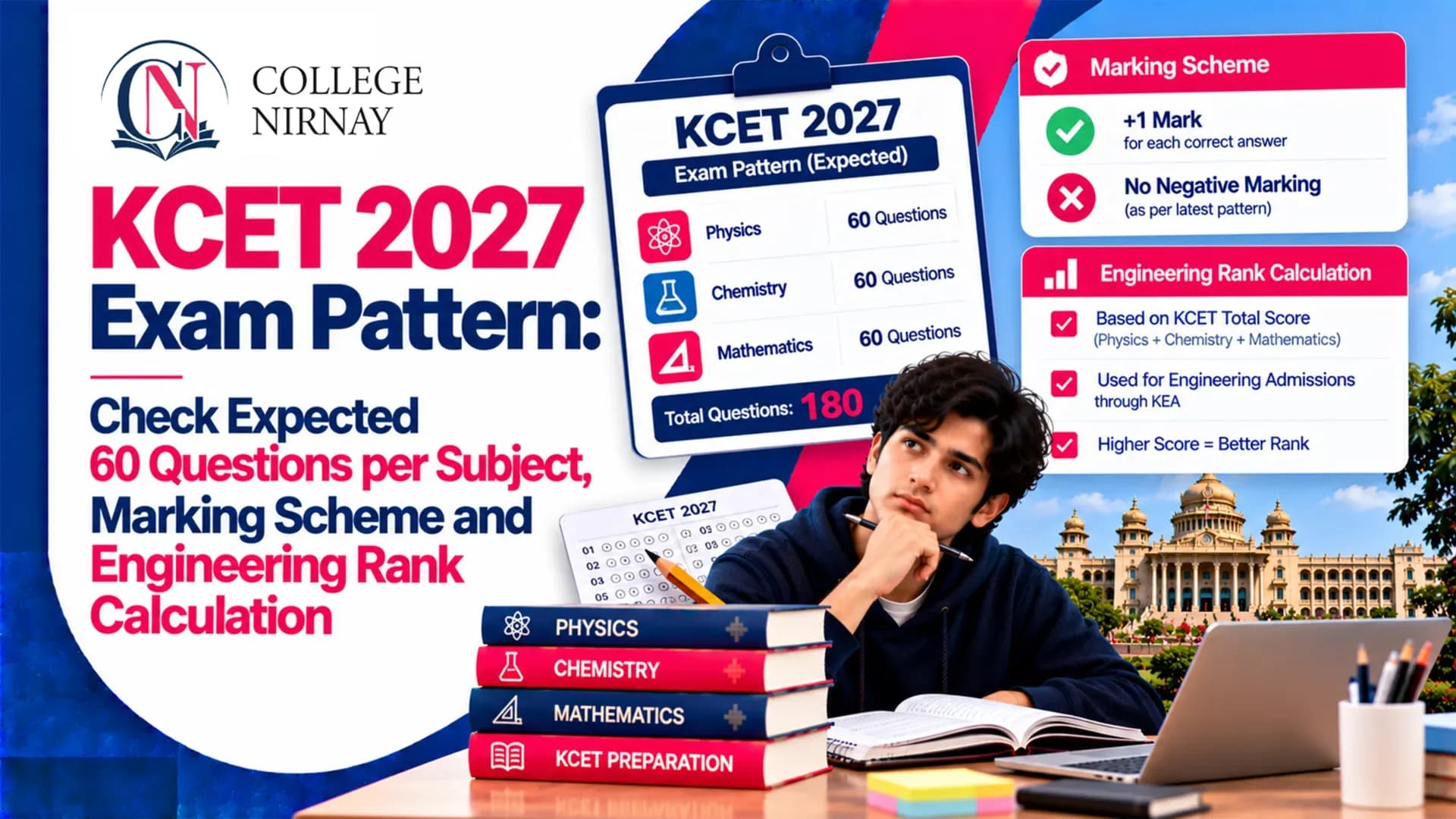
KCET 2027 Exam Pattern: Check Expected 60 Questions per Subject, Marking Scheme and Engineering Rank Calculation
Candidates preparing for engineering, pharmacy, agriculture and other professional courses in Karnataka should understand the expected KCET 2027 exam pattern before beginning their preparation. The Karnataka Examinations Authority (KEA) conducts the Karnataka Common Entrance Test, also known as UGCET, for admission to participating professional institutions. As of November 2, 2026, the official KCET 2027 Information Bulletin has not been published. Therefore, KEA's UGCET 2026 Information Bulletin provides the latest confirmed reference for the KCET 60 questions per subject format, examination duration and evaluation rules.
Under the latest KCET paper pattern, Physics, Chemistry, Mathematics and Biology are conducted as separate objective-type papers. Each subject contains 60 multiple-choice questions carrying 60 marks. The KCET marking scheme awards one mark for each correct response, with no negative marking for incorrect answers. The KCET total questions for engineering candidates are 180 across Physics, Chemistry and Mathematics. The KCET engineering rank calculation follows a 50:50 weightage between CET PCM marks and qualifying examination PCM marks, making both entrance performance and Class 12 results important for admission.
Key Highlights — KCET 2027 Exam Pattern
- KCET 2027 exam pattern — Official 2027 rules are awaited; KEA's UGCET 2026 Information Bulletin provides the latest confirmed reference.
- KCET 60 questions per subject — Each Physics, Chemistry, Mathematics and Biology paper contains 60 objective questions carrying 60 marks.
- KCET marking scheme — One mark is awarded for each correct answer, while incorrect and unanswered questions receive zero marks.
- KCET engineering rank calculation — Engineering merit is based on CET Physics, Chemistry and Mathematics marks and qualifying examination PCM marks in equal proportions.
- KCET total questions — Engineering candidates answer 180 questions, while candidates appearing for all four PCMB papers answer 240 questions.
- KCET paper pattern — The examination is conducted offline using multiple-choice question booklets and Optical Mark Reader (OMR) answer sheets.
- Each subject paper lasts 80 minutes, including an initial 10 minutes for OMR-related formalities and 70 minutes for answering.
- Every question has four answer options, with only one correct choice; multiple marked answers receive no marks.
- Physics and Chemistry are conducted in separate sessions on the first examination day, while Mathematics and Biology are conducted on the second day under the latest scheme.
- Farm Science, Veterinary Science, Pharmacy and other professional courses have separate merit-calculation rules that should not be confused with the engineering rank formula.
Explore This: Check KCET 2027 Exam Pattern
What Is the Expected KCET 2027 Exam Pattern?
The official 2027 examination scheme has not yet been announced. Based on KEA's latest published rules, candidates preparing for the expected KCET 2027 exam pattern should understand the following examination features:
- Physics — 60 multiple-choice questions carrying 60 maximum marks;
- Chemistry — 60 multiple-choice questions carrying 60 maximum marks;
- Mathematics — 60 multiple-choice questions carrying 60 maximum marks;
- Biology — 60 multiple-choice questions carrying 60 maximum marks;
- Examination duration — 80 minutes for each individual subject session, including OMR formalities;
- Marking — +1 for a correct answer, zero for an incorrect or unanswered response and no negative marking.
Candidates can review the KCET general examination pattern and important rules.
KCET Subject-Wise Paper Structure: Physics, Chemistry, Mathematics and Biology
The official 2026 examination scheme confirms the KCET 60 questions per subject format. Four separate subject papers are conducted across two examination days. Candidates appear for the subjects required by their intended courses and admission routes.
| KCET Subject | Questions, Marks and Duration |
|---|---|
| Physics and Chemistry | 60 questions and 60 marks for each subject; 80 minutes per paper; held in separate sessions on the first examination day under the 2026 schedule |
| Mathematics | 60 questions carrying 60 marks; 80 minutes; required for the engineering CET combination |
| Biology | 60 questions carrying 60 marks; 80 minutes; relevant to specified Pharmacy, Farm Science, Veterinary and allied admission routes |
Each subject is assessed through a separate paper, rather than one combined 180-question engineering booklet. In 2026, the Physics and Chemistry examinations were held on April 23, while Mathematics and Biology were held on April 24. These historical dates should not be treated as confirmed examination dates for 2027.
KCET Marking Scheme 2027: Is There Negative Marking?
The expected KCET marking scheme follows KEA's latest published examination rules. Each correctly answered question earns one mark. There is no deduction for an incorrect answer, and an unanswered question receives zero marks. However, marking more than one answer for the same question does not earn any marks.
| Response Type | Marks Awarded or Deducted |
|---|---|
| Correct Answer | +1 mark |
| Incorrect, Unanswered or Multiple-Marked Answer | 0 marks; no negative deduction |
The absence of negative marking means that candidates are not penalised for attempting an incorrect answer. KEA therefore advises candidates to attempt all questions to maximise their opportunity to score. However, candidates should still select only one option per question and shade the OMR response correctly.
For example, if a candidate answers 45 questions correctly, 10 incorrectly and leaves five unanswered in a 60-question paper, the raw score is 45 marks out of 60. The 10 incorrect responses do not reduce the marks earned from the correct answers. Final marks are determined according to the official answer key and OMR evaluation rules.
KCET Engineering Rank Calculation: How Does the 50:50 Formula Work?
The KCET engineering rank calculation is based on performance in Physics, Chemistry and Mathematics in both the CET examination and the qualifying examination, taken in equal proportions. Under KEA's UGCET 2026 Information Bulletin, this means 50% weightage for CET PCM performance and 50% for Class 12 or 2nd PUC PCM performance.
For a simplified calculation, a candidate scoring 135 out of 180 in CET PCM has obtained 75% in the entrance component. If the same candidate scores 270 out of 300 in qualifying-examination PCM, the board component is 90%. Applying equal weightage produces a combined merit percentage of 82.5%. This example illustrates the percentage calculation; it does not predict the candidate's actual engineering rank.
Candidates can review the KCET engineering rank calculation and 50:50 marks distribution.
Can Strong Class 12 Marks Improve a KCET Engineering Rank?
Yes. Because engineering merit gives equal weight to qualifying-examination PCM marks and CET PCM marks, strong Class 12 results can improve the combined merit percentage. Candidates should therefore prepare seriously for their board examinations as well as the entrance test.
A candidate with strong CET marks but comparatively low qualifying-examination PCM marks may have a lower combined percentage than another candidate whose performance is balanced across both components. Conversely, high board marks can strengthen the composite score, but do not guarantee a particular rank or college.
? Important
The 50:50 formula is based on the prescribed Physics, Chemistry and Mathematics marks, not the overall percentage obtained across every Class 12 subject. The final rank also depends on the performance of other candidates, applicable tie-breaking provisions and KEA's official merit processing.
KCET Exam Duration 2027: What Do the 80 Minutes Include?
KEA's latest examination scheme specifies 80 minutes for each subject paper. This includes 10 minutes at the beginning for entering the candidate's particulars on the OMR answer sheet and a further 70 minutes for answering the 60 multiple-choice questions.
Candidates are required to enter their CET number, question-booklet version code and other prescribed details accurately. Incorrect version-code entry or careless shading may affect response-sheet processing. Applicants should read the instructions before marking their answers.
For engineering candidates appearing in Physics, Chemistry and Mathematics, the cumulative duration is 240 minutes across three separate subject sessions. Candidates appearing in all four PCMB papers have a cumulative duration of 320 minutes. These totals describe the separate paper durations and do not mean the examination is conducted in one uninterrupted session.
✅ Time Management
Practise answering 60 questions within 70 minutes while reserving the prescribed initial time for OMR details. This provides approximately 70 seconds per question during the answering period. Candidates should also practise marking OMR responses accurately without losing time through unnecessary corrections.
KCET OMR Answer Sheet Rules: How Should Answers Be Marked?
The latest KCET paper pattern uses Optical Mark Reader sheets for recording answers. Candidates receive a question booklet containing multiple-choice questions and mark the selected option by completely shading the appropriate circle on the answer sheet.
KEA's 2026 instructions require candidates to use a blue or black ballpoint pen. Tick marks, crosses, dots, partial shading, lines and more than one shaded response are not acceptable methods of recording answers. Candidates should shade only the circle corresponding to their chosen answer.
The OMR answer sheet contains spaces for the candidate's name, CET number, booklet version code and other required information. Candidates must follow the invigilator's instructions and ensure that these details are recorded correctly. The OMR evaluation process depends on correctly entered identification details and accurately shaded responses.
Candidates can review the KCET question-paper format and OMR answering instructions.
KCET PCM, PCB and PCMB Question Distribution
| Subject Combination | Latest KCET Questions and Maximum Marks |
|---|---|
| PCM — Engineering | Physics 60 + Chemistry 60 + Mathematics 60 = 180 questions carrying 180 maximum marks |
| PCB — Relevant Pharmacy and Allied Courses | Physics 60 + Chemistry 60 + Biology 60 = 180 questions carrying 180 maximum marks |
| PCMB — Farm Science and Other Applicable Routes | Physics 60 + Chemistry 60 + Mathematics 60 + Biology 60 = 240 questions carrying 240 maximum marks |
How Are KCET Farm Science Ranks Calculated?
Farm Science admission does not follow the engineering PCM-only formula. Under KEA's 2026 rules, the Farm Science merit list is based on performance in Physics, Chemistry, Mathematics and Biology in both the Common Entrance Test and qualifying examination, taken in equal proportions.
This means candidates seeking applicable Farm Science admissions must prepare all four PCMB subjects under the prescribed entrance scheme. Their marks in the relevant Class 12 or 2nd PUC subjects also contribute to merit. Candidates should not assume that a high score in only Physics, Chemistry and Mathematics is sufficient for the standard Farm Science merit calculation.
KEA's published list of Farm Science courses includes programmes such as Agriculture, Horticulture, Forestry, Sericulture, Agricultural Engineering, Food Technology, Fisheries Science and other specified undergraduate courses. Individual academic eligibility, reservation and practical-test provisions may differ by programme and quota.
For the separately defined Agriculturist Quota, the latest rules include a 200-mark practical examination. The applicable merit formula generally uses 25% qualifying-examination PCMB marks, 25% CET marks and 50% practical-test marks. Candidates must obtain the prescribed minimum practical-test score to qualify under that quota.
KCET Pharmacy and Veterinary Rank Calculation: Is the Formula Different?
Yes. KEA's 2026 merit-determination rules distinguish Pharmacy and Veterinary Science from engineering. B.Pharmacy and Pharm.D rankings are based on the candidate's CET performance in either PCM or PCB, whichever produces the higher applicable marks. The standard engineering 50:50 Class 12 and CET formula is not used for these pharmacy merit lists.
The Bachelor of Veterinary Science and Animal Husbandry merit list is determined using Physics, Chemistry and Biology marks from the Common Entrance Test. However, candidates claiming the separate Agriculturist Quota for Veterinary Science are subject to the relevant practical-examination and quota-specific merit provisions.
Naturopathy and Yoga admission follows another course-specific merit rule, while architecture admission uses the applicable NATA requirements. Medical, Dental and AYUSH admissions follow NEET UG-based processes rather than the standard KCET engineering merit formula.
Candidates can review the KCET marking scheme and course-specific merit calculation rules.
How Does KEA Break Ties in KCET Engineering Ranks?
When candidates obtain the same engineering merit, KEA applies the tie-breaking rules specified in the admission regulations. Under the 2026 bulletin, higher marks in CET Mathematics are considered first for B.E./B.Tech admission.
If the candidates remain tied, CET Physics marks are considered next. Further ties are resolved by examining the relevant qualifying-examination marks. If the prescribed academic comparisons still do not distinguish the candidates, the older candidate receives preference under the specified age-based rule.
Where candidates remain indistinguishable even after the prescribed tie-breaking comparisons, the rules provide for determination through a draw of lots. Applicants should therefore avoid treating a calculated composite percentage as an exact predictor of the final rank.
Candidates can review the KCET examination duration and engineering merit considerations.
Will KEA Change the KCET 2027 Exam Pattern?
As of November 2, 2026, KEA has not issued an official KCET 2027 Information Bulletin confirming any change to the established 60-question-per-subject examination format. The 2026 pattern therefore remains the latest confirmed preparation reference.
- Question format — 60 objective-type questions with four options for each subject;
- Examination duration — 80 minutes per subject, including the prescribed OMR preparation time;
- Scoring — one mark per correct answer with no negative marking;
- Engineering merit — qualifying-examination PCM marks and CET PCM marks considered in equal proportions.
Candidates should monitor KEA's official website for changes in examination dates, question-paper instructions, revised syllabus provisions or merit-calculation requirements. Any actual change will need to be confirmed through an official 2027 bulletin or notification.
Candidates can review the KCET exam pattern updates and expected changes.
KCET Examination Marks vs Course-Wise Admission Rank
Candidates should distinguish between the marks obtained in KCET subject papers and the final merit rank used for a particular professional course. The KCET total questions and maximum subject marks determine the entrance score, while the merit-calculation formula depends on the programme and admission rules. A high entrance score does not automatically produce the same rank across Engineering, Farm Science, Pharmacy and Veterinary Science.
| Admission Course | Relevant CET Subject Scores | Latest Merit Calculation Rule |
|---|---|---|
| Engineering / Technology | Physics, Chemistry and Mathematics — maximum 180 CET marks | 50% CET PCM performance and 50% qualifying-examination PCM performance |
| Farm Science | Physics, Chemistry, Mathematics and Biology — maximum 240 CET marks | PCMB CET and qualifying-examination marks taken in equal proportions for the standard Farm Science merit list |
| Veterinary Science | Physics, Chemistry and Biology — maximum 180 CET marks | CET PCB marks for the standard veterinary merit list, subject to separate Agriculturist Quota rules where applicable |
| B.Pharmacy / Pharm.D | Applicable PCM or PCB combination — maximum 180 CET marks | CET PCM or PCB marks, whichever is higher, under the published pharmacy merit rules |
Common KCET 2027 Exam Pattern Mistakes
- Assuming KCET engineering contains 240 questions when engineering rank calculation uses the 180-question PCM combination;
- Believing that each subject contains 50 questions instead of the 60 questions prescribed in the latest official bulletin;
- Confusing KCET's no-negative-marking rule with examinations that deduct marks for incorrect responses;
- Ignoring the 10-minute OMR formalities and assuming all 80 minutes are available for solving questions;
- Marking multiple answer circles or using incorrect OMR shading methods;
- Calculating engineering merit using CET marks alone and overlooking the equal weightage of Class 12 PCM marks;
- Using the overall Class 12 percentage rather than the relevant qualifying-examination PCM marks for the engineering calculation;
- Applying the engineering 50:50 PCM formula to Pharmacy, Veterinary Science or other courses with different merit rules;
- Treating the 2026 KCET examination structure and rank formula as officially confirmed for 2027 before KEA releases its new bulletin.
Candidates can review the KCET exam pattern table and common preparation mistakes.
? KCET 2027 Exam Pattern Preparation Checklist
✅ Check Before Starting Preparation
- Confirm which KCET subjects are required for your intended admission course.
- For engineering, prepare Physics, Chemistry and Mathematics according to the officially prescribed syllabus.
- For Farm Science and other applicable routes, verify whether all four PCMB subjects are required.
- Remember that each subject contains 60 objective questions carrying 60 maximum marks.
- Practise solving 60 questions within the effective 70-minute answering period.
- Understand the +1 correct-answer rule and the absence of negative marking.
- Practise selecting only one option and shading OMR circles accurately.
- Prepare for both Class 12/2nd PUC PCM examinations and KCET PCM if seeking an engineering rank.
- Calculate illustrative engineering merit using equal weightage for qualifying-examination and CET PCM percentages.
- Check the separate rank formula if applying for Pharmacy, Farm Science or Veterinary Science.
- Verify the official KCET 2027 Information Bulletin, examination schedule and admit-card instructions before the examination.
? Engineering Rank Depends on CET and Class 12 Marks
Under the expected KCET 2027 exam pattern, Engineering candidates answer 60 questions each in Physics, Chemistry and Mathematics. The latest KCET engineering rank calculation uses CET PCM marks and qualifying-examination PCM marks in equal proportions. The combined merit percentage is not itself an exact rank prediction, and final admission depends on KEA's official ranking, eligibility, category, available seats and counselling rules.
Candidates can use the KCET 2027 examination pattern and engineering rank guide for quick reference.
FAQs
Q1. How many questions will be asked in KCET 2027?
Based on KEA's official 2026 examination scheme, KCET contains 60 multiple-choice questions per subject. Engineering candidates answer 180 questions across Physics, Chemistry and Mathematics, while candidates appearing for all four Physics, Chemistry, Mathematics and Biology papers answer 240 questions. The final 2027 structure must be confirmed through KEA's new Information Bulletin.
Q2. Is there negative marking in KCET 2027?
Under KEA's latest published rules, KCET has no negative marking. Candidates receive one mark for each correct answer, while incorrect and unanswered questions receive zero marks. Marking multiple options for the same question also earns zero marks. This rule is expected to continue in 2027 unless KEA announces a change.
Q3. How is the KCET engineering rank calculated?
The latest KCET engineering rank formula assigns 50% weight to Physics, Chemistry and Mathematics marks in KCET and 50% to PCM marks in the qualifying Class 12 or 2nd PUC examination. For example, a 75% CET PCM score combined with a 90% qualifying-examination PCM score produces an illustrative merit percentage of 82.5%. The actual rank depends on the complete merit list and tie-breaking rules.
Q4. What is the duration of each KCET subject paper?
Each KCET subject paper lasts 80 minutes under the 2026 rules. The first 10 minutes are provided for entering and shading the required OMR particulars, while the remaining 70 minutes are used for answering 60 objective questions. Engineering candidates appear for three separate papers, and PCMB candidates may appear for all four subjects.
Q5. Are KCET engineering, pharmacy and agriculture ranks calculated in the same way?
No. Under KEA's 2026 merit rules, Engineering uses CET PCM and qualifying-examination PCM marks in equal proportions. Farm Science generally uses CET and qualifying-examination PCMB performance in equal proportions. Veterinary Science uses CET PCB marks for its standard merit list, while B.Pharmacy and Pharm.D use the higher applicable CET PCM or PCB score. Separate quota provisions may apply.
Candidates can also review the KCET exam pattern frequently asked questions.
Stay with College Nirnay for all KCET 2027 exam pattern, KCET 60 questions per subject, KCET marking scheme, KCET engineering rank calculation, KCET total questions, KCET paper pattern, and KCET rank formula updates.