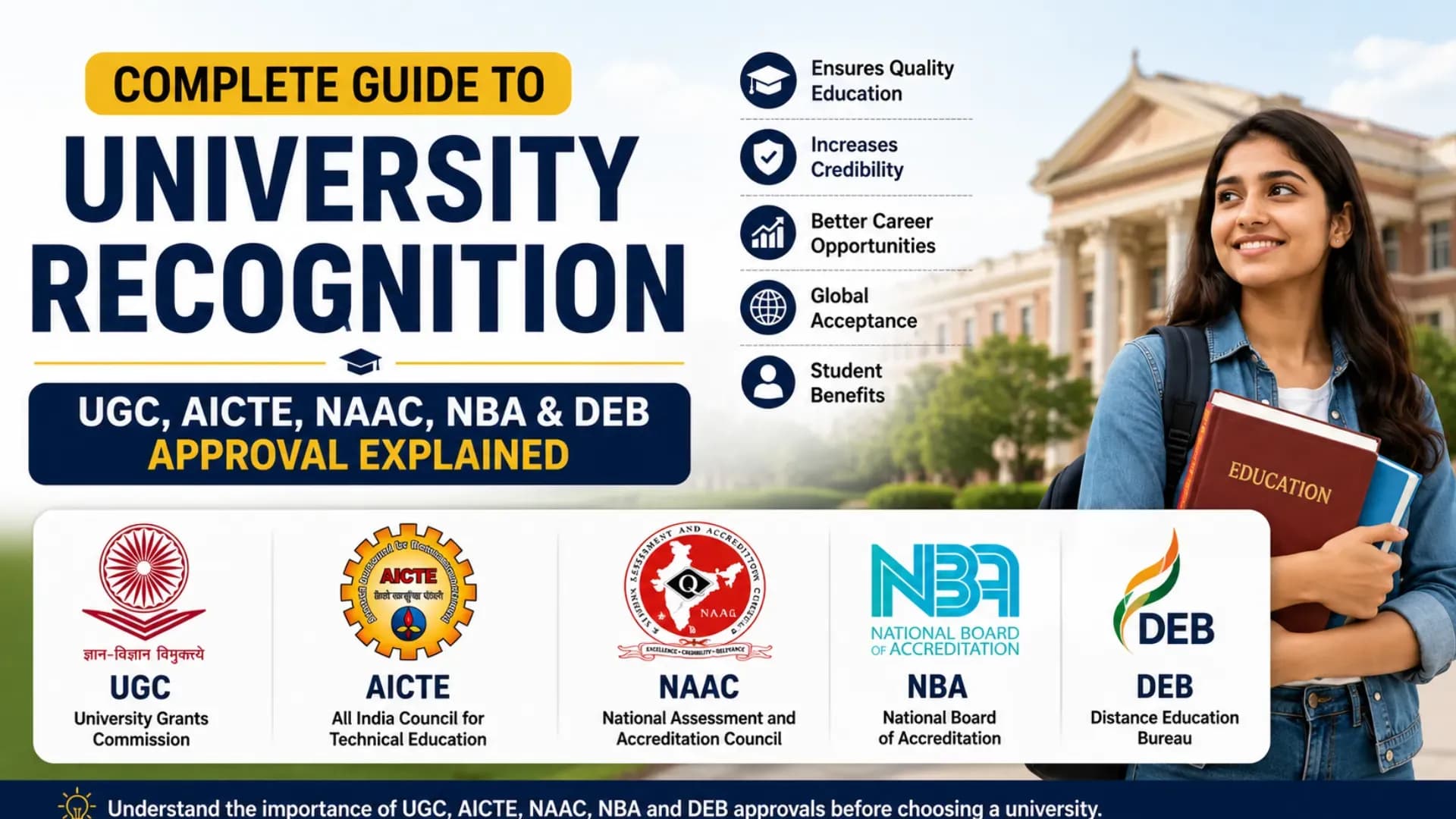
Before taking admission to any college or university in India, one of the most important checks is whether the institution is properly recognised and accredited. University Recognition in India is a multi-layered system — different bodies regulate different aspects: the UGC regulates universities, AICTE regulates technical programmes, NAAC and NBA assess quality, and DEB oversees online and distance education. This guide explains UGC Recognition, AICTE Approval, NAAC Accreditation, NBA Accreditation, and DEB Approval — what each means, why it matters, how to verify it, and what happens if a college lacks any of these. Understanding these before admission is a critical part of Admission Guidance for any student in India.
What We Cover
- Why University Recognition Matters — Degree Validity and Job Risk
- UGC Recognition — The Foundation of University Approval
- AICTE Approval — Technical and Management Programmes
- NAAC Accreditation — Quality Assessment
- NBA Accreditation — Programme-Level Engineering Quality
- DEB Approval — Online and Distance Education
- How to Verify Recognition Before Admission
- FAQs
Why University Recognition Matters — Degree Validity and Job Risk
University Recognition is not a formality — it directly determines whether your degree is valid for employment, government jobs, postgraduate admissions, and professional licensing. A degree from an unrecognised institution, or from a recognised institution in an unapproved programme, can result in:
- Rejection by government employers (UPSC, state PSC, banks, PSUs) who require Recognised University degrees for eligibility
- Rejection for postgraduate admissions where UGC/AICTE-recognised UG degree is mandatory
- Rejection for professional licensing — medical council (NMC), bar council (BCI), engineering licensing bodies — all require degrees from institutions with specific University Approval in India
- Ineligibility for UGC scholarships, fellowships, and other central government schemes
- Loss of 3–4 years and significant fees with no recoverable degree outcome
Degree Validity depends on a chain of recognition: the university must have UGC recognition; technical programme-offering institutions must have AICTE approval; online and distance programmes must have DEB approval; and quality is assessed by NAAC and NBA. This complete College Accreditation and recognition guide covers all of these. Admission Guidance: verify recognition BEFORE paying any fees — not after.
UGC Recognition — The Foundation of University Approval
UGC Recognition by the University Grants Commission of India is the foundational requirement for any university operating in India. Without UGC Recognition, a university cannot award valid degrees — its certificates are not accepted by government employers, PSUs, or most private employers for graduate and postgraduate roles.
What UGC Recognises
- Central Universities (established by Parliament — JNU, BHU, Hyderabad University etc.)
- State Universities (established by state legislature — most large public universities)
- Deemed Universities (conferred the status by MHRD on UGC recommendation — Manipal, BITS, VIT etc.)
- Institutions of National Importance (IITs, IIMs, NLUs, AIIMS — established by specific Act of Parliament; they are not UGC-recognised per se but are in a higher category)
- Private Universities (established by state acts following UGC model — proliferating across India since 2000s)
What UGC Does NOT Cover
- Autonomous colleges (recognised by UGC as colleges under a university — their degrees are awarded by the affiliating university, not independently)
- Fake universities — UGC publishes a list of "self-styled, unrecognised, fake universities" on ugc.ac.in — 23+ entries as of recent updates
How to Verify UGC Recognition
- Visit ugc.ac.in → "List of Universities" → search by state or name → verify the university appears in the list
- Also check ugc.ac.in → "Fake Universities" list — confirm your institution is NOT listed there
- UGC Recognition is the minimum for Degree Validity — all other recognitions build on top of this
AICTE Approval — Technical and Management Programmes
AICTE Approval from the All India Council for Technical Education is mandatory for any institution offering technical programmes — engineering (BTech/BE), architecture, pharmacy, hotel management, MBA/PGDM, MCA, and polytechnic diploma courses. Without AICTE Approval, these programmes are not valid for government employment, professional licensing, or postgraduate admissions.
Key points about AICTE Approval
- AICTE Approval is programme-level AND institution-level — a university having UGC recognition does NOT automatically mean its BTech programme has AICTE approval; both need to be verified independently
- AICTE approves new institutions and renewals annually — an institution with AICTE approval in 2022 must have renewed by 2024; verify the current year's approval at aicte-india.org
- PGDM programmes from AICTE-approved institutes are treated as equivalent to MBA for most purposes — but only from AICTE-approved institutions, not from all "management schools"
- Pharmacy Council of India (PCI) additionally regulates B.Pharm and D.Pharm — AICTE alone is not sufficient for pharmacy programmes
- Architecture programmes additionally need Council of Architecture (COA) approval — AICTE alone is insufficient
How to Verify AICTE Approval
- Visit aicte-india.org → "Institute" → search by institution name or state → check the list of approved programmes and valid years
- Check the approval status for the current academic year — approvals are annual
- AICTE Approval verification is mandatory for BTech, MBA, MCA, B.Pharm, Hotel Management, and Architecture candidates
NAAC Accreditation — Quality Assessment
NAAC Accreditation from the National Assessment and Accreditation Council is a voluntary quality assessment — not a recognition or approval (the distinction matters). While UGC recognition and AICTE approval determine degree legality, NAAC Accreditation is an indicator of institutional quality. However, it has become progressively mandatory for certain purposes:
- UGC schemes, grants, and autonomous status require NAAC Accreditation with a minimum grade
- NBA Accreditation (programme-level quality) requires the institution to have NAAC Accreditation first
- Many state governments make NAAC Accreditation mandatory for certain scholarship programmes and government recognition of private colleges
- NIRF rankings only include institutions with NAAC Accreditation or NAAC peer team visit
- Deemed University status requires NAAC grade of A or above
NAAC Grades — What They Mean
| Grade | CGPA Range | Quality Indicator |
|---|---|---|
| A++ | 3.76–4.00 | Exceptional — very few institutions in India |
| A+ | 3.51–3.75 | Excellent |
| A | 3.26–3.50 | Very Good — autonomous college threshold |
| B++ | 2.76–3.25 | Good |
| B+ | 2.51–2.75 | Average |
| B | 2.01–2.50 | Below Average |
| C | 1.51–2.00 | Unsatisfactory |
| D | ≤1.50 | Not Accredited |
Verify NAAC Accreditation at naac.gov.in → "Accredited Institutions" → search by name or state. The current cycle grade and validity dates are published. NAAC Accreditation is valid for 5 years — verify the grade is current, not from a 2016 assessment.
NBA Accreditation — Programme-Level Engineering Quality
NBA Accreditation from the National Board of Accreditation is a programme-level quality assessment — distinct from NAAC (which is institution-level). While NAAC Accreditation evaluates the overall institution, NBA Accreditation evaluates specific engineering, technology, management, and pharmacy programmes within an institution.
- NBA Accreditation for a BTech programme is a signal that the specific department (say, CSE or Mechanical Engineering) has met outcome-based education standards set by NBA
- Washington Accord / Seoul Accord signatories include India (through NBA) — which means NBA Accreditation for engineering programmes enables international degree recognition in signatory countries (Australia, USA, Canada, UK, Japan etc.)
- NBA Accreditation is increasingly sought after by private engineering colleges and is a differentiator for placement purposes at some employers
- An institution can have some programmes NBA-accredited and others not — verify specifically the programme you are joining
- NBA Accreditation requires the institution to first have NAAC Accreditation at B++ or above
Verify NBA Accreditation at nbaind.org → "Accredited Programmes" → search by institution name and programme. Check the specific BTech/BE branch and the validity period.
DEB Approval — Online and Distance Education
DEB Approval from the Distance Education Bureau (DEB) — a bureau under UGC — is mandatory for any university offering distance learning or online degree programmes in India. This is a rapidly growing area with significant risks for students who join unapproved online degree programmes.
Key facts about DEB Approval
- DEB Approval is required for every programme offered in ODL (Open and Distance Learning) or online mode — even if the university itself has UGC recognition, its distance/online programmes must separately have DEB Approval
- Online Degree Recognition: online degrees from UGC-DEB approved institutions are fully equivalent to regular (on-campus) degrees for all purposes including government jobs, UPSC, and postgraduate admissions — this was formally declared by the UGC in 2020
- Distance Education Approval without DEB recognition: degrees from institutions offering distance programmes without DEB Approval may not be recognised — especially for government jobs and entrance exam eligibility
- Many institutions claim to be "UGC recognised" for distance programmes when they only have basic UGC recognition — verify DEB Approval separately at deb.ugc.ac.in
- Private EdTech platforms (Coursera, upGrad, etc.) offering "online degrees" in collaboration with universities — verify that the actual degree-granting university has DEB Approval for the specific programme; the platform itself is not the degree-granting body
How to Verify DEB Approval
- Visit deb.ugc.ac.in → "Approved Institutions and Programmes" → search by university name → verify the specific ODL or online programme you are joining has DEB Approval for the current academic year
- DEB Approval verification is mandatory for any distance or online programme — do this before paying any admission fees
How to Verify All Recognitions Before Admission — Checklist
Higher Education Approval and recognition verification before admission — the complete checklist:
- Step 1 — UGC Recognition: ugc.ac.in → List of Universities → verify institution; also check Fake Universities list. Recognised University status is the baseline.
- Step 2 — AICTE Approval (if applying for BTech, MBA, MCA, B.Pharm, Hotel Management, Architecture): aicte-india.org → search institution and specific programme → verify current year approval
- Step 3 — NAAC Accreditation: naac.gov.in → Accredited Institutions → verify grade and validity. NAAC Accreditation of A or above indicates good institutional quality; check the accreditation year is current
- Step 4 — NBA Accreditation (if joining engineering BTech/BE, B.Pharm, or MCA programmes): nbaind.org → verify the specific programme (not just institution) has NBA Accreditation
- Step 5 — DEB Approval (for online or distance programmes only): deb.ugc.ac.in → verify the specific online/ODL programme has DEB Approval for the current year; Online Degree Recognition depends on this
- Step 6 — Programme-Specific Council Recognition: MBBS → NMC (nmc.org.in); BDS → DCI; LLB → BCI (barcouncilofindia.org); B.Arch → COA; B.Pharm → PCI; B.Ed → NCTE
- College Accreditation check summary: a fully compliant institution for BTech should have: UGC recognition + AICTE approval + NAAC accreditation + NBA accreditation (for the specific branch)
⚠️ Red Flags to Watch For
- Institutions claiming "affiliated to UGC" or "recognised by UGC" without listing UGC in their actual institution type — UGC recognises types of universities, not colleges independently
- Online "universities" in non-university-permitting states claiming to offer distance degrees independently
- Institutions listing NAAC accreditation from 10+ years ago without recent renewal
- Private institutes claiming their PGDM is "equivalent to MBA" without AICTE approval
- Higher Education Approval claims in admission brochures — always verify directly at the official body's portal, not from the institution's own materials
FAQs
Q1. What is the difference between UGC Recognition and NAAC Accreditation?
UGC Recognition is mandatory legal approval — without it, a university cannot award valid degrees. NAAC Accreditation is voluntary quality assessment that indicates the institution meets educational quality standards. A Recognised University (UGC) must exist; NAAC Accreditation adds quality certification on top.
Q2. Is AICTE Approval necessary for MBA admission?
AICTE Approval is required for MBA programmes offered by standalone management institutes (non-university institutions). Universities can offer MBA without AICTE approval under their UGC Recognition. However, for PGDM (Post Graduate Diploma in Management) which is not a degree, AICTE Approval is mandatory. Verify programme-type and approval status at aicte-india.org before admission.
Q3. Are online degrees from UGC-approved universities valid?
Online Degree Recognition: yes, online degrees are fully valid for all purposes (government jobs, UPSC, PG admissions) IF the degree is from a Recognised University with DEB Approval for that specific online programme. Verify at deb.ugc.ac.in. Online degrees without DEB Approval may not be valid for government employment.
Q4. What is NBA Accreditation and do I need it?
NBA Accreditation is programme-level quality certification for engineering, technology, and management programmes. It is not mandatory for Degree Validity — you do not need NBA to get a valid degree. However, NBA Accreditation indicates programme quality and enables Washington Accord international recognition. If studying abroad or working internationally is a goal, NBA Accreditation matters significantly.
Q5. How do I check if a university is fake?
Visit ugc.ac.in → "Self-Styled, Unrecognised, Fake Institutions" → check whether your institution appears on the list. Also verify that the institution appears positively in the "List of Universities" on the same portal. University Approval in India verification at ugc.ac.in is the authoritative source for confirming whether an institution is a Recognised University.