
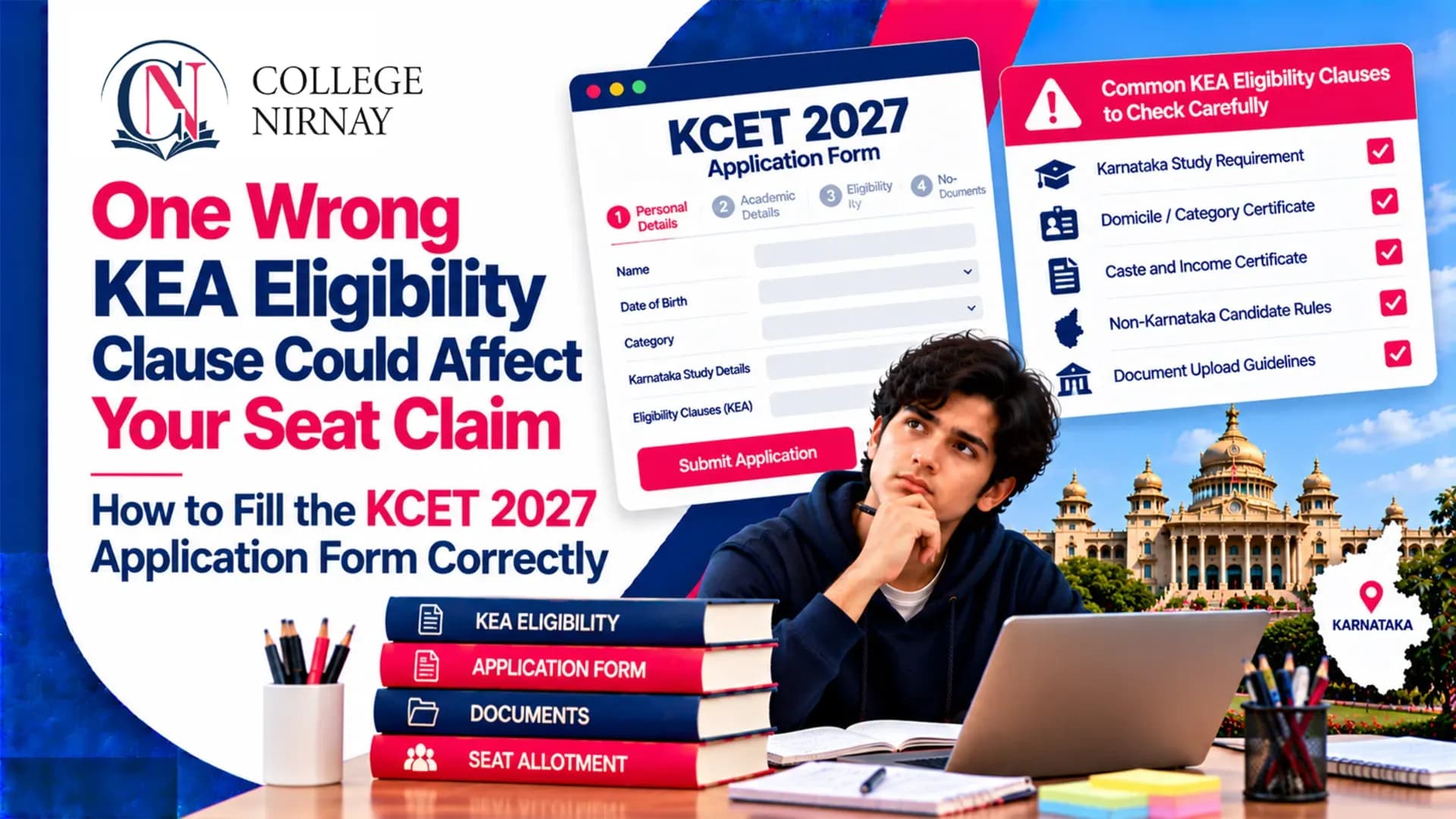
One Wrong KEA Eligibility Clause Could Affect Your Seat Claim: How to Fill the KCET 2027 Application Form Correctly
The KCET 2027 application form is an important step for students seeking admission to Engineering, Pharmacy, Farm Science and other professional courses in Karnataka. However, completing the registration form involves more than entering personal details and paying the examination fee. Candidates seeking government-quota seats must select the appropriate eligibility clause and provide documents supporting their claim. Choosing the wrong KCET KEA eligibility clause can create verification problems and affect the candidate's entitlement to participate in the relevant seat-allotment process.
The Karnataka Examinations Authority (KEA) uses specific eligibility conditions under the Karnataka Selection of Candidates for Admission to Government Seats in Professional Educational Institutions Rules, 2006, as amended. Each KCET eligibility clause has separate requirements relating to schooling, parental education, domicile, language or other recognised circumstances. Candidates must satisfy a complete clause rather than select one based solely on birthplace or family background.
Common KCET application mistakes include choosing Clause A without seven qualifying academic years in Karnataka, selecting Clause B without meeting the parental study requirement or claiming Clause C without the prescribed previous parental domicile and language conditions. Such errors can affect the KCET seat claim, particularly when the application details do not match the documents presented for verification.
The published 2026 process introduced an application-cum-verification system. KEA used SATS records to verify qualifying study details and Revenue Department certificate RD numbers to check applicable reservation information. Consequently, accurate KCET form filling requires candidates to verify their SSLC details, Aadhaar information, study certificates and reservation documents before submission. The required KCET document verification procedure also depends on the eligibility clause and additional claims selected.
The distinction between KCET reservation eligibility and general government-seat eligibility is particularly important. Some candidates may qualify for government seats through a special clause but may not qualify for Karnataka-specific reserved-category benefits. Understanding KEA eligibility rules, the applicable course qualifications and the correct certificate requirements helps prevent unsupported claims during KCET registration 2027.
This detailed Karnataka Common Entrance Test application guide explains the KCET application guide, eligibility-clause selection, registration fees, claim certificates and KCET admission eligibility checks required before completing the form.
What Is the KCET 2027 Application Form and Eligibility Clause?
The KCET 2027 application form will be the online registration document used by KEA for the relevant professional-course admission cycle. Under the published 2026 system, the application also served as an application-cum-verification module, allowing KEA to verify qualifying educational and reservation information through connected government records.
An eligibility clause identifies the rule under which an applicant claims government-seat eligibility. The 2026 bulletin included Clauses A through O and specified additional provisions for certain categories. Candidates had to be Indian citizens and satisfy at least one recognised eligibility clause for ordinary government-quota admission, subject to the applicable exceptions and rules.
Important aspects of KCET registration 2027 include:
- Candidate Registration: Create an account through KEA's authorised examination portal.
- Personal Information: Enter accurate name, date of birth, mobile number, email and identification details.
- Academic Details: Provide the recognised Class 10 and Class 12 or Second PUC information.
- Eligibility Clause: Select the complete clause that matches the candidate's actual educational and family circumstances.
- Reservation Claims: Enter only the categories and benefits supported by valid prescribed certificates.
- Application Fee: Pay the fee applicable to the candidate's category and examination-year rules.
- Claim Verification: Review the application claim certificate and complete any additional verification prescribed by KEA.
Review the KCET form filling requirements before submitting the application. The final 2027 portal instructions and eligibility clauses must be confirmed from KEA.
Why Does Selecting the Correct KEA Eligibility Clause Matter?
Selecting the correct eligibility clause is essential because KEA verifies the candidate's government-seat entitlement using the specific requirements associated with that clause. The 2026 bulletin warned that candidates who failed to satisfy any prescribed clause or could not produce the required original documents would not qualify for government-quota seats.
Correct clause selection helps candidates:
- Identify the appropriate Karnataka government-seat eligibility route.
- Determine whether the candidate's own Karnataka study history satisfies Clause A.
- Understand when parental Karnataka study records are relevant under Clause B.
- Verify special domicile and mother-tongue conditions under Clause C.
- Identify the correct study certificates and supporting documents.
- Understand whether additional verification is necessary.
- Check the reservation benefits permitted for the selected clause.
- Avoid unsupported claims that could affect subsequent seat allotment.
The published 2026 rules also warned that false or incorrect documents supporting an eligibility clause could result in cancellation of an allotted seat and forfeiture of fees. A mistaken selection does not automatically establish deliberate misrepresentation, but candidates must correct inaccuracies through the authorised procedure wherever correction is permitted.
The KCET KEA eligibility clause should therefore match the candidate's actual circumstances and records. Review the KCET admission eligibility rules before finalising a government-seat claim.
Can Choosing the Wrong KCET Eligibility Clause Affect Your Seat Claim?
Yes. An incorrect eligibility-clause declaration may prevent successful document verification or cause the claimed government-seat entitlement to be rejected. The consequences depend on the nature of the discrepancy, the applicable rules and whether KEA permits an authorised correction.
For example, Clause A requires at least seven academic years of recognised Karnataka schooling between Class 1 and Class 12, along with passing either Class 10 or Class 12 within Karnataka. A student who completed only three academic years in Karnataka cannot establish Clause A eligibility merely by producing a Karnataka birth certificate.
Before submitting a KCET seat claim, candidates should ask:
- Does your own study record satisfy the complete eligibility clause?
- Have you correctly counted the qualifying academic years?
- Do your Class 10 and Class 12 records satisfy the relevant location requirements?
- Are parental study certificates required for your selected clause?
- Does a special clause require domicile, language or service-related evidence?
- Are you eligible for the reservation benefit separately claimed?
- Can you produce all the prescribed original certificates during verification?
KEA's 2026 notification also explained that claim verification could produce different outcomes, such as successful verification or a claim remaining unverified. Candidates should not interpret the submission receipt or fee-payment confirmation as proof that their eligibility claim has been approved.
Accurate clause selection protects the integrity of the application and reduces avoidable problems during verification. Applicants should follow KEA's current correction notices if an incorrect clause has already been entered.
KCET Eligibility Clauses A, B, C and D: Which One Should You Select?
The published KEA eligibility rules distinguish candidates according to different study, parental and residence conditions. Applicants should read the full relevant clause rather than select one because its heading or a short summary resembles their circumstances.
Clause A is generally relevant to candidates who completed qualifying Karnataka schooling. Clause B applies to a defined combination of the candidate's Karnataka senior-secondary education and a parent's study history. Clauses C and D cover specified linguistic and residential circumstances, including candidates from outside Karnataka.
The following comparison summarises the published 2026 requirements:
| KEA Eligibility Clause | Published 2026 Requirement |
|---|---|
| Clause A | At least seven qualifying academic years of recognised study in Karnataka from Class 1 to Class 12, including passing either Class 10 or Class 12 in Karnataka. |
| Clause B | Both Classes 11 and 12 completed and passed in Karnataka, with either parent having studied in Karnataka for at least seven years. |
| Clause C / Clause D | Clause C involves prescribed mother-tongue, parental previous Karnataka domicile and outside-state education and residence conditions. Clause D covers specified Kannada-speaking border areas. Both include a Kannada language test. |
The KCET eligibility clause must be supported by the precise documents listed in the applicable bulletin. Other KEA clauses cover qualifying defence, government-service and additional special circumstances and should be reviewed separately where relevant.
A correct clause is the one whose complete requirements the candidate can satisfy and document. It is not necessarily the clause that appears to provide the greatest reservation advantage.
What Happens After You Submit the KCET Eligibility Claim?
The 2026 KEA system used an application-cum-verification model. After candidates submitted the application, information concerning study and reservation claims could be retrieved through government databases. KEA then followed different verification processes according to the clause and additional claims.
Important outcomes included:
- Verified Clause A: Eligible seven-year study records could be confirmed through SATS, allowing the candidate to print the application.
- Additional Reservation Claims: Certain rural, Kannada-medium and minority claims required further college-level document verification.
- Clauses B–O: Candidates were directed to undergo the prescribed KEA verification before printing the completed application.
- Claim Certificate: The portal could indicate whether a claim was verified, not verified or not made.
- Verification Slip: Eligible candidates could access the applicable verification slip during the later admission process.
Candidates should carefully distinguish a submitted claim from a verified claim. The status displayed on the claim certificate provides important information about whether the submitted details have met the applicable verification requirements.
A pending or unsuccessful verification status should be addressed according to current KEA instructions. Candidates should not assume that payment of the application fee automatically changes a claim to successfully verified.
KCET 2027 Application Fee: What Were the Charges in 2026?
The 2027 registration fee must be confirmed when KEA publishes the new examination notification. The published 2026 cycle prescribed different fees according to candidate category and whether the candidate studied within Karnataka, outside Karnataka or resided abroad.
| Candidate Category | KCET 2026 Application Fee |
|---|---|
| Karnataka General Merit, 2A, 2B, 3A and 3B | ₹500. |
| Karnataka SC, ST and Category-1 | ₹250. |
| Female Candidates of Karnataka | ₹250 under the published previous-cycle fee provisions. |
| Candidates Who Studied Outside Karnataka | ₹750 under the published fee classification. |
| Candidates Residing Outside India | ₹5,000. |
The application fee is separate from the government-seat eligibility clause, reservation entitlement and college tuition fees. A candidate who pays the fee applicable to outside-state schooling does not automatically become eligible for Karnataka government-quota seats.
Review the KCET 2027 application form fee information after the current official schedule and payment instructions are released.
How to Fill the KCET 2027 Application Form Correctly
Accurate KCET form filling requires candidates to review eligibility before entering information. The 2026 official process involved online registration, candidate identification, academic records, selection of appropriate claims, application fee payment and verification through the designated systems.
Stage 1: Register Through the Official KEA Portal
Visit https://cetonline.karnataka.gov.in/kea/ and open the official UGCET application when the 2027 link becomes active. Use the candidate's own mobile number and email address. The 2026 bulletin prescribed OTP-based verification and warned candidates to provide accurate contact information.
Stage 2: Enter Personal and Academic Information
Enter the candidate's name, date of birth, SSLC or Class 10 details, qualifying examination information, school history and applicable identification data. Match the spelling of the name against the SSLC marks card, Aadhaar and certificates. If SATS information is available, check whether the displayed academic details are accurate.
Stage 3: Select the Correct Eligibility Clause and Reservation Claims
Choose the clause whose complete requirements are satisfied by the candidate's records. Enter RD numbers for applicable caste, income, non-creamy-layer or Kalyana-Karnataka certificates. Do not make a reservation claim unless the selected eligibility clause permits it and the prescribed documents are available.
Stage 4: Review, Pay and Complete Verification
Check every field before final submission, including the selected clause, study years, category, uploaded photograph, signature and contact information. Complete the authorised online fee payment, retain the receipt and review the claim certificate. Follow the additional verification steps applicable to the displayed status.
The 2026 bulletin instructed candidates to retain multiple copies of the finally submitted application, proof of payment and photographs matching the uploaded image. The timing of application printing depended on completion of the appropriate verification process.
Review the Karnataka Common Entrance Test application process and verify the current portal instructions before submitting your form.
KCET 2027 Documents Required for Registration and Eligibility Verification
The published 2026 CET Diksuchi and information bulletin identified important records that candidates should keep ready for the application-cum-verification process. These included Class 10 marks cards, Aadhaar, a recent photograph, signature, mobile number and email address, along with clause-specific and reservation certificates where applicable.
The following checklist explains the main documents and their purpose:
| Document or Information | Purpose in the Application |
|---|---|
| SSLC / Class 10 Marks Card | Used for personal details, name consistency and relevant educational verification. |
| Aadhaar Card | Used for identification and matching personal details with academic and certificate records. |
| Student Photograph and Signature | Required for the prescribed application upload. The 2026 CET Diksuchi specified JPG files below 50 KB for each. |
| Mobile Number and Email | Used for registration verification, OTP and official communications. |
| Study Certificates and SATS Information | Support the claimed Karnataka academic study history and relevant eligibility clause. |
| Parent's Study or Domicile Certificate | May be required for Clauses B, C or other recognised eligibility circumstances. |
| Caste / Caste-Income Certificate | Supports applicable Karnataka reservation claims and requires the prescribed RD number. |
| Income, NCLC or 371(J) Certificate | Supports applicable fee concessions, rural claims, SNQ or Kalyana-Karnataka benefits. |
| Claim Certificate and Payment Receipt | Records the submitted eligibility and reservation claims, their displayed verification status and payment information. |
The 2026 bulletin required the candidate's name on the SSLC marks card, Aadhaar and applicable caste or caste-income certificates to match. Incorrect names or RD numbers could create problems when KEA attempted electronic verification.
The KCET document verification requirements should be confirmed for the chosen clause and the 2027 portal. Candidates should not rely on a general document list where a particular clause prescribes additional originals or certificates.
What Are SATS and RD Numbers in the KCET Application?
SATS refers to Karnataka's Student Achievement Tracking System. In the 2026 application-cum-verification process, KEA used SATS information to retrieve and verify relevant school study records. RD numbers were used to retrieve applicable certificates through the Karnataka Revenue Department's electronic systems.
Candidates should check:
- Whether the school study record corresponds to the correct student.
- Whether the recorded standards and academic years are accurate.
- Whether the correct Class 10 and Class 12 information appears.
- Whether the applicable caste or income certificate is in the candidate's name.
- Whether the RD number belongs to the intended valid certificate.
- Whether rural or Kannada-medium claims have the required study certificates.
- Whether an NCLC certificate is required for a particular claim.
- Whether the 371(J) certificate is valid when Kalyana-Karnataka benefits are claimed.
- Whether the displayed claim certificate requires further verification.
The presence of an RD number does not automatically establish entitlement to a reservation. The candidate must also satisfy the applicable category rules, eligibility clause and required certificate conditions.
Applicants should verify the information obtained through SATS and RD records, and follow the official correction procedure if a valid record is missing or inconsistent.
Does Every KCET Eligibility Clause Allow Karnataka Reservation Benefits?
No. Eligibility to compete for a government-quota seat and eligibility to claim a reserved category are different conditions. The 2026 information bulletin identified Clauses A, B, F, H, J, K, L and O as the clauses relevant to specified Karnataka caste and category reservations, subject to their detailed conditions.
Important reservation checks include:
- General Government-Seat Eligibility: Requires satisfaction of a recognised qualifying clause.
- SC/ST/Category-1 Claims: Require the applicable certificate and permitted eligibility conditions.
- 2A/2B/3A/3B Claims: Require valid caste-income certificates and relevant income conditions.
- Rural Reservation: Requires the prescribed qualifying rural study records and, where applicable, an NCLC certificate.
- Kannada-Medium Reservation: Requires the specified Kannada-medium study history and certificate.
- Kalyana-Karnataka Benefits: Require compliance with the relevant Article 371(J) conditions and prescribed RD-based certificate.
- Special Clauses: Eligibility under Clauses C or D does not automatically create entitlement to Karnataka caste-reservation benefits.
- Document Verification: The candidate must satisfy both the selected government-seat clause and the separate reservation requirements.
This distinction is central to KCET reservation eligibility. An applicant should not select a different clause merely to claim a reservation unavailable under the clause that actually matches their educational or parental circumstances.
The appropriate KCET seat claim must reflect the real eligibility position and valid supporting certificates. Fee concessions, reservation benefits and government-quota admission should not be treated as identical entitlements.
How to Avoid Wrong Eligibility-Clause Selection in KCET 2027
The best way to avoid clause-related errors is to complete a document-based eligibility check before registration. Candidates should identify a valid clause first and then enter the details required by the application instead of choosing a clause based only on assumed eligibility.
| Verification Stage | Recommended Action |
|---|---|
| Review Your Study History | List the state, institution and academic year for every class from Class 1 to Class 12. |
| Match the Eligibility Clause | Compare the full requirements of the relevant KEA clause with the candidate's actual educational and family records. |
| Prepare Supporting Certificates | Collect study, parental, domicile, mother-tongue or service-related certificates required for the chosen clause. |
| Verify Reservation Claims | Check the clause's reservation eligibility and validate applicable RD numbers and category certificates. |
| Review Claim Status | Inspect the application-cum-verification claim certificate and complete any additional verification prescribed by KEA. |
The process helps candidates prevent KCET application mistakes, including incorrect academic-year counts, unsupported parental claims and mismatched certificate details. Where uncertainty remains, applicants should seek clarification from KEA through the official channels before relying on a particular clause.
Review the KCET application guide and current eligibility instructions before final submission.
What Should You Do If You Selected the Wrong KCET Eligibility Clause?
Candidates who discover an incorrect clause should first review the submitted application and claim certificate. The 2026 registration cycle included an online correction facility for certain application details, but the availability, editable fields and deadlines of the 2027 correction process have not been confirmed.
Follow these six steps:
- Identify the incorrect eligibility clause or supporting information.
- Review the complete requirements of the clause that actually matches your records.
- Check the current official KEA correction notice and candidate portal.
- Make corrections only through the authorised facility where the relevant field is editable.
- Complete any additional document verification or official clarification procedure required by KEA.
- Recheck the updated claim certificate or verification status and preserve the relevant records.
Candidates should not assume that every clause or reservation claim can be changed after the application deadline. The scope of correction depends on the examination-year rules and the status of verification.
Do not submit false certificates, alter study histories or create duplicate applications as an informal workaround. Follow the procedure authorised by KEA for the particular discrepancy.
Does KCET Application Submission Guarantee Government-Quota Eligibility?
No. Registration, payment of the examination fee and generation of an application record do not independently establish the candidate's eligibility for Karnataka government seats. Under the published 2026 rules, the candidate had to satisfy a recognised clause and complete the prescribed verification process.
A candidate may submit the application successfully but still need college-level or KEA verification. Another candidate may have study records verified electronically yet require additional verification for rural, Kannada-medium, category or other special benefits.
The correct sequence is:
Verify Course Eligibility → Identify the Correct KEA Clause → Prepare Academic and Category Documents → Register Online → Enter Accurate Claims → Pay the Fee → Review Claim Certificate → Complete Required Verification → Follow Eligible Seat-Allotment Procedures
Admission also depends on the applicable examination rank, qualifying marks, seat matrix, option entry and counselling rules. A verified eligibility claim does not guarantee a seat in a preferred institution or programme.
Eight KCET Application Mistakes That Could Affect Your Eligibility Claim
- Selecting Clause A without seven academic years: The requirement involves qualifying Karnataka study years and passing Class 10 or Class 12 in the state.
- Choosing Clause B based only on parental education: The candidate must also complete and pass both Classes 11 and 12 in Karnataka.
- Claiming Clause C without complete evidence: Previous parental domicile, specified mother tongue and outside-state conditions must all be met.
- Entering incorrect SATS information: Mismatched academic records may prevent successful electronic study verification.
- Entering an incorrect RD number: Reservation certificates must correspond to the prescribed valid records and applicant.
- Claiming a reservation unavailable under the clause: Government-seat eligibility and Karnataka category benefits are not identical.
- Assuming payment confirms eligibility: A receipt does not replace verification of study, domicile or category claims.
- Ignoring current correction and verification notices: Applicants must follow the applicable KEA instructions and deadlines.
Understanding these KCET application mistakes can help candidates avoid unsupported declarations and protect the accuracy of the KCET seat claim. The correct response to an error is to seek an authorised correction, not to modify documents to fit a chosen clause.
Check the full KEA eligibility rules and keep the current application instructions available throughout registration and verification.
How to Complete KCET Registration Safely in Three Stages
A three-stage verification approach can help candidates organise their preparation before the registration portal opens. The stages below are educational recommendations, not a substitute for KEA's official registration sequence.
| Preparation Stage | Recommended Action |
|---|---|
| Stage 1: Eligibility and Document Review | Check academic qualifications, study years, the applicable KEA clause and all supporting certificates. |
| Stage 2: Accurate Application Submission | Enter personal, academic, eligibility and reservation details carefully, then complete the prescribed online fee payment. |
| Stage 3: Claim and Document Verification | Review the claim certificate and complete any electronic, college-level or KEA verification required for the selected claims. |
Candidates with complex eligibility circumstances should gather supporting records before application submission. For example, a Clause C applicant may require several separate certificates establishing language, previous parental domicile and outside-state residence.
This approach reduces avoidable registration errors but does not replace individual eligibility determination by KEA.
7-Day KCET 2027 Application Preparation Checklist
| Day | Recommended Task |
|---|---|
| Day 1 | Read the latest KEA UGCET information bulletin and identify the courses you intend to pursue. |
| Day 2 | Prepare a complete Class 1 to Class 12 study history and identify the relevant eligibility clause. |
| Day 3 | Check SSLC, Aadhaar, SATS and qualifying examination details for consistency. |
| Day 4 | Verify the applicable reservation, RD, income, NCLC or special-category records. |
| Day 5 | Prepare the prescribed photograph, signature, contact details and application fee. |
| Day 6 | When registration is open, complete the authorised application and review all entries before submission. |
| Day 7 | Check the claim certificate and complete any outstanding verification according to KEA's schedule. |
This is an illustrative preparation plan, not an official seven-day application schedule. Applicants must follow the actual 2027 registration, fee-payment, correction and verification deadlines.
KCET 2027 Application Form and Eligibility Clause: Quick Summary
| Common Question | Answer Based on Published 2026 Rules |
|---|---|
| Does selecting the wrong eligibility clause affect admission? | An unsupported clause can prevent verification or affect government-seat eligibility; false or incorrect documents may lead to cancellation. |
| What is Clause A? | At least seven qualifying academic years in Karnataka, including passing Class 10 or Class 12 in the state. |
| How are study and reservation claims checked? | The 2026 application-cum-verification system used SATS data and applicable RD-number-based Revenue Department records. |
| Is fee payment proof of eligibility? | No. Application fee payment does not establish approval of the eligibility clause or reservation claim. |
| Can incorrect information be corrected? | The 2026 cycle provided an online correction facility for certain fields. The 2027 correction rules and deadlines are not yet confirmed. |
| Are the KCET 2027 application dates final? | Applicants should wait for an authenticated KEA 2027 notification and application schedule. |
Frequently Asked Questions on KCET 2027 Application Form and Eligibility Clauses
What happens if I select the wrong eligibility clause in KCET 2027?
An incorrect KCET KEA eligibility clause may affect verification of the candidate's government-seat entitlement. The consequences depend on the discrepancy and KEA's applicable rules. If the claim is incorrect, follow the authorised correction or clarification procedure rather than submit unsupported documents.
How do I choose the correct KCET eligibility clause?
Compare your Class 1 to Class 12 education, qualifying examination, parental records and special circumstances with the full official clause requirements. The correct KCET eligibility clause is one whose conditions you actually satisfy and can support using the prescribed certificates.
What is a claim certificate in the KCET application process?
Under the 2026 application-cum-verification system, the claim certificate recorded the candidate's submitted eligibility and reservation claims and their verification status. Additional KCET document verification could be required depending on the selected clause and claims.
Can I correct the KCET eligibility clause after submitting the application?
The 2026 registration cycle provided an online correction facility for certain application information. However, a 2027 correction window and the fields that will be editable have not been confirmed. Candidates should check the current KEA instructions and request clarification for any unsupported clause selection.
Does every eligibility clause qualify for Karnataka reservation benefits?
No. KCET reservation eligibility depends on the applicable clause and separate reservation rules. The published 2026 bulletin associated specified category reservations with Clauses A, B, F, H, J, K, L and O. Other clauses may establish government-seat eligibility without automatically providing those benefits.
What was the KCET application fee in 2026?
The 2026 fee was ₹500 for specified Karnataka General Merit and OBC candidates, ₹250 for Karnataka SC/ST/Category-1 and female candidates, ₹750 for candidates who studied outside Karnataka and ₹5,000 for candidates residing outside India. The final 2027 fees must be confirmed separately.
Where can I check KCET 2027 registration and eligibility FAQs?
Review the Karnataka Common Entrance Test application FAQs for registration, eligibility clauses, payment and documents. The current KEA bulletin remains the final authority for KCET registration 2027.
Final Answer: How Can You Avoid a Wrong KCET 2027 Eligibility-Clause Claim?
The most effective way to avoid an incorrect KCET government-seat claim is to identify the applicable eligibility clause before completing registration. Candidates should compare their study history, Class 10 and 12 records, parental circumstances and supporting certificates with the complete clause requirements.
The published 2026 application process used an application-cum-verification system, supported by SATS and RD-number-based records. Applicants were required to review their claim certificates and complete additional verification where the selected clause or reservation category required it.
A submitted form and successful fee payment do not guarantee eligibility. Candidates must also satisfy the applicable government-seat clause, academic qualifications, reservation conditions where claimed and counselling requirements.
Applicants who identify a mistake should follow KEA's official correction or clarification process. They should not assume that all eligibility fields can be changed after submission, nor should they present altered documents to support an incorrect claim.
For accurate KCET 2027 application form submission, verify the relevant KCET admission eligibility and complete the required KCET document verification. A well-supported eligibility claim helps applicants participate in the correct admission process, although final seat allotment remains subject to the rules, rank, options and seat availability.