
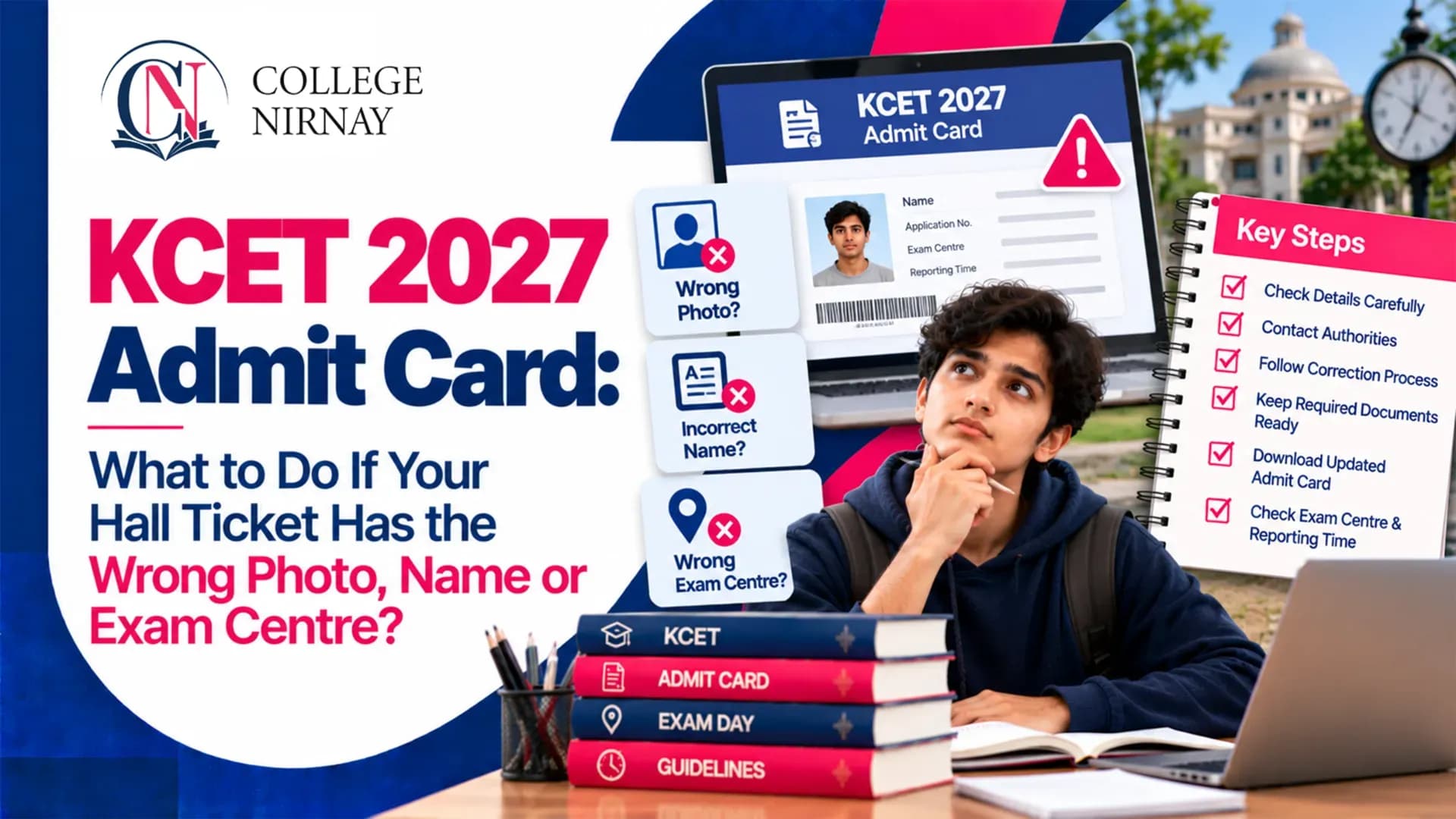
KCET 2027 Admit Card: Why Your Kannada Language Test Details May Matter as Much as Your Exam Centre
The KCET 2027 admit card will be an essential examination document for candidates appearing in the Karnataka Common Entrance Test, conducted by the Karnataka Examinations Authority (KEA). Although most applicants focus on their allotted examination venue, some candidates must also check whether they are required to appear for the Kannada Language Test. Missing this additional examination can affect eligibility for government-seat consideration under the applicable KEA clauses.
The KCET admit card 2027 release date, examination schedule and detailed entry instructions will be announced through KEA's official portal. During the 2026 cycle, admission tickets were scheduled for downloading from 10 April 2026, the Kannada Language Test was held on 22 April, and the main entrance examinations followed on 23 and 24 April. These are previous-year dates, not confirmed dates for 2027.
The KCET Kannada Language Test was prescribed for certain Horanadu and Gadinadu Kannadiga candidates claiming government-seat eligibility. Under the 2026 rules, the test was conducted at the Class 4 level, carried 50 marks and required at least 12 marks to qualify. Candidates should verify the applicable KCET Kannada test details before making travel arrangements because the Kannada test and the main KCET papers follow separate schedules.
Checking the allotted KCET exam centre is equally important. In 2026, candidates required to take the Kannada Language Test also had to appear for the main entrance examination at designated centres in Bengaluru, Belagavi, Vijayapura or Mangaluru. The KCET hall ticket and subsequent official notices should therefore be reviewed for the exact venue, examination date and applicable KCET reporting time.
Important KCET admit card details generally include the candidate's identity, examination information, allotted centre and instructions. Applicants should verify their KCET candidate details, read the KCET exam day instructions and confirm any additional test requirements associated with their eligibility clause. The distinction between ordinary entrance-test papers and KCET language test eligibility is especially important for candidates applying through Clauses C and D.
This detailed Karnataka Common Entrance Test admit card guide explains hall-ticket downloading, Kannada-test rules, KCET exam centre details, document verification and steps to avoid examination-day difficulties.
What Is the KCET 2027 Admit Card and Why Is It Important?
The KCET 2027 admit card will be the official admission ticket issued through KEA's authorised candidate portal for the relevant examination cycle. It provides information needed to identify the candidate and attend the scheduled examination. The published 2026 information bulletin instructed candidates to preserve their admission tickets until admission to a college or institution was completed.
Candidates should download the document themselves through the official portal and verify its contents. In the 2026 cycle, admission tickets were issued online from 10 April. The final 2027 download date and login requirements must be confirmed through a new notification rather than assumed from the previous year's schedule.
Important KCET Kannada test details and hall-ticket checks include:
- Candidate Identity: Check the candidate's name, photograph and identification information.
- Examination Number: Verify the application or CET number displayed on the authorised document.
- Subject Papers: Confirm the Physics, Chemistry, Mathematics or Biology examinations applicable to the selected courses.
- Examination Date: Read the date assigned to each relevant subject paper.
- Examination Venue: Verify the exact centre name and complete address.
- Reporting Instructions: Check the reporting or entry timing communicated by KEA.
- Additional Language Test: Confirm whether the selected eligibility clause requires a separate Kannada Language Test.
Review the KCET hall ticket information before planning travel or final examination preparation.
Why Should Candidates Check Kannada Language Test Eligibility?
The Kannada Language Test is an additional qualifying requirement for candidates applying through certain Horanadu and Gadinadu Kannadiga eligibility provisions. It is not a compulsory language examination for every KCET applicant. Candidates should determine whether the requirement applies to their own KEA eligibility clause before assuming that they must attend it.
Checking KCET language test eligibility helps candidates:
- Identify whether Clause C or Clause D applies to their government-seat claim.
- Check whether the prescribed Kannada Language Test is compulsory.
- Understand the previous-cycle qualifying-mark requirement.
- Determine whether a recognised ten-year Kannada-medium exemption applies.
- Verify the permitted Kannada Language Test cities.
- Check restrictions on the main KCET examination-city allocation.
- Prepare the language, domicile and study records required for the claim.
- Avoid missing a compulsory examination or relying on an unsupported exemption.
The official 2026 information bulletin required relevant candidates to demonstrate their ability to speak, read and write Kannada. Those required to take the test had to obtain a minimum of 12 out of 50 marks to be considered for rank assignment and subsequent seat allotment under the applicable provisions.
Understanding the KCET Kannada Language Test requirement is therefore an eligibility matter as well as an examination-scheduling matter. Candidates should verify it before travelling to their allocated centres.
Who Must Appear for the KCET Kannada Language Test?
Under the 2026 KEA bulletin, candidates claiming eligibility through the relevant Horanadu and Gadinadu Kannadiga provisions had to take the Kannada Language Test, except where the published exemption applied. The principal provisions concerned Clause C and Clause D.
Clause C applied to specified candidates who completed their qualifying examination outside Karnataka and satisfied the prescribed mother-tongue, parental previous Karnataka domicile and outside-state residence conditions. Clause D applied to qualifying candidates from specified Kannada-speaking border areas. Both clauses included the Kannada Language Test requirement.
Before deciding whether to attend the test, ask:
- Have you selected an eligibility clause requiring the Kannada Language Test?
- Are you claiming eligibility as a Horanadu or Gadinadu Kannadiga?
- Does your mother-tongue declaration satisfy the prescribed clause?
- Do you have the relevant parental domicile or border-area study records?
- Have you completed ten full academic years in Kannada medium outside Karnataka?
- Can you produce the prescribed certificate supporting an exemption, if claimed?
- Have you confirmed your status through the current KEA instructions?
The 2026 bulletin specifically exempted qualifying Horanadu and Gadinadu Kannadiga candidates, including those under Clause N, who had studied ten full academic years in Kannada medium from Class 1 through Class 10 outside Karnataka. Candidates should not assume that ordinary knowledge of Kannada or speaking Kannada at home establishes the same exemption.
A Kannada Language Test exemption must be supported by the requirements prescribed for the relevant eligibility clause. The final 2027 provisions may be updated.
KCET Kannada Language Test vs Main Entrance Exam: Important Differences
The Kannada Language Test and the main KCET examinations serve different purposes. The Kannada test establishes the required language qualification for candidates under the applicable clauses, while the main KCET papers assess the academic subjects relevant to professional-course admission.
The official 2026 bulletin scheduled the Kannada Language Test on 22 April, followed by Physics and Chemistry on 23 April and Mathematics and Biology on 24 April. These dates illustrate the importance of checking the complete candidate-specific timetable instead of focusing on a single examination date.
The main differences are:
| Examination Feature | Published KCET 2026 Position |
|---|---|
| Kannada Language Test | Held on 22 April 2026, 10:30 AM–11:30 AM; Class 4 level, maximum 50 marks and minimum qualifying score of 12. |
| Main KCET Papers | Physics and Chemistry on 23 April; Mathematics and Biology on 24 April, with each subject carrying 60 questions. |
| Purpose and Centre Restrictions | The Kannada test was a qualifying eligibility requirement for specified candidates. Those candidates were restricted to four designated cities for the Kannada test and main KCET. |
The published KCET Kannada test details demonstrate that a candidate may need to account for an additional examination day. The language test should not be confused with an ordinary KCET subject paper or a general Kannada-medium reservation certificate.
Review the KCET admit card 2027 release information and check KEA's latest examination-year timetable.
Which KCET Examination Centres Were Available for the Kannada Language Test?
The official 2026 UGCET bulletin limited the Kannada Language Test to four designated Karnataka cities: Bengaluru, Belagavi, Vijayapura and Mangaluru. Candidates required to take the Kannada test also had to appear for their main KCET examinations at centres located in these cities.
This was an important restriction for candidates whose usual residence was in another state. Choosing a convenient main-exam venue outside the permitted cities could conflict with the location requirement associated with the Kannada Language Test.
Important centre-planning checks include:
- Bengaluru: One of the four designated 2026 Kannada-test cities.
- Belagavi: A designated centre city under the published language-test schedule.
- Vijayapura: Listed as Bijapura or Vijayapura in the official English document.
- Mangaluru: Listed as Mangalore in the published English bulletin.
- Main KCET Restriction: Kannada-test candidates were required to attend the main entrance examination within these designated city options.
The city name alone does not identify the actual examination building. Candidates must check the authorised institution name, complete address and reporting instructions appearing on their admission ticket or official centre notice.
The final KCET exam centre allocation for 2027 must be verified through KEA. Do not assume that the four-city arrangement or a particular venue will remain unchanged.
KCET 2026 Reference Schedule: Kannada Test, Physics, Chemistry, Mathematics and Biology
The previous examination cycle illustrates why candidates must review all relevant examination dates. For some candidates, the Kannada Language Test was held one day before the first main KCET examination paper.
| 2026 Examination Session | Official Schedule and Details |
|---|---|
| Admission-Ticket Download | Available from 11:00 AM on 10 April 2026, according to the published calendar. |
| Kannada Language Test | 22 April 2026, 10:30 AM–11:30 AM, for qualifying candidates required to attend. |
| Physics | 23 April 2026, 10:30 AM–11:50 AM; 60 marks/questions. |
| Chemistry | 23 April 2026, 2:30 PM–3:50 PM; 60 marks/questions. |
| Mathematics | 24 April 2026, 10:30 AM–11:50 AM; 60 marks/questions. |
Biology was scheduled separately on 24 April 2026 from 2:30 PM to 3:50 PM and also carried 60 questions. Candidates were required to attend the subject papers relevant to their selected courses.
These are historical timings and must not be used as the official 2027 schedule. The exact KCET reporting time and entry instructions must be taken from the current admission ticket and official notices.
How to Download the KCET 2027 Admit Card and Verify Kannada Test Details
The KCET admit card 2027 should be obtained only through the authorised KEA website or its official candidate-login facility. During the previous cycle, KEA made admission tickets available online. Candidates were advised to check the information carefully and preserve their documents for subsequent admission procedures.
Stage 1: Visit the Official KEA Website
Open https://cetonline.karnataka.gov.in/kea/ and locate the UGCET 2027 admission-ticket notification when it is published. Follow the official link instead of relying on forwarded messages or unofficial websites claiming to provide early access.
Stage 2: Open the Candidate Login
Enter the application number, password or other credentials requested by the current portal. The previous-cycle process used candidate login to access the admission ticket. Candidates should not share passwords, OTPs or personal records with unauthorised intermediaries.
Stage 3: Check Main Exam and Kannada Test Information
Verify the candidate's identity, examination subjects, assigned centre and relevant dates. Candidates under the prescribed language-test clauses must also check the separate Kannada test schedule and confirm how KEA communicates the applicable language-test venue and entry instructions.
Stage 4: Download, Print and Preserve the Document
Download the authorised admission ticket and print a legible copy. Preserve the electronic version and follow any additional instructions about original identification, photographs, allowed stationery or supplementary examination documents.
If the hall ticket does not show an expected Kannada test entry, do not assume either that the test is waived or that a separate admission ticket will automatically be issued. Check the eligibility clause, official schedule and candidate-specific directions, and seek clarification through KEA if necessary.
Review the KCET hall ticket download guidance and use only KEA's official instructions for the 2027 cycle.
KCET 2027 Hall Ticket Verification Checklist
Candidates should verify the admission ticket immediately after downloading it. A last-minute discrepancy involving an examination centre, candidate identity or additional Kannada test requirement may be more difficult to resolve close to the examination date.
Use the following checklist to organise KCET admit card details and supplementary examination information:
| Verification Item | What Candidates Should Check |
|---|---|
| Candidate's Name and Identity | Confirm spelling and identifying information against the registered application and official records. |
| Application / CET Number | Check the examination or application identifier associated with the correct candidate. |
| Photograph and Personal Details | Verify the displayed photograph and relevant identity information. |
| Main KCET Subjects | Identify the Physics, Chemistry, Mathematics and/or Biology sessions that apply to the selected courses. |
| Examination Dates | Confirm every subject's final official date and check for amendments to the original schedule. |
| Centre Name and Address | Check the exact allotted institution and location rather than relying only on the examination city. |
| Kannada Language Test | For applicable candidates, verify the language-test requirement, date, location and any special ticket instructions. |
| Reporting and Entry Rules | Read the candidate-specific reporting, entry, identification and permitted-material instructions. |
| Official Updates | Check the KEA website for changes in examination venue, timing or test-related eligibility directions. |
The published bulletin confirms the main language-test conditions, but the exact field names displayed on the 2027 admission ticket must be verified when that ticket is released. This checklist is therefore guidance for checking the document, not a representation of an already-issued 2027 hall ticket.
Read the KCET candidate details carefully and report any apparent discrepancy through the current authorised process.
Which Documents May Be Needed for KCET and the Kannada Language Test?
Candidates should distinguish documents needed for entering the examination hall from those required to establish eligibility under a Kannada-language clause. The precise examination-entry documents must be taken from the current KEA admission ticket and any separate instructions.
Prepare and verify the following:
- The official KCET admission ticket downloaded from KEA.
- Accepted original photo identification as specified in the current examination instructions.
- Any additional photograph required by KEA for identity verification.
- Application and eligibility-clause information for reference.
- Original study certificates supporting the selected eligibility clause.
- Parental previous Karnataka domicile records where Clause C applies.
- Mother-tongue declaration and supporting records where required.
- Ten-year Kannada-medium study records where a language-test exemption is claimed.
- Other documents expressly required for the examination or later verification.
The published 2026 bulletin prescribed particular documents for Clauses C, D and N, including school records, domicile or residential evidence and certificates supporting the relevant mother-tongue or Kannada-medium study conditions.
Not all eligibility-verification certificates necessarily need to be carried inside the examination hall. Candidates should follow the separate examination-entry and document-verification instructions rather than assume that every certificate is required at the test venue.
How to Avoid Confusion About Kannada Test Venues and KCET Reporting Time
Candidates required to attend the Kannada Language Test should plan their travel around both the language test and the applicable main KCET examinations. The 2026 bulletin restricted qualifying candidates to designated cities and scheduled the language test one day before the main examination began.
Useful preparation steps include:
- Check whether the Kannada Language Test is compulsory under the selected clause.
- Read the officially published language-test date and time.
- Confirm the designated test city and actual centre address.
- Check whether the main KCET centre must be in the same permitted city group.
- Verify each main-examination subject and session.
- Confirm the official reporting time and any gate-entry deadline.
- Plan accommodation or transportation if travelling from another state.
- Check official notices for any change in examination venue or schedule.
The KCET exam centre details should be read directly from the admission ticket or authorised KEA instructions. A language-test city is not sufficient to identify the precise examination building, and the location of the main KCET paper should not be guessed from an older schedule.
The KCET reporting time must come from the current official instructions. Candidates should plan additional travel time but should not treat a general recommendation to arrive early as an official reporting-time announcement.
What to Do if Your Kannada Language Test Information Appears Missing or Incorrect
Candidates should not assume that missing Kannada-test information proves that they are exempt. The requirement depends on the selected eligibility clause and the conditions prescribed by KEA. If the candidate's application indicates Clause C or D, the current official instructions must be checked for the applicable examination and exemption procedure.
| Potential Problem | Recommended Response |
|---|---|
| Expected Kannada Test Entry Is Missing | Check the applicable eligibility clause and official language-test instructions. Ask KEA whether a separate document or schedule applies. |
| Incorrect Test City or Centre | Verify the official centre allotment and report the discrepancy through the authorised KEA process before travelling. |
| Unclear Kannada-Medium Exemption | Review the ten-year Kannada-medium study requirements and supporting certificates. Obtain official confirmation rather than self-declaring an exemption. |
| Candidate Identity Does Not Match | Compare the hall ticket with the submitted application and academic records, then follow the official discrepancy procedure. |
| Download or Login Failure | Use the official portal and its authorised login-recovery or technical-help procedure. Avoid unofficial links requesting credentials. |
The published 2026 bulletin required candidates under the relevant Horanadu and Gadinadu Kannadiga provisions to satisfy the applicable Kannada-test qualification unless an authorised exemption applied. Candidates should resolve uncertainty before the scheduled language examination.
Review the KCET admit card details and discrepancy guidance before contacting the examination authority.
How Should Candidates Respond to a KCET Admit Card Error?
A genuine discrepancy involving identity, centre allocation or additional examination requirements should be addressed through KEA's authorised communication or correction procedure. Candidates should preserve the original downloaded document rather than make their own alterations.
Follow these six steps:
- Download and preserve the original admission-ticket file.
- Identify the exact entry or instruction that appears incorrect.
- Compare the information with the submitted application and eligibility-clause records.
- Review KEA's current notices for a correction, helpdesk or clarification process.
- Submit an authorised enquiry or correction request with the prescribed supporting documents.
- Recheck the official admission ticket and timetable after receiving any approved correction.
An enquiry does not automatically authorise a change of examination centre or eligibility clause. Candidates should follow only the instruction or revised document officially issued by KEA.
If the Kannada Language Test is required, do not ignore the examination while an enquiry remains unresolved unless KEA expressly confirms an exemption or alternative arrangement.
Can You Attend KCET Without Confirming Your Kannada Language Test Requirement?
A candidate should not assume that attendance in the main KCET examination alone satisfies every condition attached to a special eligibility clause. Under the 2026 rules, relevant Clause C and D candidates had to pass the Kannada Language Test to be considered for the assignment of ranks and allotment of seats, unless the applicable exemption requirements were fulfilled.
Similarly, merely attending the Kannada test does not replace the compulsory subject papers or other academic and government-seat eligibility conditions. Candidates must follow every examination and verification requirement relevant to the admission route they claim.
A reliable preparation sequence is:
Confirm KEA Eligibility Clause → Check Language-Test Requirement → Verify Any Exemption → Download Admission Ticket → Check Test Dates and Centres → Read Entry Instructions → Attend Required Examinations → Complete Admission Verification
The exact 2027 rules, including any change in testing or exemption procedures, must be checked through the current official information bulletin.
Common KCET Admit Card and Kannada Language Test Mistakes to Avoid
- Assuming every candidate must take the Kannada Language Test: The requirement applies to specified eligibility clauses and circumstances.
- Ignoring a compulsory language test: Candidates under the relevant clauses may be unable to secure rank assignment or seat allotment without satisfying the test requirement.
- Claiming an exemption without qualifying study records: The published exemption requires the prescribed ten full years of Kannada-medium study.
- Confusing the language test with a main KCET paper: The Kannada test has a separate purpose, qualifying marks and schedule.
- Ignoring centre-city restrictions: The 2026 bulletin required relevant candidates to take the main KCET in one of four designated cities.
- Using old reporting times: The examination-year admission ticket and official notices determine the correct timing.
- Trusting unofficial hall-ticket links: Use KEA's authorised website and protect application credentials.
- Failing to check identity and venue details: Verify the downloaded document and seek official clarification where needed.
Avoiding these mistakes helps candidates follow the KCET exam day instructions and understand the importance of checking both KCET exam centre details and additional language-test requirements.
Students should prepare according to the latest official bulletin and avoid making assumptions about language-test exemptions or allotted examination centres.
How to Complete KCET Admit Card Verification in Three Stages
A structured verification process can help candidates avoid overlooking important information when the admission ticket is released. These stages are practical recommendations and not an official KEA correction schedule.
| Verification Stage | Recommended Action |
|---|---|
| Stage 1: Identity and Examination Information | Download the official admission ticket and check the candidate's identity, subjects, dates and allotted centre. |
| Stage 2: Language-Test Requirement | Review the selected eligibility clause, Kannada-test conditions, qualifying marks and any applicable study-based exemption. |
| Stage 3: Travel and Entry Readiness | Verify exact venues, reporting instructions, required documents and the current official timetable before travelling. |
Candidates should immediately address any material discrepancy rather than postpone an enquiry until the final preparation stage.
The current KEA admission ticket and official notices remain authoritative for individual examination requirements.
7-Day KCET 2027 Admit Card and Kannada Language Test Preparation Checklist
| Day | Recommended Task |
|---|---|
| Day 1 | Check the latest official KEA timetable and admission-ticket release notice. |
| Day 2 | Verify the eligibility clause and determine whether the Kannada Language Test applies. |
| Day 3 | Download the hall ticket when available and check all candidate information. |
| Day 4 | Confirm the main KCET subjects, Kannada-test date where applicable and venue details. |
| Day 5 | Prepare the officially prescribed entry documents and relevant eligibility records. |
| Day 6 | Review reporting instructions and arrange travel or accommodation if needed. |
| Day 7 | Check the official website for changes and organise the documents for every required examination session. |
This is an illustrative checklist, not a claim that KEA will release the 2027 hall ticket exactly seven days before the examination. Candidates should follow the actual official schedule.
KCET 2027 Admit Card and Kannada Language Test: Quick Summary
| Common Question | Answer Based on Published 2026 Rules |
|---|---|
| When was the KCET 2026 hall ticket released? | Admission-ticket downloading began on 10 April 2026 under the official calendar. |
| Who had to take the Kannada Language Test? | Specified Horanadu and Gadinadu Kannadiga candidates under the applicable clauses, subject to a recognised exemption. |
| What were the qualifying marks? | A minimum of 12 out of 50 marks in a Class 4-level Kannada Language Test. |
| Where was the Kannada test held? | Bengaluru, Belagavi, Vijayapura and Mangaluru under the published 2026 rules. |
| Was an exemption available? | Yes, under prescribed conditions for ten full years of Kannada-medium education outside Karnataka. |
| Are the KCET 2027 dates confirmed? | The official 2027 hall-ticket and Kannada-test schedule must be verified when KEA publishes them. |
Frequently Asked Questions on KCET 2027 Admit Card and Kannada Language Test
When will the KCET 2027 admit card be released?
The official KCET 2027 admit card release date has not yet been confirmed. In 2026, admission-ticket downloading began on 10 April, before the main examinations on 23 and 24 April. Candidates should check KEA's official portal for the new schedule.
Is the Kannada Language Test compulsory for every KCET candidate?
No. The KCET Kannada Language Test applies to candidates claiming government-seat eligibility under specified Horanadu and Gadinadu Kannadiga clauses, subject to the published exemption conditions. Ordinary KCET applicants should not assume that the language test is compulsory for everyone.
What are the passing marks for the Kannada Language Test?
Under the 2026 rules, the Kannada Language Test carried 50 marks and required at least 12 marks to qualify. It was conducted at the Class 4 level. These are previous-year KCET Kannada test details; the final 2027 rules must be checked separately.
Where will the KCET Kannada Language Test be conducted?
In 2026, the Kannada Language Test was held in Bengaluru, Belagavi, Vijayapura and Mangaluru. Applicable candidates were also required to appear for the main KCET examinations within these designated cities. The final 2027 KCET exam centre arrangements must be confirmed through KEA.
Can candidates be exempted from the Kannada Language Test?
The 2026 bulletin provided an exemption for qualifying Horanadu and Gadinadu Kannadiga candidates, including Clause N candidates, who studied ten full academic years in Kannada medium from Classes 1–10 outside Karnataka. The prescribed study records must support any exemption claim.
What if Kannada test details are missing from my KCET hall ticket?
Check the applicable eligibility clause and current official KEA notices. Do not assume that missing information automatically means exemption. Use the authorised helpdesk or clarification procedure to determine whether a separate test document or additional instruction applies.
Where can I check KCET 2027 admit card and examination FAQs?
Review the Karnataka Common Entrance Test admit card FAQs for hall-ticket downloading, language-test requirements, exam centres and candidate instructions. The official KEA information bulletin remains the final authority.
Final Answer: Why Do Kannada Test Details Matter for the KCET 2027 Admit Card?
The Kannada Language Test can be an important eligibility requirement for candidates applying through specified Horanadu and Gadinadu Kannadiga clauses. Under the published 2026 rules, relevant candidates had to qualify in the language test unless an authorised exemption applied.
The 2026 examination was conducted at the Class 4 level for 50 marks, with a minimum qualifying score of 12. The test took place on 22 April, while the main KCET examinations were scheduled for 23 and 24 April.
KEA restricted language-test candidates to designated examination cities and required them to attend the main entrance examination in those permitted cities. As a result, verifying the language-test requirement, examination centre and candidate-specific timing was essential.
Candidates should carefully check their eligibility clause and any relevant Kannada-medium exemption before assuming that the additional language examination applies or does not apply to them. They should also verify their identity, downloaded admission ticket, subject papers and official entry instructions.
For the KCET 2027 admit card, the most important preparation step is to verify the complete examination requirements rather than focus only on the main test centre. Review the KCET language test eligibility conditions, official timetable and current KCET exam day instructions before travelling. The dedicated 2027 KEA bulletin will determine the final arrangements.