TG EAPCET 2027 Exam Pattern: Check Expected 160 Questions, Engineering and Agriculture & Pharmacy Papers, Marks and Duration
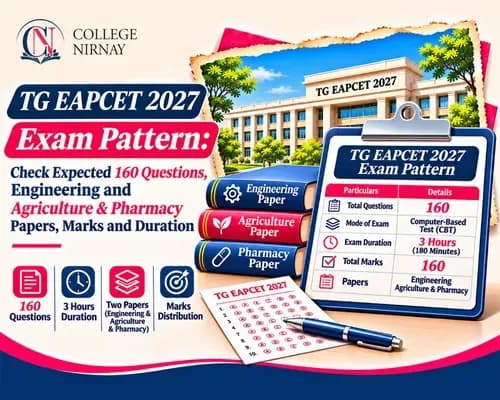
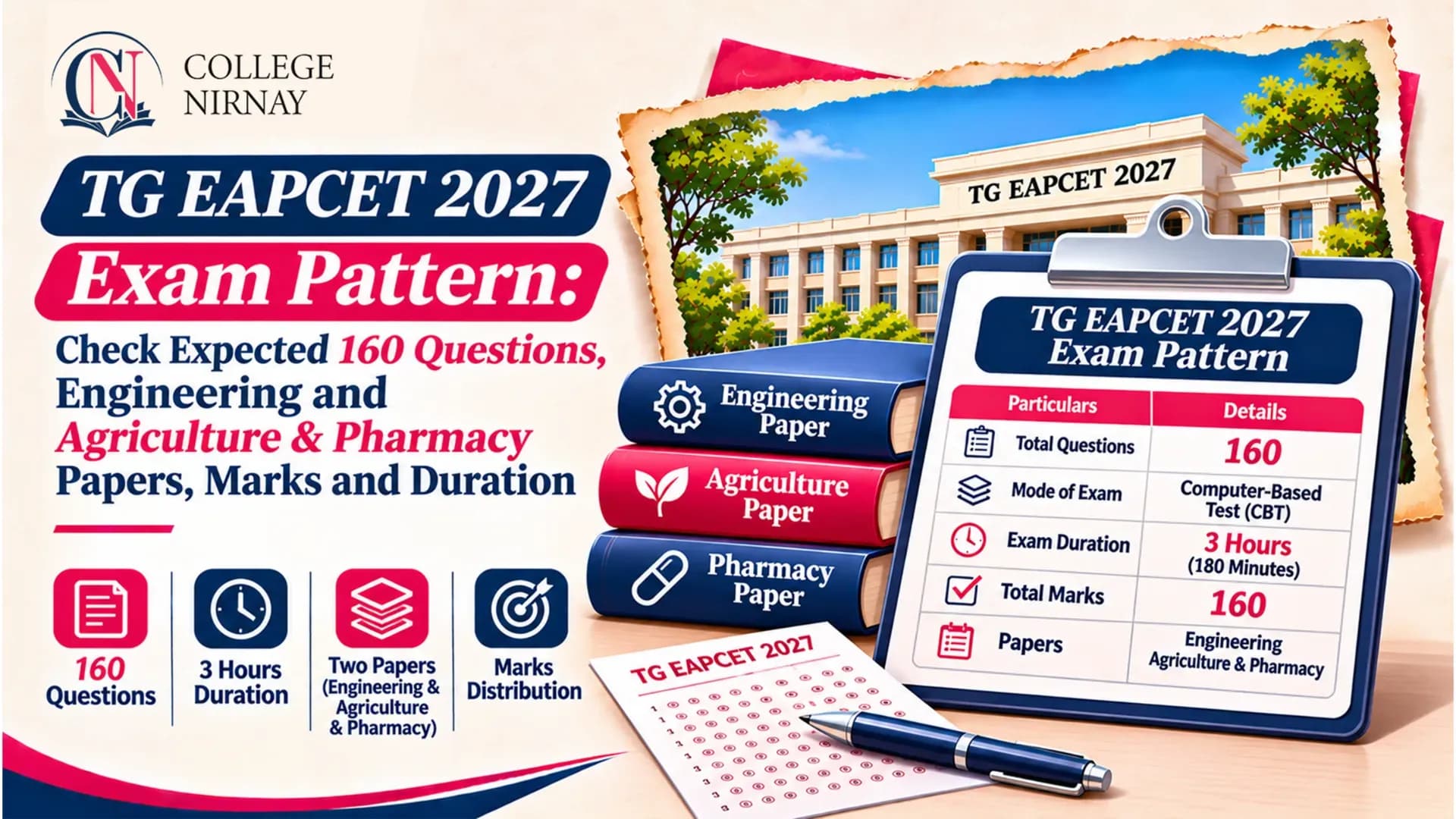
The TG EAPCET 2027 exam pattern is expected to retain the traditional 160-question format for candidates seeking admission to Engineering, Agriculture, Pharmacy and other participating professional undergraduate programmes across Telangana for the academic session 2027-28.
Based on the previous examination framework, the Telangana Engineering, Agriculture and Pharmacy Common Entrance Test is expected to be conducted as a Computer-Based Test (CBT), with candidates receiving 180 minutes to answer 160 multiple-choice questions carrying a maximum of 160 marks per paper.
The TG EAPCET exam pattern 2027 is expected to feature separate Engineering and Agriculture & Pharmacy question papers. Engineering aspirants will generally answer questions from Mathematics, Physics and Chemistry, while Agriculture and Pharmacy stream candidates will answer questions from Botany, Zoology, Physics and Chemistry.
Mathematics is expected to account for 80 questions in the Engineering paper, while Botany and Zoology together are expected to contribute 80 questions in the Agriculture & Pharmacy paper. Physics and Chemistry are expected to contribute 40 questions each in both streams.
Another important feature of the previous examination pattern was the absence of negative marking. Candidates could attempt all questions without losing marks for incorrect answers. The final examination structure, subject distribution, marking rules and duration will be confirmed through the official TG EAPCET 2027 notification.
Important Update for TG EAPCET 2027 Aspirants
The examination structure discussed in this article is an expectation based on the previous TG EAPCET examination framework. Candidates should not consider the 160-question format, subject-wise distribution, examination languages or marking scheme officially confirmed for 2027 until the relevant information booklet becomes available.
Table of Contents
TG EAPCET 2027 Exam Pattern: General Overview
TG EAPCET is a state-level entrance examination used for admission to participating professional undergraduate programmes in Telangana. The examination assesses candidates' understanding of Intermediate-level scientific concepts, mathematical applications, numerical problem-solving and subject knowledge.
Understanding the Telangana EAPCET exam pattern before beginning preparation helps students identify the relative importance of each subject, organise their revision schedules and develop an appropriate examination strategy.
| Examination Particular | Expected Details for 2027 |
|---|---|
| Examination Name | Telangana Engineering, Agriculture and Pharmacy Common Entrance Test |
| Academic Session | 2027-28 |
| Examination Level | State-Level Entrance Examination |
| Conducting Authority | JNTU Hyderabad on behalf of TGCHE, subject to confirmation |
| Examination Mode | Computer-Based Test (CBT) |
| Available Papers | Engineering and Agriculture & Pharmacy |
| Question Type | Objective Multiple-Choice Questions |
| Total Questions | 160 per paper |
| Maximum Marks | 160 per paper |
| Examination Duration | 180 minutes (3 hours) |
| Correct Answer | +1 mark |
| Incorrect Answer | 0 marks |
| Unattempted Question | 0 marks |
| Negative Marking | None under the previous framework |
| Syllabus Level | Intermediate First and Second Year |
| Official Website | eapcet.tgche.ac.in |
Candidates can review the detailed TG EAPCET general exam pattern to understand the examination format and important structural information.
TG EAPCET 2027 Engineering and Agriculture & Pharmacy Papers
The examination is expected to continue offering two separate papers according to the candidate's selected stream. Although both papers are expected to contain 160 questions, their subject combinations differ.
Engineering Stream (E)
Designed primarily for eligible Mathematics-based candidates seeking Engineering, Technology and selected professional course admissions.
- Mathematics: 80 questions
- Physics: 40 questions
- Chemistry: 40 questions
- Total: 160 questions
- Maximum marks: 160
- Duration: 180 minutes
Agriculture & Pharmacy Stream (AP)
Designed primarily for eligible Biology-based candidates seeking Agriculture, Pharmacy and related professional programme admissions.
- Botany: 40 questions
- Zoology: 40 questions
- Physics: 40 questions
- Chemistry: 40 questions
- Total: 160 questions
- Maximum marks: 160
- Duration: 180 minutes
Eligible candidates may be permitted to apply for both examination streams under the applicable registration rules. However, appearing in both papers does not automatically establish eligibility for every participating professional programme.
Check the detailed TG EAPCET Engineering and Agriculture & Pharmacy papers before choosing an examination stream.
TG EAPCET Engineering Exam Pattern 2027
The Engineering paper is expected to assess Mathematics, Physics and Chemistry concepts from the prescribed Intermediate First Year and Second Year syllabus.
Mathematics is particularly important because it accounts for half of the questions and maximum marks under the previous Engineering examination structure.
| Subject | Questions | Maximum Marks | Weightage |
|---|---|---|---|
| Mathematics | 80 | 80 | 50% |
| Physics | 40 | 40 | 25% |
| Chemistry | 40 | 40 | 25% |
| Total | 160 | 160 | 100% |
Engineering Paper Subject Weightage
Why Does Mathematics Receive Greater Importance in the Engineering Paper?
Mathematics contributes 80 out of the expected 160 questions because mathematical reasoning and numerical problem-solving are fundamental to Engineering and Technology education.
Students who improve their mathematical accuracy and calculation speed may gain a considerable advantage in the Engineering examination. However, neglecting Physics and Chemistry would mean overlooking the remaining 80 marks.
TG EAPCET Agriculture and Pharmacy Exam Pattern 2027
The Agriculture & Pharmacy question paper is expected to consist of four equally weighted subjects: Botany, Zoology, Physics and Chemistry.
Together, Botany and Zoology account for 80 questions under the previous examination framework, making Biology responsible for half of the total marks in the Agriculture & Pharmacy stream.
| Subject | Questions | Maximum Marks | Weightage |
|---|---|---|---|
| Botany | 40 | 40 | 25% |
| Zoology | 40 | 40 | 25% |
| Physics | 40 | 40 | 25% |
| Chemistry | 40 | 40 | 25% |
| Total | 160 | 160 | 100% |
Why Should Agriculture and Pharmacy Aspirants Prepare All Four Subjects?
Every subject contributes an equal share of the expected total marks. Although Biology collectively receives 50% weightage, students must also develop sufficient proficiency in Physics and Chemistry to maximise their overall examination score.
Pharmacy candidates should additionally verify whether their preferred course requires the Engineering or Agriculture & Pharmacy examination stream according to their qualifying academic subjects and admission regulations.
TG EAPCET Subject Wise Marks Distribution: Engineering vs Agriculture & Pharmacy
Both examination streams are expected to have the same maximum marks and duration. The principal difference lies in the subjects through which candidates obtain those marks.
| Subject | Engineering Questions / Marks | Agriculture & Pharmacy Questions / Marks |
|---|---|---|
| Mathematics | 80 / 80 | Not Applicable |
| Botany | Not Applicable | 40 / 40 |
| Zoology | Not Applicable | 40 / 40 |
| Physics | 40 / 40 | 40 / 40 |
| Chemistry | 40 / 40 | 40 / 40 |
| Total | 160 / 160 | 160 / 160 |
How Are the 160 Questions Divided Between Common and Stream-Specific Subjects?
Common Subject Areas
Physics and Chemistry together account for 80 questions in each examination stream. The actual questions need not be identical across the two papers or examination sessions.
Stream-Specific Subjects
Mathematics accounts for 80 questions in Engineering, while Botany and Zoology together contribute 80 questions in Agriculture & Pharmacy.
Students can explore the complete TG EAPCET subject wise question and marks distribution to plan their preparation according to the expected subject weightage.
TG EAPCET Question Paper Pattern: MCQs and Computer-Based Examination
The previous TG EAPCET question paper pattern consisted of objective multiple-choice questions, with each question providing four answer options and ordinarily requiring the selection of one correct or most appropriate answer.
Unlike descriptive board examinations, candidates are not expected to write lengthy explanations, mathematical derivations or step-by-step solutions on an answer sheet.
Conceptual Questions
Assess understanding of scientific laws, principles, mathematical properties and biological concepts.
Numerical Questions
Require candidates to calculate values using relevant formulas, equations and scientific relationships.
Application-Based Questions
Evaluate the ability to apply theoretical knowledge to unfamiliar problems and scientific situations.
Factual Questions
Test knowledge of definitions, terminology, reactions, classifications and other prescribed subject content.
Illustrative TG EAPCET-Style Multiple-Choice Question
A body of mass 2 kg moves with a velocity of 3 m/s. What is its kinetic energy?
View Correct Answer and Explanation
Correct Answer: C. 9 J
Kinetic Energy = ½ × mass × velocity² = ½ × 2 × 3² = 9 joules.
This is an original illustrative practice question, not an officially released TG EAPCET previous-year question.
What Should Students Expect From the CBT Interface?
- Questions displayed on a computer screen.
- Four answer options for each standard MCQ.
- An examination countdown timer.
- A question navigation palette.
- Options to save or change responses according to the examination instructions.
- A facility to mark questions for review, where enabled.
- Automatic or manual examination submission according to the prescribed procedure.
Candidates should review the TG EAPCET MCQ pattern and question types and practise computer-based mock examinations before their scheduled test.
TG EAPCET Marking Scheme 2027: Is There Negative Marking?
One of the most important features of the previous TG EAPCET marking scheme was that candidates received one mark for every correct answer without any deduction for incorrect responses.
If the examination authority retains this framework for 2027, candidates will be able to attempt uncertain questions without incurring a negative score.
One mark awarded
No mark deducted
No mark awarded
| Response Type | Marks | Expected Evaluation |
|---|---|---|
| Correct Answer | +1 | One mark added to raw score |
| Incorrect Answer | 0 | No marks awarded or deducted |
| Unattempted Question | 0 | No effect on raw score |
| Question Marked for Review | Depends on saved response | Subject to the official CBT evaluation instructions |
Should Candidates Attempt All 160 Questions?
If the TG EAPCET negative marking rules remain unchanged, attempting all questions can be advantageous because incorrect answers do not reduce the raw score.
However, candidates should first complete questions they can answer confidently, then return to uncertain questions using elimination and logical reasoning. Spending excessive time on a difficult question may prevent a student from answering several easier questions.
Review the detailed TG EAPCET marking scheme and negative marking rules before developing an examination attempt strategy.
How to Calculate TG EAPCET 2027 Expected Raw Marks
Under the previous marking framework, the number of correctly answered questions directly determines the candidate's raw examination score before any applicable normalisation or official result processing.
| Candidate | Correct | Incorrect | Unattempted | Raw Score | Score Percentage |
|---|---|---|---|---|---|
| A | 145 | 15 | 0 | 145 | 90.63% |
| B | 120 | 30 | 10 | 120 | 75% |
| C | 100 | 50 | 10 | 100 | 62.50% |
| D | 80 | 60 | 20 | 80 | 50% |
| E | 40 | 80 | 40 | 40 | 25% |
These examples illustrate raw score calculations only. They do not represent official ranks, percentiles or normalised marks.
Illustrative Engineering Subject-Wise Score
TG EAPCET Exam Duration 2027: Can Students Complete 160 Questions in Three Hours?
The TG EAPCET exam duration is expected to remain 180 minutes for each examination paper. Candidates will need to manage these three hours across all the subjects included in their selected stream.
With 160 questions and 180 minutes available, the average time per question is approximately 67.5 seconds.
Suggested Time Management Plan for Engineering Candidates
| Subject or Activity | Questions | Suggested Time |
|---|---|---|
| Mathematics | 80 | 90 Minutes |
| Physics | 40 | 40 Minutes |
| Chemistry | 40 | 35 Minutes |
| Review and Remaining Questions | As required | 15 Minutes |
| Total | 160 | 180 Minutes |
Suggested Time Management Plan for Agriculture & Pharmacy Candidates
| Subject or Activity | Questions | Suggested Time |
|---|---|---|
| Botany | 40 | 40 Minutes |
| Zoology | 40 | 40 Minutes |
| Physics | 40 | 45 Minutes |
| Chemistry | 40 | 40 Minutes |
| Review and Remaining Questions | As required | 15 Minutes |
| Total | 160 | 180 Minutes |
These time allocations are suggested preparation strategies, not official sectional time limits. Students should adjust them according to their individual strengths and the final CBT navigation rules.
Expected Examination Shifts
Previous TG EAPCET examinations were conducted across multiple dates and sessions. Common session timings included morning examinations from 9:00 AM to 12:00 noon and afternoon examinations from 3:00 PM to 6:00 PM.
The actual examination session, duration and reporting time will be specified on the candidate's hall ticket. Check the detailed TG EAPCET examination duration and timing guidelines for further information.
TG EAPCET 2027 Examination Languages and Medium
Previous TG EAPCET examination frameworks provided bilingual question papers in English and Telugu or English and Urdu, subject to applicable examination language and test-centre arrangements.
The available language combinations and any regional test-zone restrictions for Urdu-medium candidates must be checked through the official 2027 instructions.
English and Telugu
A previous bilingual question paper option for candidates who prefer to review questions in English or Telugu.
English and Urdu
A previous bilingual option subject to the examination authority's language selection and centre availability provisions.
Candidates should practise objective questions in their preferred examination medium and become comfortable with scientific and mathematical terminology in both languages.
TG EAPCET 2027 Qualifying Marks: How Many Marks Are Required?
Under the previous examination framework, the prescribed qualifying threshold for most candidates was 25% of the maximum marks considered for ranking.
For an examination carrying 160 maximum marks, 25% corresponds to 40 marks. Previous rules did not prescribe a minimum qualifying score for candidates belonging to Scheduled Castes and Scheduled Tribes, subject to the applicable admission provisions.
| Candidate Category | Previous Qualifying Requirement | Equivalent Marks |
|---|---|---|
| Candidates Other Than SC/ST | 25% | 40 / 160 |
| Scheduled Caste | No prescribed minimum | Subject to admission rules |
| Scheduled Tribe | No prescribed minimum | Subject to admission rules |
Illustrative Score Targets for Preparation
| Raw Score Target | Score Percentage | Preparation Objective |
|---|---|---|
| 40 Marks | 25% | Historical qualifying benchmark for applicable categories |
| 80 Marks | 50% | Intermediate practice target |
| 100 Marks | 62.50% | Advanced practice target |
| 120 Marks | 75% | Higher accuracy and syllabus coverage target |
| 140 Marks | 87.50% | High-performance mock-test target |
These preparation benchmarks are illustrative. They must not be interpreted as predicted 2027 college cutoffs, official rank ranges or guaranteed admission scores.
TG EAPCET Marks Normalisation and Rank Calculation
Because TG EAPCET is conducted across multiple examination sessions, candidates may receive different sets of questions. Although each paper follows a common examination structure, the difficulty level can vary between sessions.
Previous examination authorities used a normalisation procedure intended to account for differences in difficulty and candidate performance across sessions. The normalisation methodology applicable to 2027 will be specified by the examining authority.
Stage 1: Raw Examination Score
The candidate's recorded responses are evaluated using the applicable final answer key and marking scheme.
Stage 2: Score Normalisation
The prescribed normalisation method may be applied to account for differences across examination sessions.
Stage 3: Merit Rank Preparation
Eligible candidates are ranked according to the applicable examination marks, official ranking procedure and tie-breaking rules.
Stage 4: Counselling and Seat Allotment
Candidates participate in the applicable admission process using their rank and other required eligibility information.
Will Intermediate Marks Be Added to TG EAPCET 2027 Rank?
The recent examination framework discontinued the earlier 25% Intermediate marks weightage when preparing TG EAPCET ranks. Candidates should nevertheless verify the official 2027 ranking provisions because examination policies may change.
Intermediate marks remain relevant to academic eligibility and admission verification even when they are not directly included in entrance examination rank calculation.
Will There Be Changes in the TG EAPCET 2027 Exam Pattern?
The previous TG EAPCET examination structure provides a useful reference for students beginning their 2027 preparation. However, the examination authority may revise certain provisions through the official information brochure.
| Exam Component | Previous Framework | 2027 Expectation |
|---|---|---|
| Total Questions | 160 per paper | Expected to remain 160 |
| Maximum Marks | 160 per paper | Expected to remain unchanged |
| Exam Duration | 180 minutes | Three-hour format expected |
| Examination Mode | Computer-Based Test | CBT format expected |
| Question Type | Objective MCQs | Expected to continue |
| Negative Marking | None | No negative marking expected |
| Subject Distribution | MPC and BiPC-based papers | Previous distribution expected |
| Score Normalisation | Applied under prescribed methodology | Final methodology awaited |
| Syllabus Coverage | Prescribed Intermediate syllabus | Updated syllabus to be verified |
Important Changes Students Should Monitor
- Any revision to the total number of questions.
- Changes in subject-wise marks distribution.
- Introduction of sectional time restrictions.
- Changes in negative marking or evaluation rules.
- Updates to Intermediate syllabus coverage.
- Revised qualifying marks and rank calculation provisions.
- Changes in examination dates, sessions or test-centre arrangements.
- Updates to computer-based examination instructions.
Students can follow the TG EAPCET 2027 exam pattern changes section for information regarding potential revisions to the examination structure.
TG EAPCET 2027 Subject-Wise Preparation Strategy
Students should use the expected examination structure to develop a preparation strategy that balances syllabus completion, conceptual understanding, question practice, calculation speed and examination accuracy.
Mathematics Preparation
Engineering aspirants should allocate substantial practice time to mathematical problem-solving.
- Algebra and functions
- Trigonometry
- Coordinate geometry
- Differential and integral calculus
- Vectors and three-dimensional geometry
- Probability
Physics Preparation
Focus on understanding physical concepts and applying formulas accurately under time pressure.
- Mechanics and laws of motion
- Work, energy and power
- Thermodynamics
- Oscillations and waves
- Electricity and magnetism
- Optics and modern physics
Chemistry Preparation
Build a balanced understanding of physical, inorganic and organic chemistry concepts.
- Atomic structure
- Chemical bonding
- Chemical thermodynamics
- Equilibrium and electrochemistry
- Organic chemistry reactions
- Coordination compounds
Botany Preparation
Revise plant structure, physiology, biological processes and prescribed textbook content.
- Plant diversity and classification
- Morphology and anatomy
- Cell structure and cell division
- Plant physiology
- Genetics and reproduction
- Biotechnology and ecology
Zoology Preparation
Develop strong conceptual knowledge of animal biology, human systems and biological processes.
- Animal diversity
- Animal structural organisation
- Human physiology
- Human reproduction
- Genetics and evolution
- Human health and applied biology
The topics listed above are illustrative preparation areas. They do not constitute an official or exhaustive TG EAPCET 2027 syllabus or confirmed chapter-wise weightage.
Suggested 120-Day TG EAPCET Preparation Roadmap
Days 1–30: Build the Foundation
Revise fundamental Intermediate concepts, prepare subject-wise notes and identify topics requiring additional attention.
Days 31–60: Complete Syllabus and MCQ Practice
Work through remaining prescribed chapters, solve topic-wise objective questions and record recurring conceptual errors.
Days 61–90: Previous Papers and Timed Tests
Practise previous-year questions, complete timed subject tests and improve calculation speed and response accuracy.
Days 91–120: Full-Length Mock Tests and Revision
Simulate the 160-question, 180-minute examination format, review mock-test errors and strengthen weak areas before the examination.
How Should Students Analyse Their Mock-Test Performance?
| Performance Metric | What to Measure | Improvement Strategy |
|---|---|---|
| Accuracy | Correct answers divided by attempted questions | Review concepts and avoid repeated careless mistakes |
| Question Coverage | Questions attempted out of 160 | Improve navigation and time allocation |
| Subject-Wise Score | Marks obtained in each subject | Prioritise weak subjects and chapters |
| Average Solving Time | Time spent per attempted question | Practise efficient calculation and elimination |
| Raw Examination Score | Correct responses out of 160 | Track consistent improvement across mock tests |
Common TG EAPCET 2027 Exam Pattern Mistakes Students Should Avoid
Understanding the expected examination pattern is not sufficient unless students also develop practical strategies for managing time, selecting questions and avoiding unnecessary errors.
| Common Mistake | Potential Impact | Recommended Approach |
|---|---|---|
| Giving equal preparation time to all Engineering subjects without considering weightage | Insufficient Mathematics practice | Account for Mathematics carrying 50% of expected marks while addressing weak areas |
| Ignoring Physics and Chemistry in the Agriculture & Pharmacy stream | Neglecting half of the examination marks | Prepare all four equally weighted subjects |
| Spending too much time on difficult questions | Fewer questions attempted | Return to challenging questions after completing easier ones |
| Leaving uncertain questions unanswered despite no negative marking | Possible loss of scoring opportunities | Use elimination and answer remaining questions if no negative marking is confirmed |
| Practising only untimed questions | Difficulty completing the paper within three hours | Include regular full-length timed mock tests |
| Memorising formulas without application practice | Difficulty solving unfamiliar numerical questions | Practise concept-based and application-oriented MCQs |
| Confusing qualifying marks with admission cutoffs | Unrealistic college admission expectations | Review programme-wise counselling ranks and eligibility |
| Assuming previous rules are confirmed for 2027 | Preparation based on outdated instructions | Verify the official information booklet after release |
TG EAPCET 2027 Examination Preparation Checklist
Candidates can use this checklist to review whether their preparation is aligned with the expected examination structure.
TG EAPCET 2027 Exam Pattern: Frequently Asked Questions
The following frequently asked questions explain the expected paper structure, subject-wise marks, question types, duration and evaluation rules for the upcoming entrance examination.
1. What is the expected TG EAPCET 2027 exam pattern?
The examination is expected to consist of 160 multiple-choice questions carrying 160 marks, with a duration of three hours for each examination stream.
2. How many questions will be asked in TG EAPCET 2027?
Based on the previous examination pattern, each Engineering or Agriculture & Pharmacy paper is expected to contain 160 questions.
3. What are the expected TG EAPCET total marks 2027?
The maximum marks are expected to remain 160 per examination paper, with one mark awarded for each correct answer.
4. What is the TG EAPCET Engineering exam pattern 2027?
The Engineering paper is expected to contain 80 Mathematics questions, 40 Physics questions and 40 Chemistry questions.
5. What is the TG EAPCET Agriculture and Pharmacy exam pattern?
The Agriculture & Pharmacy paper is expected to contain 40 questions each from Botany, Zoology, Physics and Chemistry.
6. What is the expected TG EAPCET Mathematics exam pattern?
Mathematics is expected to carry 80 questions and 80 marks in the Engineering examination, accounting for 50% of the total marks.
7. How many Physics questions are expected in TG EAPCET 2027?
Physics is expected to consist of 40 questions carrying 40 marks in each examination stream.
8. How many Chemistry questions are expected?
Chemistry is expected to contribute 40 questions and 40 marks to both Engineering and Agriculture & Pharmacy papers.
9. How many Botany and Zoology questions will be asked?
The Agriculture & Pharmacy paper is expected to include 40 Botany questions and 40 Zoology questions, carrying a combined maximum of 80 marks.
10. Is there negative marking in TG EAPCET 2027?
The previous examination framework did not include negative marking. Incorrect answers received zero marks without any deduction. The 2027 rule must be confirmed officially.
11. What is the TG EAPCET marking scheme 2027?
The expected marking scheme awards one mark for each correct answer and zero marks for incorrect or unattempted questions.
12. What is the expected TG EAPCET exam duration?
The examination duration is expected to be 180 minutes or three hours per paper.
13. How much time is available per question?
With 180 minutes available for 160 questions, the average time available is 67.5 seconds per question. This is an average rather than an individual question time limit.
14. Will TG EAPCET 2027 be conducted online or offline?
The examination is expected to continue as a computer-based test conducted at designated examination centres.
15. Will descriptive questions be included in TG EAPCET?
The previous question paper pattern consisted entirely of objective multiple-choice questions rather than descriptive answers.
16. How many answer options are provided for each question?
The previous TG EAPCET MCQ pattern generally provided four answer options for each question, with one correct or most appropriate response.
17. Should students attempt every question in TG EAPCET?
If no negative marking is confirmed for 2027, attempting all questions can be beneficial. Students should first complete questions they can answer confidently.
18. Is Mathematics compulsory in the Engineering examination?
Yes, under the previous Engineering paper framework, Mathematics was a core subject carrying 80 questions and 80 marks.
19. Does the Agriculture & Pharmacy paper include Mathematics?
The previous Agriculture & Pharmacy question paper consisted of Botany, Zoology, Physics and Chemistry rather than Mathematics.
20. Can eligible candidates appear for both TG EAPCET papers?
Previous registration provisions allowed eligible candidates to register for both streams by paying the applicable combined fee. Each paper has a separate examination session and score.
21. Is there a separate examination paper exclusively for Pharmacy?
The previous framework offered Engineering and Agriculture & Pharmacy papers rather than a third standalone Pharmacy paper. The appropriate stream depends on the candidate's subjects and course eligibility.
22. What are the expected qualifying marks for TG EAPCET 2027?
The previous qualifying benchmark for candidates other than SC/ST was 25% of maximum marks, equivalent to 40 out of 160. The 2027 provisions are subject to confirmation.
23. Are there minimum qualifying marks for SC/ST candidates?
Previous examination rules did not prescribe minimum qualifying marks for SC/ST candidates, although relevant admission and reservation provisions continued to apply.
24. Does scoring 40 marks guarantee admission to an Engineering college?
No. Qualifying marks and admission cutoffs are different. Seat allotment depends on rank, programme eligibility, category, college preferences and available seats.
25. How are TG EAPCET raw marks calculated?
Under the previous marking system, raw marks equal the number of correctly answered questions, before any applicable normalisation or official result adjustment.
26. Why are TG EAPCET marks normalised?
Normalisation is intended to account for differences in question paper difficulty and candidate performance across examination sessions.
27. Will Intermediate marks be included in the TG EAPCET 2027 rank?
Recent examination frameworks discontinued the earlier Intermediate marks weightage for rank preparation. Candidates should verify the final 2027 ranking provisions.
28. Is there a separate time limit for each TG EAPCET subject?
The previous examination provided an overall duration of three hours. Students should check the final 2027 CBT instructions for any sectional restrictions.
29. Can students change an answer during the examination?
The previous CBT format provided response navigation and editing facilities within the allowed examination period. Candidates must follow the official instructions for saving and changing answers.
30. Will TG EAPCET questions be based on Intermediate First Year and Second Year?
Yes, the previous examination syllabus was based on prescribed Intermediate-level subject content. The detailed official 2027 syllabus should be checked for exact coverage.
31. Is TG EAPCET conducted in Telugu and Urdu?
Previous examinations offered bilingual English-Telugu and English-Urdu question paper options, subject to applicable language selection and examination centre provisions.
32. Can students use calculators during TG EAPCET?
Candidates should not bring calculators or unauthorised electronic devices unless expressly permitted by the official examination instructions.
33. How many mock tests should students attempt?
There is no fixed requirement. Students should regularly complete full-length mock examinations, analyse their mistakes and gradually improve their speed and accuracy.
34. Is the TG EAPCET 2027 exam pattern officially confirmed?
The pattern presented here is based on previous examination rules. Students should check the official 2027 notification and information booklets for confirmed examination details.
35. Where can students check the complete TG EAPCET exam pattern 2027?
Candidates can refer to the official TG EAPCET examination portal and College Nirnay's detailed exam pattern guide for subject distribution, marking rules, preparation guidance and examination updates.
Conclusion
The TG EAPCET 2027 exam pattern is expected to retain the previous 160-question, 160-mark and three-hour computer-based examination format for both Engineering and Agriculture & Pharmacy aspirants.
Engineering candidates should prepare for an expected distribution of 80 Mathematics questions, 40 Physics questions and 40 Chemistry questions. Agriculture & Pharmacy candidates should focus on Botany, Zoology, Physics and Chemistry, with each subject expected to contribute 40 questions.
The absence of negative marking under the previous evaluation framework provides an opportunity for candidates to attempt more questions without risking mark deductions. Nevertheless, effective time management remains essential because students have an average of approximately 67.5 seconds per question.
Candidates preparing for the academic session 2027-28 should combine comprehensive Intermediate syllabus revision with regular computer-based mock examinations, previous-year question practice and subject-wise performance analysis.
Before appearing for the examination, students must confirm the final TG EAPCET question paper pattern, marking scheme, examination duration, qualifying marks and official instructions through the examination authority.
For comprehensive entrance examination guidance, subject-wise preparation information and examination updates, visit the College Nirnay TG EAPCET Exam Pattern Guide.
Explore More TG EAPCET Exam Pattern Information
Official Examination Information
The expected examination pattern presented in this article is based on the previous TG EAPCET examination framework. All 2027 examination details remain subject to the official notification and information booklets for the academic session 2027-28.
Official examination website: eapcet.tgche.ac.in
Candidates are advised to verify the final examination pattern, syllabus, qualifying criteria, marking scheme and examination instructions directly through the official examination authority.