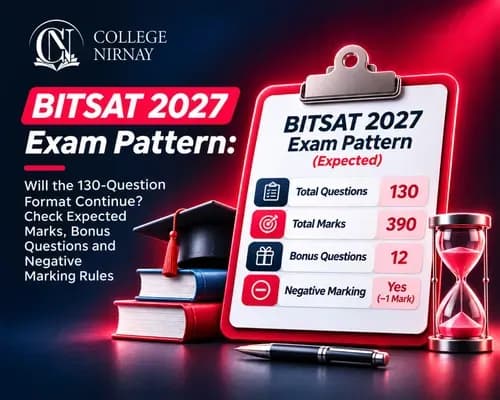
BITSAT 2027 Exam Pattern: Will the 130-Question Format Continue? Check Expected Marks, Bonus Questions and Negative Marking Rules
Latest Update – November 28, 2026: The BITSAT 2027 exam pattern is expected to retain the 130-question examination format with a regular maximum score of 390 marks and a duration of three hours. Based on the 2026 information brochure, candidates answering every regular question may also receive an opportunity to attempt 12 additional questions within the remaining examination time. The final examination pattern for the 2027–28 admission cycle is subject to official confirmation by BITS Pilani.
The Birla Institute of Technology and Science Admission Test is conducted for admission to integrated first-degree programmes offered at the participating BITS campuses. The BITSAT exam pattern 2027 is expected to assess candidates through Physics, Chemistry, Mathematics or Biology, English Proficiency and Logical Reasoning.
The BITSAT 130 questions format differs from several other engineering entrance examinations because eligible candidates may attempt additional questions after answering the entire regular paper. The BITSAT 390 marks structure represents the maximum score available from the standard questions, while the theoretical maximum may reach 426 marks through additional questions.
Students preparing for the examination should understand the BITSAT negative marking 2027 system, BITSAT marking scheme, subject distribution and time management requirements before attempting full-length mock tests. Special attention should be given to the BITSAT bonus questions rules, as opting for additional questions prevents candidates from revisiting their original answers.
Regular Questions
Regular Maximum Marks
Duration in Minutes
Optional Additional Questions
Table of Contents
BITSAT 2027 Exam Pattern: Key Highlights
The BITS Pilani entrance exam pattern 2027 is expected to follow the computer-based examination structure used during the previous admission cycle. The paper is designed to evaluate academic knowledge, problem-solving ability, language proficiency and analytical reasoning.
The BITSAT expected exam pattern includes four examination parts covering five subject areas. Mathematics and Biology are alternative subjects according to the applicable programme eligibility conditions.
| Particulars | Expected Details |
|---|---|
| Examination Name | Birla Institute of Technology and Science Admission Test |
| Conducting Authority | BITS Pilani |
| Academic Session | 2027–28 |
| Examination Mode | Computer-Based Test (CBT) |
| Examination Sessions | Two, subject to confirmation |
| Question Type | Single-correct-answer multiple-choice questions |
| Regular Questions | 130 |
| Additional Questions | Up to 12 optional questions |
| Regular Maximum Marks | 390 |
| Theoretical Maximum With Additional Questions | 426 |
| Examination Duration | 180 minutes |
| Correct Answer | +3 marks |
| Incorrect Answer | -1 mark |
| Unattempted Question | 0 marks |
| Sectional Time Limit | No separate sectional time limit |
| Examination Language | English |
| 2027 Pattern Status | Awaiting official confirmation |
Students can review the BITSAT general examination pattern for details about the examination structure, mode and scoring system.
BITSAT 2027 Examination Parts: PCM and PCB Subject Combinations
BITSAT consists of a single integrated examination containing multiple subject sections rather than separate examinations for every subject. The previous examination framework included four parts, with English Proficiency and Logical Reasoning grouped together in Part III.
Part I
Physics
30 questions carrying a maximum of 90 regular marks.
Part II
Chemistry
30 questions carrying a maximum of 90 regular marks.
Part III
English and Reasoning
10 English and 20 Logical Reasoning questions carrying 90 combined marks.
Part IV
Mathematics or Biology
40 questions in the applicable subject carrying 120 regular marks.
Which Candidates Can Select Mathematics or Biology?
| Programme Category | Part IV Subject |
|---|---|
| Most B.E. programmes | Mathematics |
| Integrated M.Sc. programmes | Mathematics |
| B.Pharm. | Mathematics or Biology, according to eligibility |
| B.E. Environmental and Sustainability Engineering | Mathematics or Biology under the 2026 framework |
For additional information about alternative subject combinations, check the BITSAT examination parts and papers.
BITSAT Subject Wise Question Distribution 2027
The BITSAT subject wise question distribution is expected to remain consistent with the previous-year examination format. Mathematics or Biology represents the largest individual subject allocation, while Physics and Chemistry carry equal weight.
| Subject | Questions | Maximum Marks | Weightage |
|---|---|---|---|
| Physics | 30 | 90 | 23.08% |
| Chemistry | 30 | 90 | 23.08% |
| English Proficiency | 10 | 30 | 7.69% |
| Logical Reasoning | 20 | 60 | 15.38% |
| Mathematics or Biology | 40 | 120 | 30.77% |
| Total | 130 | 390 | 100% |
Subject-Wise Marks Distribution Chart
The chart compares the maximum regular marks available in each subject. Bar lengths are scaled against the highest individual subject allocation of 120 marks.
Combined PCM or PCB Marks
English and Reasoning Marks
English and Logical Reasoning collectively account for approximately 23.08% of the regular examination marks. Candidates should therefore allocate dedicated preparation time to these subjects rather than concentrating exclusively on Physics, Chemistry and Mathematics or Biology.
Students can check the detailed BITSAT subject-wise marks and question distribution before creating their preparation timetable.
BITSAT 2027 Subject-Wise Exam Pattern
Candidates should understand the expected scope of each examination subject. The following topics are indicative preparation areas rather than an officially prescribed chapter-wise weightage list for 2027.
BITSAT Physics Exam Pattern
The Physics section generally assesses conceptual knowledge, numerical problem-solving and the application of scientific principles.
- Units and measurements.
- Kinematics and laws of motion.
- Work, energy and power.
- Rotational motion and gravitation.
- Thermodynamics.
- Oscillations and waves.
- Electrostatics and current electricity.
- Magnetism and electromagnetic induction.
- Optics and modern physics.
BITSAT Chemistry Exam Pattern
The Chemistry section covers preparation areas from Physical, Organic and Inorganic Chemistry, including theoretical and numerical concepts.
- Atomic structure and chemical bonding.
- States of matter and thermodynamics.
- Chemical and ionic equilibrium.
- Solutions and electrochemistry.
- Chemical kinetics.
- Periodic properties.
- Coordination compounds.
- Organic reaction mechanisms.
- Hydrocarbons and functional groups.
BITSAT Mathematics Exam Pattern
Mathematics has the largest individual subject allocation in the PCM examination. Speed and accuracy are particularly important in this section.
- Algebra and complex numbers.
- Quadratic equations.
- Sequences and series.
- Trigonometry.
- Coordinate geometry.
- Matrices and determinants.
- Differential and integral calculus.
- Vectors and three-dimensional geometry.
- Probability and statistics.
BITSAT Biology Exam Pattern
Biology is an alternative to Mathematics for eligible programme applicants. Preparation requires strong knowledge of biological processes and terminology.
- Diversity of living organisms.
- Cell structure and function.
- Plant physiology.
- Human physiology.
- Reproduction.
- Genetics and inheritance.
- Evolution.
- Biotechnology.
- Ecology and environment.
BITSAT English Proficiency Questions
The English section evaluates vocabulary, grammar, reading comprehension and the correct use of written English.
- English grammar.
- Vocabulary and word meanings.
- Synonyms and antonyms.
- Sentence completion.
- Reading comprehension.
- Sentence arrangement and composition.
BITSAT Logical Reasoning Questions
The Logical Reasoning section evaluates analytical thinking and the ability to identify relationships, sequences and patterns.
- Verbal reasoning.
- Non-verbal reasoning.
- Number and letter series.
- Analogies and classification.
- Logical deductions.
- Figure-based pattern recognition.
BITSAT Question Paper Pattern: Types of Questions and CBT Mode
The BITSAT computer based test is expected to use objective multiple-choice questions. Candidates select one answer from four available options through the examination interface.
The BITSAT question paper pattern may include conceptual questions, numerical calculations, language-based questions and analytical reasoning problems. Individual question sets may differ because questions are selected from a larger question bank.
| Question Category | Expected Nature |
|---|---|
| Conceptual Questions | Assessment of subject knowledge and understanding. |
| Numerical Questions | Calculation-based problems with predefined answer options. |
| Application-Based Questions | Use of academic concepts in different problem-solving situations. |
| Language Questions | Grammar, vocabulary and comprehension. |
| Analytical Questions | Logical sequences, patterns and deductions. |
Illustrative BITSAT Multiple-Choice Question
Question: A body of mass 4 kg moves with a velocity of 5 m/s. What is its kinetic energy?
View Correct Answer and Explanation
Correct Answer: Option C – 50 J.
Kinetic Energy = 1/2 × Mass × Velocity² = 1/2 × 4 × 25 = 50 joules.
The above question is an original illustrative practice question, not an official previous-year BITSAT question.
Expected Computer-Based Examination Features
- On-screen multiple-choice questions.
- Selection of a single answer option.
- Examination countdown timer.
- Navigation between regular questions.
- Option to revise answers before selecting additional questions.
- Question status information through the examination interface.
- Final submission according to the prescribed examination instructions.
The detailed BITSAT question types and examination format can help candidates familiarise themselves with the expected examination interface.
BITSAT Marking Scheme and Negative Marking Rules 2027
The BITSAT marking scheme is expected to award three marks for each correct response and deduct one mark for every incorrect response. Unanswered questions do not contribute positively or negatively to the score.
Understanding BITSAT negative marking 2027 is essential because answering uncertain questions indiscriminately may reduce a candidate's final score.
Correct Answer
Three marks awarded
Incorrect Answer
One mark deducted
Unattempted
No marks awarded or deducted
BITSAT Score Calculation Formula
Expected Raw Score Formula
Unattempted questions contribute zero marks.
| Correct | Incorrect | Unattempted | Score |
|---|---|---|---|
| 100 | 20 | 10 | 280 |
| 110 | 15 | 5 | 315 |
| 120 | 10 | 0 | 350 |
| 90 | 10 | 30 | 260 |
| 130 | 0 | 0 | 390 |
With four equally plausible options, a purely random guess has an expected mathematical score of zero under the +3/-1 system. However, the actual result may be positive or negative, and repeated uncertain attempts increase score variability.
For more information, students can review the BITSAT marking scheme and negative marking rules.
BITSAT 12 Bonus Questions: How Do Additional Questions Work?
The BITSAT 12 bonus questions provision is one of the distinctive features of the entrance examination. It gives candidates who complete all regular questions an opportunity to attempt further questions if time remains.
The BITSAT additional questions are optional and are not automatically made available to every candidate. Under the previous examination framework, all 130 regular questions must have recorded responses before the additional-question option becomes available.
9 Maximum Marks
9 Maximum Marks
9 Maximum Marks
9 Maximum Marks
| Subject | Additional Questions | Maximum Additional Marks |
|---|---|---|
| Physics | 3 | 9 |
| Chemistry | 3 | 9 |
| Mathematics or Biology | 3 | 9 |
| Logical Reasoning | 3 | 9 |
| English Proficiency | 0 | 0 |
| Total | 12 | 36 |
BITSAT Bonus Question Eligibility: Conditions and Restrictions
BITSAT bonus question eligibility depends on the completion of the regular examination and the availability of remaining time. Candidates are not required to answer all regular questions correctly to unlock the additional-question option, but every regular question must have an answer recorded.
Expected Additional Question Process
Essential Rules Candidates Should Remember
Complete All Regular Responses
Leaving even one regular question unanswered prevents access to the optional additional-question facility.
Time Must Remain
The additional questions must be attempted within the original 180-minute examination duration.
Review Before Proceeding
Candidates should verify uncertain regular answers before choosing to access the additional section.
Additional Questions Are Optional
Eligible candidates may decide not to proceed if they prefer to retain the opportunity to review their regular answers.
BITSAT Total Marks 2027: Is the Maximum Score 390 or 426?
Students frequently encounter two different maximum-score figures while reviewing the examination pattern. The standard BITSAT examination consists of regular questions and optional additional questions for eligible candidates.
Regular Maximum
130 × 3 Marks
Additional Maximum
12 × 3 Marks
Theoretical Combined Maximum
390 + 36 Marks
The BITSAT total marks figure of 390 refers to the standard paper. The figure of 426 is a theoretical mathematical maximum that requires correct answers to all regular and additional questions.
Previous official admission cutoff tables use 390 as the standard examination maximum. Candidates should therefore avoid treating 426 as the ordinary maximum for every applicant.
BITSAT 2027 Score Calculation With Additional Questions
The final raw examination score depends on the number of correct and incorrect answers recorded across the regular questions and any eligible additional attempts.
Example 1: Candidate Attempts Only Regular Questions
Correct answers: 105
Incorrect answers: 15
Unattempted questions: 10
Score = (105 × 3) − 15 = 315 − 15
Example 2: Candidate Attempts Regular and Additional Questions
| Parameter | Regular Questions | Additional Questions |
|---|---|---|
| Correct Responses | 115 | 9 |
| Incorrect Responses | 15 | 2 |
| Unattempted | 0 | 1 |
| Score | 330 | 25 |
Example 3: Additional Questions Reduce the Final Score
Consider a candidate who obtains 310 marks in the regular examination but answers all 12 additional questions incorrectly. Under the expected marking scheme, the additional attempts would result in a deduction of 12 marks.
Regular Score: 310
Additional Question Score: -12
Final Score: 298 MarksAccuracy vs Number of Attempts
| Candidate | Attempted | Correct | Incorrect | Accuracy | Score |
|---|---|---|---|---|---|
| A | 130 | 100 | 30 | 76.92% | 270 |
| B | 115 | 100 | 15 | 86.96% | 285 |
| C | 110 | 105 | 5 | 95.45% | 310 |
These illustrative regular-paper scores demonstrate why a high number of attempts does not necessarily guarantee a higher result. Candidates should balance examination speed with answer accuracy.
BITSAT Exam Duration 2027: Three-Hour Time Management
The BITSAT three hour exam is expected to provide a total of 180 minutes for completing the examination without a standard scheduled break. The previous framework did not prescribe separate time limits for individual subjects.
Candidates must manage their own time across the regular paper and any optional additional questions. The additional section does not extend the original examination duration.
Total Available Time
Average Per Regular Question
Average Across 142 Questions
Suggested Examination Time Allocation
The following time allocation is an illustrative strategy rather than an official sectional time limit. Candidates should adjust the allocation according to their individual strengths.
| Section | Questions | Suggested Time |
|---|---|---|
| Physics | 30 | 40 Minutes |
| Chemistry | 30 | 30 Minutes |
| Mathematics or Biology | 40 | 60 Minutes |
| English Proficiency | 10 | 10 Minutes |
| Logical Reasoning | 20 | 25 Minutes |
| Review or Additional Questions | Variable | 15 Minutes |
| Total | 130 + Optional | 180 Minutes |
Illustrative Examination Timeline
Students should practise complete three-hour mock tests and review the BITSAT examination duration and time allocation to develop an effective examination strategy.
BITSAT 2027 Session 1 and Session 2 Examination Pattern
BITSAT is expected to be conducted through two examination sessions in the 2027 admission cycle. The overall examination structure is generally consistent across the two sessions, although individual questions and question sets may differ.
| Parameter | Session 1 | Session 2 |
|---|---|---|
| Regular Questions | 130 | 130 |
| Regular Maximum Marks | 390 | 390 |
| Optional Additional Questions | 12 | 12 |
| Duration | 180 Minutes | 180 Minutes |
| Marking Scheme | +3 / -1 | +3 / -1 |
| Question Set | May Vary | May Vary |
Which Session Score Is Considered for Admission?
Under the 2026 admission rules, the higher individual BITSAT score was considered when an eligible candidate appeared in both examination sessions.
Session 1 Score
Session 2 Score
Higher Score Considered
The two scores are not added together under this framework. Admission also depends on academic eligibility, programme preferences, applicable merit rules and seat availability.
Will BITSAT Exam Pattern 2027 Change?
The BITSAT expected exam pattern is likely to retain the main examination features followed during the recent admission cycles. The continuation of the 130-question format, additional-question provision and negative marking system will depend on the final 2027 examination notification.
| Examination Feature | 2026 Pattern | 2027 Expected Pattern |
|---|---|---|
| Regular Questions | 130 | 130 |
| Regular Maximum Marks | 390 | 390 |
| Additional Questions | 12 | 12 |
| Duration | 180 Minutes | 180 Minutes |
| Correct Answer | +3 | +3 |
| Incorrect Answer | -1 | -1 |
| Examination Mode | CBT | CBT |
| Number of Sessions | Two | Two |
| Additional Question Locking Rule | Applicable | Expected to Continue |
| Official Confirmation | Published | Awaited |
Examination Updates Students Should Monitor
- Changes to the number of regular questions.
- Revised subject-wise marks distribution.
- Changes to the additional-question conditions.
- Revisions to the negative marking system.
- Updated Mathematics and Biology programme eligibility.
- Changes in examination duration or conducting mode.
- Revised instructions related to question navigation.
- Changes to session-wise examination arrangements.
Students can follow the latest BITSAT examination pattern changes once the official 2027 admission brochure becomes available.
Complete BITSAT 2027 Exam Pattern Table With Regular and Additional Questions
The following comprehensive table combines the expected regular examination structure with the additional-question distribution for eligible candidates.
| Subject | Regular Questions | Regular Marks | Additional Questions | Additional Marks | Potential Combined Marks |
|---|---|---|---|---|---|
| Physics | 30 | 90 | 3 | 9 | 99 |
| Chemistry | 30 | 90 | 3 | 9 | 99 |
| English Proficiency | 10 | 30 | 0 | 0 | 30 |
| Logical Reasoning | 20 | 60 | 3 | 9 | 69 |
| Mathematics / Biology | 40 | 120 | 3 | 9 | 129 |
| Total | 130 | 390 | 12 | 36 | 426 |
The combined marks represent theoretical subject-wise maximum scores if the candidate is eligible to access all additional questions and answers every applicable question correctly.
Check the complete BITSAT exam pattern table for a consolidated view of the examination structure.
How to Prepare According to the BITSAT 2027 Exam Pattern
Effective BITSAT preparation requires a combination of syllabus coverage, question-solving speed, accuracy and regular examination analysis. Students should gradually develop their ability to complete the regular paper within the available time instead of making additional questions their primary preparation target.
Suggested 120-Day Preparation Roadmap
Strengthen Academic Foundations
Review fundamental concepts, identify weak chapters, prepare formula notes and establish a daily English and Logical Reasoning practice routine.
Complete Syllabus and Practice MCQs
Complete the prescribed syllabus, solve topic-wise objective questions and revise incorrect solutions through a structured error notebook.
Improve Speed and Accuracy
Attempt timed sectional tests, practise numerical calculations, revise frequently missed concepts and gradually introduce complete examination simulations.
Full-Length Mock Tests and Final Revision
Attempt complete 180-minute mock examinations, analyse subject-wise scores and practise deciding whether to access additional questions based on remaining time and confidence.
Suggested Daily Study Timetable
| Preparation Activity | Suggested Daily Time |
|---|---|
| Mathematics or Biology | 2 Hours |
| Physics | 1.5 Hours |
| Chemistry | 1.5 Hours |
| English Proficiency | 30 Minutes |
| Logical Reasoning | 30 Minutes |
| Revision and Error Analysis | 1 Hour |
| Total Suggested Study Time | 7 Hours |
This is an illustrative full-time preparation schedule. Students should adapt it around school, coaching, rest and other commitments rather than treating seven hours as a mandatory daily requirement.
Recommended Three-Round Attempt Strategy
Round 1: Confident Questions
Attempt familiar and straightforward questions first to secure marks without spending excessive time on difficult problems.
Round 2: Moderate Questions
Return to questions requiring detailed calculations, additional reasoning or careful evaluation of answer options.
Round 3: Review and Decide
Review uncertain answers and determine whether accessing additional questions is worthwhile within the remaining time.
Mock Test Performance Indicators
| Metric | Purpose |
|---|---|
| Total Raw Score | Measure overall examination performance. |
| Attempt Accuracy | Identify whether incorrect responses are reducing the score. |
| Average Question Time | Evaluate speed and time utilisation. |
| Subject-Wise Score | Identify subjects requiring additional preparation. |
| Negative Marks | Track avoidable score deductions. |
| Additional Question Performance | Assess whether additional attempts improve the overall score. |
Common Mistakes to Avoid in BITSAT 2027
| Common Mistake | Recommended Approach |
|---|---|
| Attempting Every Question Without Confidence | Understand the impact of negative marking and avoid unnecessary random guesses. |
| Ignoring English Proficiency | Practise grammar, vocabulary and comprehension regularly. |
| Neglecting Logical Reasoning | Allocate dedicated preparation time to analytical and reasoning questions. |
| Prioritising Bonus Questions Over Regular Accuracy | Secure regular examination marks before considering additional attempts. |
| Entering the Additional Section Too Early | Review regular responses before selecting the optional section. |
| Assuming Extra Questions Provide Extra Time | Complete all examination activities within the original duration. |
| Confusing 390 and 426 Marks | Distinguish the standard maximum from the theoretical maximum with additional questions. |
| Spending Excessive Time on One Question | Skip difficult regular questions temporarily and return during revision. |
| Practising Only Untimed Questions | Include full-length timed mock examinations. |
| Relying on Predicted Chapter Weightage | Cover the complete official syllabus and use predictions only for supplementary planning. |
| Ignoring Updated Examination Instructions | Review the final 2027 examination brochure and hall ticket guidelines. |
BITSAT 2027 Examination Preparation Checklist
Students can use the following checklist to monitor their familiarity with the examination format and preparation progress.
BITSAT 2027 Exam Pattern: Frequently Asked Questions
Check the following frequently asked questions about the examination structure, additional questions, negative marking and scoring system. Students can also review the BITSAT exam pattern FAQs for further examination-related information.
1. What is the expected BITSAT 2027 exam pattern?
The examination is expected to include 130 regular questions worth 390 marks, with an optional additional section for eligible candidates. The duration is expected to remain 180 minutes.
2. Will the BITSAT 130 questions format continue in 2027?
The 130-question structure is expected to continue based on the recent examination framework. Final confirmation will depend on the official 2027 brochure.
3. What does the BITSAT 390 marks format mean?
The standard paper contains 130 questions, with three marks available for every correct answer. Therefore, the regular maximum score is 390 marks.
4. Can a candidate score 426 marks in BITSAT?
Yes, 426 is the theoretical maximum if the candidate correctly answers all 130 regular questions and all 12 optional additional questions under the previous marking framework.
5. What are the BITSAT bonus questions rules?
Candidates must answer every regular question and have remaining examination time. After opting for additional questions, they cannot return to change their original responses.
6. How many additional questions are available in BITSAT?
The previous examination format provided up to 12 additional questions distributed across Physics, Chemistry, Mathematics or Biology, and Logical Reasoning.
7. Are all 130 regular questions compulsory?
No. Candidates may leave regular questions unanswered. However, answering every regular question is necessary to become eligible for the optional additional section.
8. Must all 130 answers be correct to unlock bonus questions?
No. The previous rules required every regular question to have a recorded response. They did not require every response to be correct.
9. Is additional time provided for bonus questions?
No. Additional questions must be attempted within the remaining time of the original examination duration.
10. Does BITSAT have negative marking?
Yes. Under the previous examination pattern, one mark was deducted for each incorrect answer, including incorrect additional-question responses.
11. What is the BITSAT exam duration 2027?
The examination is expected to last 180 minutes without a standard scheduled break, subject to confirmation in the official 2027 brochure.
12. Is there a sectional time limit in BITSAT?
The previous examination framework did not prescribe individual time limits for each subject. Candidates managed their own time within the overall examination duration.
13. What is the BITSAT Physics exam pattern?
Physics is expected to contain 30 regular questions carrying 90 marks. Three additional Physics questions may become available to eligible candidates.
14. What is the BITSAT Chemistry exam pattern?
Chemistry is expected to contain 30 regular questions worth 90 marks, with questions covering prescribed Physical, Organic and Inorganic Chemistry topics.
15. What is the BITSAT Mathematics exam pattern?
Mathematics is expected to comprise 40 regular questions carrying a maximum of 120 marks. This is the largest regular individual subject allocation.
16. What is the BITSAT Biology exam pattern?
Biology is expected to contain 40 regular questions carrying 120 marks for eligible candidates who select Biology instead of Mathematics.
17. How many BITSAT English proficiency questions are asked?
The standard examination includes 10 English Proficiency questions worth 30 marks under the previous examination structure.
18. How many BITSAT logical reasoning questions are included?
Logical Reasoning contains 20 regular questions worth 60 marks. Three further reasoning questions form part of the optional additional section.
19. Is the BITSAT computer based test conducted online from home?
No. The previous examination framework required candidates to attend an assigned examination centre and complete the test using the designated computer system.
20. Is BITSAT conducted in Hindi?
The previous examination format used English for the questions and examination instructions. The 2027 language policy will be confirmed through the final brochure.
21. Can candidates change their answers during the examination?
Candidates could revise regular answers within the examination duration under the previous rules, provided they had not opted for the additional-question section.
22. Can candidates return to regular questions after attempting bonus questions?
No. Once the optional additional section has been selected, the original responses cannot be revised under the previous examination framework.
23. Are calculators allowed during BITSAT?
Personal calculators and unauthorised electronic devices were prohibited under the previous examination instructions. Students should follow the final hall ticket guidelines.
24. Is rough work material provided during BITSAT?
Under the 2026 examination arrangements, candidates received a scratch pad at the examination centre for rough calculations and were required to return it.
25. Do Session 1 and Session 2 have the same examination pattern?
Both sessions are expected to follow the same overall question distribution, duration and marking scheme, although individual questions may differ.
26. Which examination score is considered if a candidate appears twice?
Under the previous admission policy, the higher individual BITSAT score was considered for eligible candidates who appeared in both examination sessions.
27. Are additional questions compulsory after answering the regular paper?
No. The additional-question provision is optional. Eligible candidates may choose whether to access it based on remaining time and confidence in their answers.
28. Can additional questions reduce the final BITSAT score?
Yes. Incorrect additional-question responses attract negative marking. The additional section does not guarantee an improvement in the candidate's score.
29. Does the BITSAT three hour exam include additional questions?
Yes. The overall three-hour duration includes regular examination activities and any additional questions that the candidate becomes eligible to attempt.
30. Can students with Biology apply for engineering programmes through BITSAT?
Under the 2026 admission framework, eligible PCB candidates could apply for B.E. Environmental and Sustainability Engineering in addition to B.Pharm. This provision did not extend automatically to every engineering discipline.
31. Does BITSAT prescribe fixed chapter-wise question weightage?
The previous official examination pattern specified subject-wise question allocations but did not guarantee a fixed question count from every individual chapter.
32. Are all BITSAT questions multiple-choice questions?
The previous test format used objective single-correct-answer multiple-choice questions with four available options for each question.
33. Should students attempt every question to maximise their score?
Not necessarily. Candidates should balance accuracy, confidence and remaining time rather than attempting uncertain questions solely to increase their total number of attempts.
34. When will the official BITSAT 2027 examination pattern be released?
BITS Pilani is expected to publish the confirmed examination format as part of the official 2027 admission brochure. The release date has not been established in this article.
35. Can candidates prepare using the previous-year BITSAT pattern?
Yes. The previous examination structure provides a useful preparation framework. However, students should revise their strategy if any official changes are announced for 2027.
Conclusion
The BITSAT 2027 exam pattern is expected to retain the 130-question format with 390 regular maximum marks, a three-hour examination duration and an optional additional-question facility. Mathematics or Biology is expected to continue carrying the largest individual subject allocation, followed by Physics, Chemistry, Logical Reasoning and English Proficiency.
Candidates should focus on complete syllabus coverage, consistent mock test practice and improved examination accuracy. The provision of additional questions can provide a valuable scoring opportunity, but students should carefully evaluate the risks of negative marking and the restriction on revisiting regular answers.
Students are advised to follow the latest BITSAT 2027 examination pattern updates for confirmed question distribution, examination duration, additional-question conditions and marking rules.
Note: The expected 2027 examination structure described in this article is based on the official 2026 examination framework. The final 2027 information brochure will determine the applicable examination rules.