
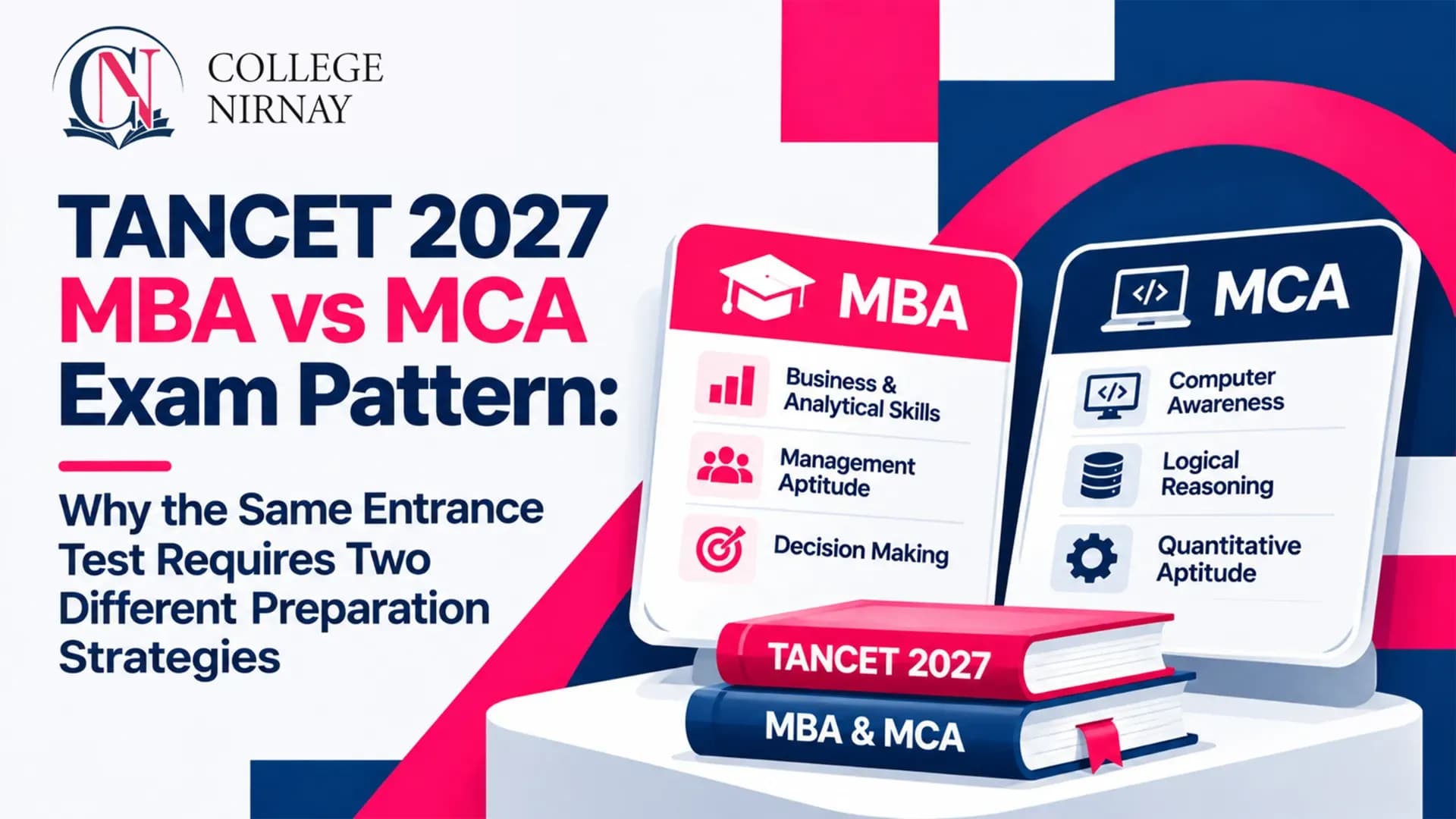
TANCET 2027 MBA vs MCA Exam Pattern: Why the Same Entrance Test Requires Two Different Preparation Strategies
The TANCET 2027 exam pattern is an important consideration for candidates planning to pursue Master of Business Administration (MBA) or Master of Computer Applications (MCA) programmes in Tamil Nadu. Although both entrance examinations are conducted under the Tamil Nadu Common Entrance Test framework, their subject requirements and question-solving demands are different. Candidates should therefore avoid using exactly the same study plan for both programmes.
The TANCET MBA exam pattern in the official 2026 reference brochure included questions assessing business-situation analysis, reading comprehension, mathematics, data sufficiency and written English. By comparison, the TANCET MCA exam pattern covered quantitative ability, analytical ability, logical reasoning and computer awareness, with some questions potentially involving verbal activity or basic science.
Understanding TANCET MBA vs MCA helps candidates identify the subjects that require additional preparation. MBA aspirants need to develop strong interpretation, business decision-making, verbal and quantitative skills. MCA aspirants need to strengthen mathematical reasoning, logical problem-solving, analytical ability and fundamental computer knowledge.
A suitable TANCET preparation strategy must consider the time available, the number of questions, the marking scheme and the nature of each examination. Effective TANCET section wise strategy should focus on conceptual understanding, appropriate question selection and accurate OMR marking rather than simply maximising the number of attempts.
For TANCET MBA preparation, candidates should practise interpreting business-related information, understanding passages and assessing whether given data is sufficient to answer a question. TANCET MCA preparation, meanwhile, should include quantitative problem-solving, analytical puzzles, logical relationships and computer-awareness topics.
The previous TANCET question pattern consisted of 100 multiple-choice questions in 120 minutes for each programme. Both examinations awarded one mark for a correct answer and deducted 0.25 mark for an incorrect response. Consequently, an effective TANCET scoring strategy must balance accuracy, speed and informed answering.
Although the two examinations shared the same overall TANCET exam structure, the appropriate TANCET subject wise preparation methods were different. Candidates should use the latest officially announced syllabus and practice questions that reflect their selected programme.
This detailed Tamil Nadu Common Entrance Test pattern guide compares MBA and MCA sections, marking rules, question types, time allocation, OMR precautions and preparation techniques for the 2027 admission cycle.
TANCET 2027 Exam Pattern Overview: Are MBA and MCA Papers the Same?
The TANCET 2027 exam pattern has not yet been confirmed through a final 2027 information brochure as of November 13, 2026. Candidates can use the official Anna University TANCET 2026 brochure as a historical preparation reference while checking for subsequent changes.
Both MBA and MCA examinations had 100 questions, four answer alternatives per question, a two-hour examination duration and a maximum score of 100 marks in 2026. However, the syllabus and the abilities assessed were different.
| Exam Feature | TANCET MBA 2026 | TANCET MCA 2026 |
|---|---|---|
| Conducting University | Anna University | Anna University |
| Examination Mode | Offline, OMR-based | Offline, OMR-based |
| Question Type | Multiple-choice | Multiple-choice |
| Total Questions | 100 | 100 |
| Maximum Marks | 100 | 100 |
| Duration | 120 minutes | 120 minutes |
| Correct Answer | +1 mark | +1 mark |
| Incorrect Answer | -0.25 mark | -0.25 mark |
| Main Focus | Business, comprehension, mathematics, data sufficiency and English | Quantitative, analytical, logical and computer awareness |
The shared examination duration does not mean the same preparation techniques are equally effective. MBA candidates must practise interpretation and decision-making, while MCA candidates should allocate sufficient time to computer fundamentals and analytical reasoning.
Review the TANCET general exam pattern before designing a study schedule.
TANCET MBA vs MCA: How Do the Examination Papers Differ?
The distinction between TANCET MBA vs MCA is most visible in the subjects assessed. While both contain quantitative reasoning, the MBA examination focuses on business and verbal applications, whereas the MCA examination includes computer awareness and broader analytical and logical reasoning.
TANCET MBA Paper: Five Main Assessment Areas
The official 2026 TANCET MBA exam pattern described the following five areas:
- Analysis of Business Situations: Identifying relevant information and applying it to business decisions.
- Reading Comprehension: Understanding passages and answering questions based on the content.
- Quantitative Ability: Solving mathematical problems at the prescribed level.
- Data Sufficiency: Deciding whether the given information is adequate to answer a question.
- Written English: Understanding grammar, usage, punctuation and related language rules.
TANCET MCA Paper: Four Main Assessment Areas
The official 2026 TANCET MCA exam pattern described:
- Quantitative Ability: Mathematical problem-solving and numerical reasoning.
- Analytical Ability: Interpreting information and determining logical conclusions.
- Logical Reasoning: Recognising patterns, relationships and deductions.
- Computer Awareness: Knowledge of computer concepts and related fundamentals.
The brochure also stated that a few MCA questions could involve verbal activity, basic science or similar areas. Candidates should not assume that the MCA paper is limited exclusively to programming or computer science.
Review the TANCET MBA and MCA paper structure to understand the subject differences.
TANCET Section-Wise Question Distribution: What Do Candidates Need to Know?
The 2026 official brochure confirmed 100 total questions for MBA and 100 for MCA. It listed the relevant subjects but did not provide a separately numbered question allocation for each MCA subject in its evaluation scheme.
Several preparation resources commonly describe the MBA paper as five sections of 20 questions and the MCA paper as four sections of approximately 25 questions. Candidates should distinguish such historical or coaching-oriented distributions from the exact officially prescribed structure for 2027.
| MBA Section | Common Practice Allocation | Preparation Focus |
|---|---|---|
| Business Situations | 20 questions | Interpretation and practical decision-making |
| Reading Comprehension | 20 questions | Passage interpretation |
| Quantitative Ability | 20 questions | Mathematical accuracy |
| Data Sufficiency | 20 questions | Testing adequacy of information |
| English Usage | 20 questions | Grammar and language usage |
The MBA section counts above are a commonly used historical practice distribution and should be verified against the applicable 2027 instructions and actual paper.
| MCA Section | Official 2026 Brochure | Preparation Recommendation |
|---|---|---|
| Quantitative Ability | Included; exact count not specified | Practise mathematics regularly |
| Analytical Ability | Included; exact count not specified | Develop analytical problem-solving |
| Logical Reasoning | Included; exact count not specified | Practise logical relationships and patterns |
| Computer Awareness | Included; exact count not specified | Revise computer fundamentals |
| Additional Areas | A few questions may cover verbal activity or basic science | Do not ignore the officially noted additional scope |
Candidates should build flexibility into their study plan instead of relying entirely on a fixed number of questions from each MCA section.
Review the TANCET section-wise question distribution when planning mock tests.
TANCET MBA Preparation: How to Approach Each of the Five Sections
Effective TANCET MBA preparation should focus on business interpretation, comprehension, quantitative skills, data sufficiency and written English. These sections test different abilities, so preparing every section exclusively through mathematics questions would leave important gaps.
1. Analysis of Business Situations
Candidates should practise identifying the essential facts in a business scenario, distinguishing relevant and irrelevant information, and selecting decisions supported by the provided data. Business-related questions may involve commercial or operational situations rather than specialised management theory alone.
2. Reading Comprehension
Read passages carefully, identify the main idea and distinguish conclusions supported by the passage from unsupported assumptions. Practise responding to direct, inference-based and interpretation questions using only the given material.
3. Quantitative Ability
Revise mathematical foundations including arithmetic, algebra, percentages, ratios, averages, time and work, and other topics covered by the relevant syllabus. Practise accurate calculation and efficient formula selection.
4. Data Sufficiency
The objective is to determine whether the supplied statements contain enough information to answer a question. Candidates should not automatically solve the entire numerical problem when a sufficiency judgement can be made through reasoning.
5. English Usage
Prepare grammar, sentence structure, punctuation, word usage and common language errors. Revise the rules and practise identifying mistakes in unfamiliar sentences.
A strong MBA study plan combines reading practice, decision-making exercises, quantitative revision and language accuracy. Candidates should use a mixture of sectional tests and complete mock examinations.
TANCET MCA Preparation: How to Balance Mathematics, Reasoning and Computer Awareness
Effective TANCET MCA preparation requires a different combination of skills. The official syllabus framework covers quantitative ability, analytical ability, logical reasoning and computer awareness. Candidates should practise all four areas without assuming that the examination tests only advanced programming.
1. Quantitative Ability
Candidates should revise mathematical operations, numerical interpretation and other topics specified by the applicable syllabus. Solving problems with correct methods and manageable calculation time is more useful than memorising formulas without understanding their conditions.
2. Analytical Ability
Practise interpreting information, identifying relationships and reaching conclusions through structured reasoning. Tables, conditions, comparisons and multi-step logical situations can be useful preparation exercises.
3. Logical Reasoning
Work on sequences, classification, logical statements, relationships and similar reasoning formats as applicable to the syllabus. Candidates should learn to identify the rule governing a question before attempting a solution.
4. Computer Awareness
Revise the computing concepts listed in the applicable official syllabus. Preparation may include computer fundamentals, hardware and software concepts, operating systems, data representation and introductory programming-related knowledge where prescribed.
5. Additional Areas
The 2026 brochure noted that a few MCA questions could cover verbal activity, basic science and similar subjects. Students should therefore read the final 2027 syllabus rather than assume these areas can always be skipped.
The most suitable MCA preparation plan depends on the student's mathematics background, reasoning speed and computer-fundamentals knowledge. Mock-test error analysis should determine the areas needing additional revision.
TANCET Question Pattern: What Types of Problems Should MBA and MCA Aspirants Practise?
The TANCET question pattern is objective, but different sections require different approaches. Some questions involve direct knowledge, while others require interpreting a passage, deciding whether information is sufficient or completing a multi-step calculation.
The following examples are descriptions of practice question types, not reproductions of actual TANCET 2027 questions.
| Programme / Section | Illustrative Question Type | Preparation Skill |
|---|---|---|
| MBA: Business Situations | Interpret business data to select a supported decision | Decision-making and data interpretation |
| MBA: Comprehension | Identify a conclusion supported by a passage | Reading accuracy |
| MBA: Quantitative | Calculate a percentage change or ratio | Arithmetic reasoning |
| MBA: Data Sufficiency | Judge whether statements are sufficient to answer a question | Conditional reasoning |
| MBA: English | Identify incorrect usage in a sentence | Grammar accuracy |
| MCA: Quantitative | Solve a numerical or algebraic problem | Mathematical problem-solving |
| MCA: Analytical | Analyse multiple conditions to reach a conclusion | Structured analysis |
| MCA: Logical Reasoning | Recognise a sequence or logical relationship | Pattern recognition |
| MCA: Computer Awareness | Identify a correct computer-system concept | Computer fundamentals |
Candidates should avoid using questions from the other programme as a complete substitute for their own examination preparation. Common quantitative practice can be shared, but each programme has distinct subject demands.
Review the TANCET question types and examination format when selecting practice materials.
TANCET Marking Scheme 2027: How Do Negative Marks Affect MBA and MCA Scores?
The 2026 TANCET MBA and MCA examinations both awarded one mark per correct response and deducted one-quarter mark per incorrect response. The same brochure stated that marking multiple alternatives for a question would be treated as a wrong response and would attract the 0.25-mark deduction.
A useful TANCET scoring strategy involves calculating net marks rather than counting attempts alone.
Net Score = Correct Answers − (Incorrect Answers × 0.25)
| Correct | Incorrect | Unanswered | Net Marks |
|---|---|---|---|
| 50 | 20 | 30 | 45 |
| 60 | 20 | 20 | 55 |
| 70 | 15 | 15 | 66.25 |
| 80 | 20 | 0 | 75 |
| 85 | 10 | 5 | 82.5 |
These scores are mathematical examples, not predicted cutoffs or rank estimates. A candidate should evaluate the chance of answering correctly, the time needed and the risk of an OMR marking error.
Under the +1/-0.25 scheme, an answer has a positive expected score when the probability of being correct is greater than 20%. This does not guarantee that any particular guess will earn marks, and time spent guessing can reduce opportunities to solve other questions.
Review the TANCET marking scheme and negative marking before creating an attempt plan.
TANCET 120-Minute Exam: How Should MBA and MCA Candidates Allocate Time?
The 2026 MBA and MCA examinations provided 120 minutes for 100 questions, giving candidates an average of 1.2 minutes, or 72 seconds, per question. This is an overall planning average rather than an official question-wise time limit.
Time allocation should reflect the examination content. MBA candidates may require additional time for reading passages and analysing business situations, while MCA candidates may need more time for quantitative or analytical problems.
Illustrative TANCET MBA Time Allocation
| MBA Section | Suggested Time |
|---|---|
| Business Situations | 25 minutes |
| Reading Comprehension | 25 minutes |
| Quantitative Ability | 25 minutes |
| Data Sufficiency | 20 minutes |
| English Usage | 15 minutes |
| Final Review / OMR Check | 10 minutes |
| Total | 120 minutes |
Illustrative TANCET MCA Time Allocation
| MCA Preparation Area | Suggested Time |
|---|---|
| Quantitative Ability | 35 minutes |
| Analytical Ability | 25 minutes |
| Logical Reasoning | 25 minutes |
| Computer Awareness and Other Questions | 25 minutes |
| Final Review / OMR Check | 10 minutes |
| Total | 120 minutes |
These allocations are illustrative mock-test strategies, not official subject-wise time restrictions. Candidates should adapt them to actual paper content and individual performance. OMR responses must be marked in accordance with the applicable examination instructions.
Review the TANCET examination duration and practise realistic timed papers.
TANCET Section Wise Strategy: How Should Candidates Select Questions?
An effective TANCET section wise strategy should distinguish questions that can be answered confidently from those requiring substantial additional time. The best approach depends on the candidate's performance during practice.
A three-stage attempt method may be tested in mock examinations:
Stage 1: Attempt Familiar Questions
Answer questions that rely on well-understood concepts and can be solved accurately without excessive calculation or rereading.
Stage 2: Return to Moderate Questions
Revisit questions that require additional reasoning but appear solvable within the remaining time. Compare the likely benefit of completing the question against the time needed.
Stage 3: Review Uncertain Questions
Evaluate whether further reasoning or elimination can improve confidence. Remember that wrong answers receive a penalty under the 2026 reference scheme.
For MBA, candidates should avoid getting stuck repeatedly rereading a comprehension passage or analysing an ambiguous business scenario without making progress. For MCA, candidates should be cautious about unusually lengthy numerical questions and complex analytical puzzles.
This method is a preparation suggestion, not an officially prescribed examination sequence. Candidates should follow the answer-sheet and question-booklet instructions issued for 2027.
TANCET Subject Wise Preparation: Which Topics Should Receive Extra Attention?
Good TANCET subject wise preparation begins with a comparison between the official syllabus and the candidate's current skills. Topic priorities should be based on confirmed syllabus coverage and recurring mistakes, not unsupported predictions about guaranteed question frequency.
| Programme | Area Needing Attention | Recommended Practice |
|---|---|---|
| MBA | Business Data Interpretation | Business scenarios and fact-based decision questions |
| MBA | Reading Comprehension | Passage analysis and inference questions |
| MBA | Quantitative Problems | Arithmetic, algebra and relevant mathematical applications |
| MBA | Data Sufficiency | Logical assessment of statements |
| MBA | Written English | Usage, grammar and punctuation correction |
| MCA | Quantitative Ability | Numerical and algebraic problem-solving |
| MCA | Analytical Ability | Structured puzzles and information-based reasoning |
| MCA | Logical Reasoning | Patterns and logical deductions |
| MCA | Computer Awareness | Officially prescribed computer fundamentals |
The recommendations are not a verified chapter-weightage ranking. Candidates should adjust practice intensity after analysing timed tests and incorrect responses.
Students applying for both MBA and MCA should develop a shared quantitative foundation while maintaining separate preparation schedules for the unique sections.
TANCET OMR Answer Sheet: How Can Marking Errors Reduce Your Score?
Under the 2026 examination structure, both MBA and MCA candidates answered questions on an OMR sheet. The official brochure specifically stated that multiple shading would be treated as an incorrect response, resulting in a one-quarter-mark deduction.
Candidates should observe the following precautions:
- Read the current OMR instructions before marking answers.
- Confirm the question number and corresponding response location.
- Use the permitted writing instrument specified by Anna University.
- Mark only the selected alternative for each question.
- Avoid multiple shading or unauthorised corrections.
- Check candidate particulars and booklet information carefully.
- Do not postpone all answer marking until the final moments.
- Follow the invigilator's instructions throughout the examination.
The previous examination instructions specified a black ballpoint pen for OMR marking. Candidates should verify the applicable 2027 instructions rather than assume every examination year uses identical stationery rules.
OMR accuracy should be practised during full-length mock tests because avoidable marking mistakes can affect the final score even when the underlying question is solved correctly.
How Should MBA and MCA Candidates Analyse Their TANCET Mock Tests?
Mock tests are useful only when candidates review the reasons behind incorrect responses, unanswered questions and time-consuming problems. The analysis should identify specific improvements needed before the next test.
| Metric | What to Measure |
|---|---|
| Total Attempts | Number of questions answered |
| Correct Answers | Accurately solved questions |
| Incorrect Answers | Responses attracting negative marks |
| Unanswered Questions | Questions skipped through uncertainty or lack of time |
| Section Accuracy | Correct responses divided by attempts in each section |
| Solving Time | Minutes spent across different question types |
| Error Type | Concept, reading, calculation, reasoning or OMR mistake |
| Net Marks | Score after applying negative marking |
| Revision Action | Topic or solving method needing attention |
MBA candidates should distinguish comprehension and interpretation mistakes from numerical errors. MCA candidates should separately track quantitative, analytical, logical and computer-awareness weaknesses.
Improvement should be measured through fresh questions rather than repeatedly solving the same mock until the answers become familiar.
Will the TANCET 2027 MBA or MCA Exam Pattern Change?
The final TANCET 2027 examination brochure has not been confirmed as published as of November 13, 2026. Consequently, the 2026 MBA and MCA structure should be used as a reference, not as a guarantee that every detail will remain unchanged.
The 2026 framework specified 100 questions, four options per question, a two-hour duration, +1 for correct answers and -0.25 for incorrect responses. It also identified the subject areas assessed in each programme.
When Anna University issues the 2027 information brochure, candidates should verify:
- Whether MBA and MCA continue to have separate examination papers.
- The total questions and maximum marks.
- The final section list and syllabus for each programme.
- Any prescribed section-wise question allocation.
- The examination duration.
- The negative-marking scheme.
- The number of alternatives per question.
- The answer-sheet and OMR instructions.
- The examination language and permitted stationery.
- The final examination date and programme-specific schedule.
Candidates should not assume that an unofficial statement about changed section counts or revised negative marking is correct unless it can be traced to an official Anna University notification.
Review the TANCET exam pattern changes before finalising the 2027 preparation strategy.
TANCET MBA vs MCA Exam Pattern: Quick Comparison Table
| Preparation Question | MBA | MCA |
|---|---|---|
| How many questions? | 100 in 2026 | 100 in 2026 |
| How much time? | 120 minutes | 120 minutes |
| Which core sections? | Business analysis, comprehension, mathematics, data sufficiency and English | Quantitative, analytical, logical and computer awareness |
| What is the reference marking? | +1 / -0.25 | +1 / -0.25 |
| Main preparation difference? | Interpretation, business decisions and language | Analytical reasoning, mathematics and computer knowledge |
| Is exact 2027 section weightage known? | Await official confirmation | Await official confirmation |
| What should guide time allocation? | Mock-test accuracy and reading/solving demands | Quantitative and reasoning time plus computer awareness |
The table summarises the 2026 reference scheme and general preparation implications. It should be updated if Anna University modifies the syllabus, duration, question count or marking scheme for 2027.
Review the TANCET exam pattern comparison table for a quick reference.
Common Preparation Mistakes in TANCET MBA and MCA Examinations
- Using the same syllabus for both papers: MBA and MCA assess different knowledge areas.
- Ignoring business situations for MBA: Quantitative practice alone does not cover the complete MBA paper.
- Ignoring computer awareness for MCA: Mathematics and reasoning alone are insufficient.
- Skipping reading comprehension: MBA aspirants must practise passage interpretation.
- Confusing data sufficiency with regular arithmetic: The task is often to judge whether information is adequate.
- Memorising computer terms without understanding: Fundamental concepts should be applied accurately.
- Following unsupported section weightage: The final 2027 official pattern must determine the examination requirements.
- Ignoring negative marking: Incorrect and multiple-shaded responses attract penalties under the 2026 scheme.
- Using only sectional tests: Full-length practice is needed to assess time management.
- Failing to review mistakes: Mock-test scores are more useful when followed by targeted revision.
- Leaving OMR marking until the end: This can create unnecessary time pressure.
- Assuming previous-year timings are final: The 2027 schedule must be confirmed through official announcements.
Avoiding these mistakes can help candidates develop stronger subject coverage, better question selection and more reliable examination performance.
7-Day TANCET MBA and MCA Preparation Strategy
The following schedule is an illustrative preparation cycle. Candidates should adjust the activities based on their programme and current progress.
| Day | MBA Preparation | MCA Preparation |
|---|---|---|
| Day 1 | Business situation analysis | Quantitative ability |
| Day 2 | Reading comprehension practice | Analytical ability |
| Day 3 | Quantitative ability revision | Logical reasoning |
| Day 4 | Data sufficiency questions | Computer fundamentals |
| Day 5 | English usage and mixed sections | Mixed quantitative, analytical and computer-awareness practice |
| Day 6 | Two-hour MBA mock test | Two-hour MCA mock test |
| Day 7 | Review net marks and weak MBA sections | Review net marks and weak MCA sections |
The cycle should be repeated with different questions and targeted revision. Candidates should update their preparation if the official syllabus changes.
Candidates appearing for both programmes should create separate full-length mock sessions, since each examination has its own subject requirements.
Frequently Asked Questions About TANCET 2027 MBA vs MCA Exam Pattern
Is the TANCET 2027 exam pattern the same for MBA and MCA?
The TANCET 2027 exam pattern must be confirmed through the official 2027 brochure. In 2026, both programmes had 100 questions in 120 minutes with the same marking rules, but their subject coverage differed significantly.
How many questions are in the TANCET MBA paper?
The official 2026 TANCET MBA exam pattern had 100 MCQs carrying 100 marks. The paper tested business situations, comprehension, quantitative ability, data sufficiency and English usage.
What subjects are included in the TANCET MCA paper?
The 2026 TANCET MCA exam pattern included quantitative ability, analytical ability, logical reasoning and computer awareness. The brochure also allowed a few questions involving verbal activity and basic science.
Is TANCET MBA easier than TANCET MCA?
There is no universal answer. The TANCET MBA vs MCA difficulty comparison depends on each candidate's preparation and the actual questions. MBA focuses more on business and verbal interpretation, while MCA includes computer awareness and analytical or logical problem-solving.
Is there negative marking in TANCET MBA and MCA?
Yes. The 2026 marking scheme deducted 0.25 mark per incorrect response for both programmes. Multiple shading was also treated as wrong. The 2027 rules should be verified when published.
What is the duration of the TANCET entrance examination?
Both MBA and MCA papers lasted two hours, or 120 minutes, under the official 2026 framework. Candidates should use the current 2027 instructions for final confirmation.
What is the best TANCET preparation strategy?
An effective TANCET preparation strategy combines the official syllabus, programme-specific sectional practice, timed mocks, negative-marking awareness and detailed error analysis.
How should MBA candidates prepare for TANCET?
For TANCET MBA preparation, practise business-data interpretation, reading comprehension, mathematics, data sufficiency and written English. Use mock tests to identify which sections require additional attention.
How should MCA candidates prepare for TANCET?
For TANCET MCA preparation, revise quantitative ability, analytical ability, logical reasoning and computer awareness, together with any additional areas specified by the official syllabus.
Does TANCET MCA always have 25 questions from each section?
The official 2026 brochure specified 100 questions overall but did not separately guarantee 25 questions in each MCA section. Candidates should not treat a commonly used practice allocation as an official 2027 distribution.
Can students prepare for both TANCET MBA and MCA together?
Candidates eligible for both programmes can share some quantitative and reasoning practice. However, they need separate preparation for MBA-specific business and language sections and MCA-specific computer-awareness and analytical sections.
What is the best scoring strategy for TANCET?
A practical TANCET scoring strategy focuses on accurate answers, sensible question selection and correct OMR marking. Under the 2026 scheme, net marks equal correct answers minus 0.25 times incorrect answers.
Where can I check the official TANCET exam structure for 2027?
Review the TANCET exam pattern FAQs and Anna University's official information brochure. The final Tamil Nadu Common Entrance Test pattern for 2027 will determine the applicable syllabus, question count, timing and marking rules.
Final Answer: Why Do TANCET 2027 MBA and MCA Require Different Preparation Strategies?
TANCET MBA and MCA share an entrance-test framework but assess different academic and problem-solving abilities. In 2026, both examinations contained 100 multiple-choice questions, lasted two hours and applied a 0.25-mark penalty for incorrect answers.
MBA preparation should emphasise business-situation analysis, reading comprehension, quantitative ability, data sufficiency and written English. MCA preparation should focus on quantitative ability, analytical ability, logical reasoning and computer awareness, while also checking the additional areas mentioned in the official syllabus.
Candidates should not assume that identical examination duration means identical question difficulty or the same section-wise time allocation. Their study schedules should reflect programme-specific subjects, individual strengths and the time needed to solve questions accurately.
Negative marking also makes careful question selection important. Students should practise understanding the question, eliminating unsupported options, avoiding OMR errors and reviewing their performance through full-length tests.
The most suitable TANCET section wise strategy combines syllabus coverage, targeted practice and error analysis. A strong TANCET exam structure understanding can help candidates distinguish which sections require reading, calculation, logical analysis or factual computer knowledge.
For effective TANCET subject wise preparation, use the 2026 official pattern as a historical reference and verify the final 2027 notification before making assumptions about section distribution or marking changes. Separate MBA and MCA preparation plans provide a more appropriate foundation than relying on one identical strategy for both examinations.