
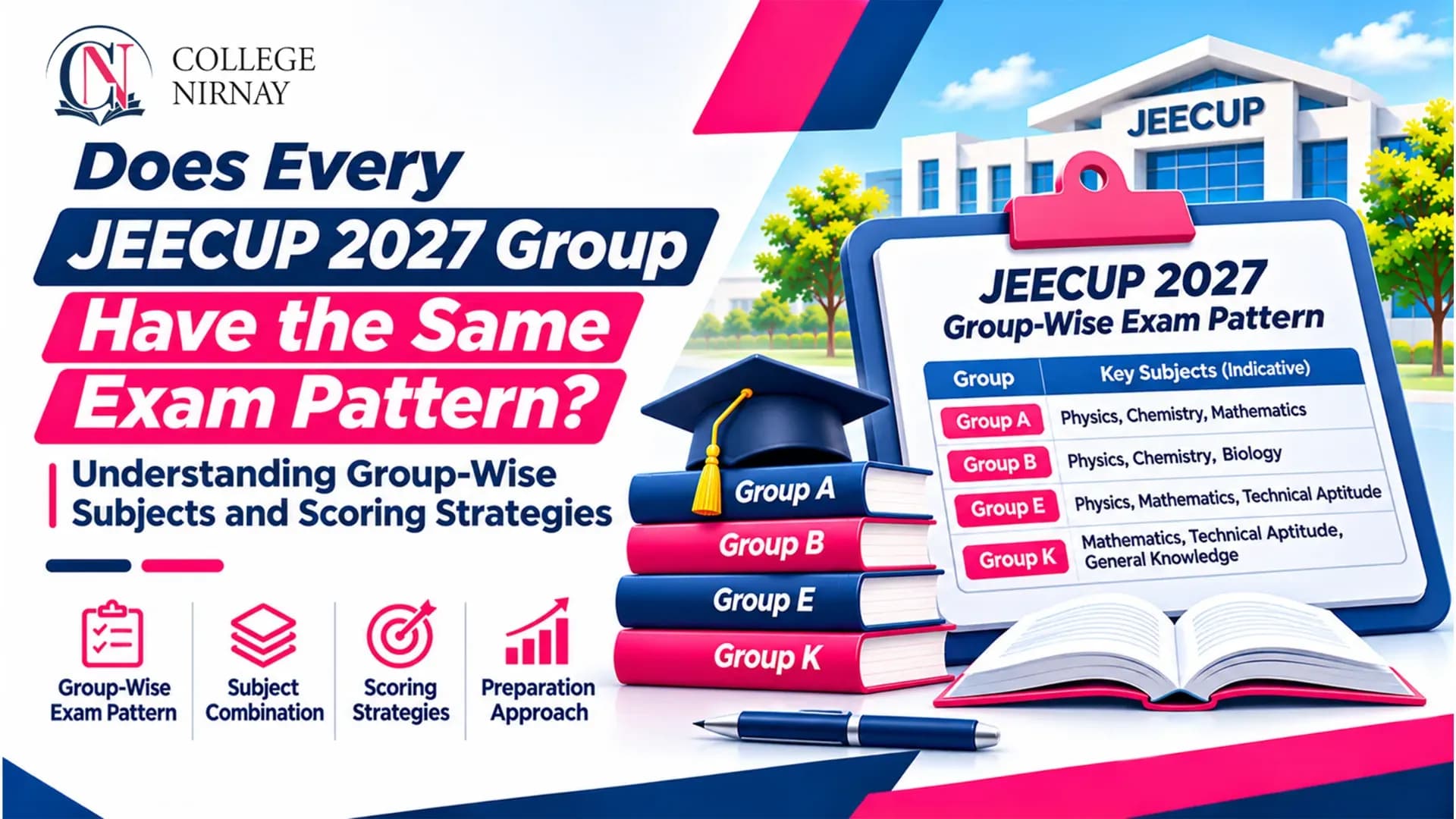
Does Every JEECUP 2027 Group Have the Same Exam Pattern? Understanding Group-Wise Subjects and Scoring Strategies
The JEECUP 2027 exam pattern is an important part of preparation for students seeking admission to polytechnic diploma courses in Uttar Pradesh. One common question is whether every examination group follows the same question paper or whether Engineering, Agricultural Engineering, Pharmacy and lateral-entry candidates need to prepare different subjects.
The answer is that the JEECUP group wise exam pattern has shared examination features but different subject combinations. Under the official 2026 reference scheme, each group had a computer-based test consisting of 100 multiple-choice questions carrying 400 marks, with a duration of two hours and thirty minutes. However, the JEECUP group wise subjects depended on the diploma programme selected by the applicant.
The JEECUP exam groups include Group A for Engineering and Technology Diplomas, Group B for Agricultural Engineering, Group E for Pharmacy, and Group K for lateral entry into eligible engineering diploma programmes. Other groups cover courses involving languages, reasoning, science, management and specialised technical subjects.
Understanding the JEECUP subject combinations is necessary because students cannot follow a universal preparation schedule for every course group. For example, the JEECUP group A pattern assigns half of the paper to Mathematics, whereas the JEECUP group E pattern includes Physics and Chemistry with Biology or Mathematics, depending on the relevant paper option.
The JEECUP group B pattern includes Mathematics together with Physics, Chemistry and Agriculture. The JEECUP group K pattern gives substantial weightage to engineering or technical subjects associated with the appropriate lateral-entry branch.
An effective JEECUP scoring strategy should therefore reflect the number of questions assigned to each subject, the candidate's existing knowledge and the examination rules. A balanced JEECUP preparation strategy involves revising the correct syllabus, practising subject-specific questions and using timed mock tests to improve performance.
The JEECUP question pattern under the 2026 brochure included four answer options per question, four marks for a correct response and no negative marking. The broader UP Polytechnic exam pattern also included bilingual presentation in Hindi and English and the possibility of score normalisation when the same group was examined in multiple shifts.
This detailed JEECUP 2027 exam pattern guide explains the common examination structure, different group-wise subjects, question distribution, marking scheme, time management and preparation methods. The final 2027 rules must be confirmed when the official examination brochure is published.
JEECUP 2027 Exam Pattern Overview: What Is Common Across All Groups?
The JEECUP 2027 exam pattern is expected to retain several features of the previous examination, but the final scheme for the 2027–28 admission session has not yet been notified.
The official 2026 information brochure specified a common computer-based examination format for the listed groups. The questions were objective-type, with four options and one correct answer under the normal marking scheme.
| Feature | 2026 Official Reference |
|---|---|
| Examination | Uttar Pradesh Joint Entrance Examination (Polytechnic) |
| Conducting Authority | Joint Entrance Examination Council, Uttar Pradesh |
| Mode | Computer-Based Test (CBT) |
| Question Type | Multiple-choice questions |
| Questions | 100 per paper |
| Maximum Marks | 400 |
| Correct Answer | +4 marks |
| Incorrect Answer | No negative marking |
| Unattempted Question | 0 marks |
| Duration | 2 hours 30 minutes |
| Language | Hindi and English |
| Subjects | Different for each examination group |
These common features should not be confused with identical question papers. The subject coverage differs according to the programme group and applicable qualifying education.
As of November 14, 2026, the official JEECUP information bulletin page lists the 2026 brochure. Candidates should verify the corresponding 2027 publication before assuming these details remain unchanged.
Review the JEECUP general examination pattern before planning preparation.
JEECUP Exam Groups: How Do Engineering, Agriculture, Pharmacy and Lateral-Entry Papers Differ?
The JEECUP exam groups are organised around different diploma admission pathways. Candidates should first identify the programme they intend to pursue and then check the examination group associated with that programme.
Group A – Engineering and Technology
This group is associated with first-year admission to three-year engineering and technology diploma programmes. The 2026 reference paper consisted of Mathematics and Physics/Chemistry sections.
Group B – Agricultural Engineering
Group B is intended for Agricultural Engineering. The reference examination included Mathematics, Physics, Chemistry and Agriculture-related questions.
Group E1 and E2 – Diploma in Pharmacy
Group E offered Pharmacy paper options based on Biology or Mathematics, along with Physics and Chemistry.
Group K1–K8 – Engineering Diploma Lateral Entry
Group K is associated with admission to the second year of eligible engineering diploma programmes. The examination included common Mathematics/Science questions and questions associated with the relevant engineering branch or ITI trade.
Other JEECUP Groups
The council's 2026 brochure also included Groups C, D, F, G, H, I and L. These covered other diploma programmes requiring languages, reasoning, numerical ability, science, technical aptitude or course-specific knowledge.
Review the JEECUP group-wise examination papers to understand the difference between entry routes.
JEECUP Group A Pattern: Mathematics, Physics and Chemistry Distribution
The JEECUP group A pattern is relevant to students preparing for Engineering and Technology Diploma admission. Under the 2026 brochure, Mathematics accounted for 50% of the examination questions, while Physics and Chemistry together accounted for the remaining 50%.
| Section | Question Share | Questions Out of 100 | Marks |
|---|---|---|---|
| Mathematics | 50% | 50 | 200 |
| Physics and Chemistry Combined | 50% | 50 | 200 |
| Total | 100% | 100 | 400 |
The brochure gives Physics and Chemistry a combined allocation. It does not separately guarantee 25 questions from Physics and 25 from Chemistry in every paper.
Suggested Group A Preparation Strategy
- Revise Class 10 Mathematics foundations.
- Practise arithmetic, algebra, geometry and other relevant syllabus topics.
- Study Physics and Chemistry concepts from the prescribed level.
- Attempt mixed Mathematics and Science practice sets.
- Use timed tests to identify slow or unfamiliar question types.
- Review incorrect responses and recurring concept gaps.
A candidate should not spend all available study time on Mathematics because Physics and Chemistry together represent half of the reference paper.
JEECUP Group B Pattern: Why Agriculture Changes the Question Paper
The JEECUP group B pattern is used for Agricultural Engineering. It resembles Group A in having a substantial Mathematics component but differs because Agriculture is included in the other subject section.
According to the 2026 brochure, Mathematics represented 50% of the Group B questions, while Physics, Chemistry and Agriculture together represented 50%.
| Section | Share | Questions | Marks |
|---|---|---|---|
| Mathematics | 50% | 50 | 200 |
| Physics, Chemistry and Agriculture Combined | 50% | 50 | 200 |
| Total | 100% | 100 | 400 |
The official reference does not divide the combined Physics, Chemistry and Agriculture section into fixed individual subject counts.
Suggested Group B Preparation Strategy
- Maintain regular Mathematics practice.
- Revise the required Physics and Chemistry concepts.
- Cover the Agriculture syllabus appropriate to the qualifying education.
- Practise identifying agricultural terms and technical concepts.
- Use mock tests covering both halves of the paper.
- Compare progress across Mathematics and the combined science/agriculture component.
Group B candidates should not simply follow a Group A study schedule because the relevant Agriculture material must also be prepared.
JEECUP Group E Pattern: Physics, Chemistry, Biology or Mathematics?
The JEECUP group E pattern is associated with Diploma in Pharmacy admission. The 2026 reference framework included Group E1 and E2 paper options involving Biology or Mathematics.
Physics and Chemistry together accounted for 50% of the paper, while Biology or Mathematics accounted for the other 50%, depending on the applicable option.
| Component | Share | Questions | Marks |
|---|---|---|---|
| Physics and Chemistry Combined | 50% | 50 | 200 |
| Biology or Mathematics | 50% | 50 | 200 |
| Total | 100% | 100 | 400 |
Candidates should carefully check the exact E1/E2 paper designation and qualifying subject requirements when registering. Class 12 Physics and Chemistry with Mathematics or Biology formed the academic foundation for this admission route under the previous brochure.
Suggested Group E Strategy
- Revise the relevant Class 11 and 12 science concepts.
- Strengthen both Physics and Chemistry fundamentals.
- Prepare the Biology or Mathematics option corresponding to the registration.
- Attempt objective questions based on the official syllabus.
- Review incorrectly answered scientific questions.
- Practise both components under timed conditions.
Preparing for Group E as though it were a Class 10 engineering paper would be inappropriate because its qualification and subject requirements differ.
JEECUP Group K Pattern: Why Does Engineering Carry 60% Weightage?
The JEECUP group K pattern applies to lateral-entry admission into the second year of eligible Engineering Diploma programmes.
Under the 2026 reference framework, 40% of Group K questions covered high-school-level Mathematics, Physics and Chemistry. The remaining 60% covered engineering or trade-specific subjects linked to the relevant K subdivision.
| Section | Share | Questions | Marks |
|---|---|---|---|
| Mathematics, Physics and Chemistry | 40% | 40 | 160 |
| Relevant Engineering / Trade Subjects | 60% | 60 | 240 |
| Total | 100% | 100 | 400 |
Group K includes subdivisions for different engineering branches. Candidates should verify the exact K1–K8 category, the corresponding engineering subject and their eligibility through the official brochure.
Suggested Group K Preparation Strategy
- Identify the correct lateral-entry group subdivision.
- Revise common Mathematics and Science fundamentals.
- Prepare the engineering or ITI trade subject specified for the branch.
- Give substantial preparation time to the technical portion because it carries 60% of the reference paper.
- Practise technical MCQs and mixed full-length tests.
- Review the course-specific syllabus instead of preparing a different engineering branch.
The 60% technical allocation makes Group K particularly different from Group A. Candidates should not assume that success in a Class 10 Mathematics/Science test alone is sufficient preparation.
JEECUP Group-Wise Subject Distribution: How Many Questions Come From Each Section?
The JEECUP group wise subjects differ because the programmes assess different types of academic preparation. The JEECUP subject combinations are described through percentages in the official information brochure.
The following table summarises major 2026 reference allocations. Each percentage corresponds numerically to the same number of questions because the standard examination contained 100 questions.
| Group | Subject Distribution | Preparation Emphasis |
|---|---|---|
| A | Mathematics 50%; Physics/Chemistry 50% | Engineering-entry Mathematics and Science |
| B | Mathematics 50%; Physics/Chemistry/Agriculture 50% | Mathematics, Science and Agriculture |
| C | English/Hindi comprehension 20%; Reasoning/Intelligence 50%; General Awareness 30% | Language, reasoning and awareness |
| D | Comprehension 30%; Reasoning/Intelligence 35%; Numerical Ability 10%; General Awareness 25% | Comprehension, reasoning and aptitude |
| E1/E2 | Physics/Chemistry 50%; Biology or Mathematics 50% | Pharmacy-related science subjects |
| F | Chemistry 50%; Zoology and Botany in the remaining portion | Biological and chemical sciences |
| G | English 20%; Numerical Ability 15%; Reasoning 30%; General Intelligence 20%; General Awareness 15% | Graduate-level general aptitude |
| H | Reasoning 25%; Numerical/Scientific Aptitude 25%; English 25%; General Knowledge 25% | Hotel management-related aptitude |
| I | Physics/Chemistry 50%; Mathematics 50% | Higher-secondary science and Mathematics |
| K1–K8 | Mathematics/Physics/Chemistry 40%; relevant Engineering 60% | Branch-specific technical subjects |
| L | Specialised technical subjects as prescribed in the brochure | Course-specific technical preparation |
For Groups F and L, candidates should consult the original official table for exact subdivisions and subject allocations rather than rely on a simplified summary.
The distribution table does not imply that every group has the same syllabus difficulty or qualification level. For example, an engineering Class 10 route and a postgraduate diploma route can both have 100 questions while assessing different educational material.
Review the JEECUP subject-wise question distribution before setting study priorities.
JEECUP Question Pattern: Are All Groups Asked 100 Questions?
The JEECUP question pattern in the official 2026 scheme included 100 objective-type questions per group, each with four answer options.
The questions were presented through computer-based testing in Hindi and English. The examination interface also provided a facility to mark questions for later review.
Although every paper carried the same maximum marks, the subject coverage differed considerably.
| Feature | Common Reference | Possible Difference |
|---|---|---|
| Question Count | 100 | Subjects differ by group |
| Maximum Marks | 400 | Admission ranking and competition differ |
| Question Type | Objective MCQ | Knowledge and skills assessed differ |
| Language | Hindi and English display | Language-comprehension sections have their own content |
| Duration | 150 minutes | Time needed per topic can differ |
Students should practise reading questions carefully, navigating between questions and reviewing uncertain answers. The CBT format rewards familiarity with the examination interface as well as subject knowledge.
Review the JEECUP question format and CBT details before attempting practice examinations.
JEECUP Marking Scheme: Is There Negative Marking in 2027?
The official 2026 JEECUP brochure stated that each correct answer received four marks and no marks were deducted for an incorrect answer.
This is important because some unofficial examination guides describe a negative penalty that does not match the 2026 official instructions.
| Response | 2026 Marking |
|---|---|
| Correct Answer | +4 |
| Wrong Answer | 0 |
| Unanswered Question | 0 |
| Maximum Marks | 400 |
Illustrative JEECUP Scoring Examples
| Correct | Incorrect | Unattempted | Marks |
|---|---|---|---|
| 45 | 35 | 20 | 180 |
| 60 | 30 | 10 | 240 |
| 75 | 20 | 5 | 300 |
| 90 | 10 | 0 | 360 |
These are simple calculations based on the 2026 scoring rule, not predicted qualifying marks or college cutoffs.
If the same no-negative-marking system continues in 2027, candidates can attempt remaining questions without a score deduction for incorrect responses. However, they should first use available time to solve questions they understand and review uncertain answers.
Review the JEECUP marking scheme and scoring rules once the final 2027 brochure is released.
JEECUP Exam Duration: How to Manage 100 Questions in 150 Minutes
The official 2026 examination duration was two hours and thirty minutes, equivalent to 150 minutes.
With 100 questions, the average available time was 1.5 minutes, or 90 seconds, per question. This is an arithmetic average rather than an official time limit for each individual question.
Some numerical questions may take longer than 90 seconds, while factual or language questions may be answered more quickly.
Suggested Time Management Framework
| Stage | Suggested Minutes | Activity |
|---|---|---|
| First Pass | 75 | Attempt familiar and straightforward questions |
| Second Pass | 55 | Return to questions requiring more reasoning or calculations |
| Final Review | 20 | Check marked questions and unanswered items |
| Total | 150 | Illustrative allocation only |
Candidates should adapt this time distribution based on their group. For example, technical calculations in Group K may require different pacing from language and reasoning questions in Group C or G.
Review the JEECUP exam duration and time management before practising full-length tests.
JEECUP Scoring Strategy: How Should Preparation Change According to Your Group?
A suitable JEECUP scoring strategy starts with the subject distribution in the selected paper. Candidates should avoid studying an unrelated group syllabus simply because free mock tests or coaching materials are more readily available.
| Group | Primary Strategy | Potential Risk |
|---|---|---|
| A | Balance Mathematics and Physics/Chemistry | Ignoring half the paper |
| B | Combine Mathematics with Agriculture and Science | Following only Group A material |
| C | Prioritise reasoning while covering languages and awareness | Neglecting comprehension |
| D | Prepare reasoning, comprehension and general aptitude | Underestimating numerical ability |
| E | Balance Physics/Chemistry and the selected Biology/Mathematics option | Preparing wrong paper option |
| G/H | Practise timed reasoning, comprehension and aptitude | Ignoring breadth of topics |
| K | Devote substantial effort to the relevant technical branch | Studying only common Mathematics/Science |
How to Improve Scoring Accuracy
- Use the official group-wise syllabus as the starting point.
- Assess current performance with a diagnostic test.
- Identify high-weightage sections without ignoring the remaining syllabus.
- Revise weak fundamentals before attempting advanced questions.
- Take timed subject-wise practice tests.
- Complete full-length CBT-style mock examinations.
- Analyse unanswered and incorrectly answered questions.
- Revisit older topics regularly.
- Follow the final examination marking rules.
- Use official instructions for question review and final submission.
No particular score can guarantee a preferred polytechnic college because rank, available seats, category, choices and counselling rules also affect admission.
JEECUP Preparation Strategy 2027: Seven-Day Group-Wise Study Framework
An effective JEECUP preparation strategy should distribute study time according to the candidate's group and observed weaknesses. The following schedule is illustrative and can be repeated with fresh topics and practice papers.
| Day | Suggested Task | Group-Specific Adjustment |
|---|---|---|
| Day 1 | Review syllabus and diagnostic score | Identify weak subjects for the registered group |
| Day 2 | Study the highest-weightage area | Maths for A/B, Science for E, Technical subject for K |
| Day 3 | Revise remaining main subjects | Science, Agriculture, language or aptitude as applicable |
| Day 4 | Attempt topic-wise objective questions | Use current group-specific question sets |
| Day 5 | Mixed question practice | Balance sections according to paper distribution |
| Day 6 | Full 150-minute mock test | Simulate the appropriate group examination |
| Day 7 | Analyse and revise errors | Create the next week's topic priorities |
The schedule is a study suggestion, not an official preparation timetable. Students who have not completed the syllabus should spend additional time learning concepts before increasing the number of full-length mocks.
Candidates should also practise the official computer-based test interface when the council provides an authorised mock examination facility.
Will the JEECUP 2027 Exam Pattern Change From 2026?
The official 2027–28 examination pattern has not yet been confirmed as of November 14, 2026. The most recent available information brochure on the official portal describes the 2026 admission session.
The following points must be verified when the new brochure is issued:
- Whether the examination remains computer-based for all listed groups.
- Whether each group continues to have 100 questions.
- Whether the maximum remains 400 marks.
- Whether four marks are awarded for each correct answer.
- Whether the no-negative-marking rule remains unchanged.
- Whether the duration remains two hours and thirty minutes.
- Whether the group-wise subject percentages remain the same.
- Whether any group codes or diploma options are introduced, revised or discontinued.
- Whether any updates are made to the CBT interface or examination instructions.
- Whether normalisation continues for examinations held across multiple shifts.
The council may also issue updates to the examination timetable, group availability or counselling rules independently of the core paper format.
Review the JEECUP 2027 exam pattern changes when the official notification becomes available.
How Does Normalisation Affect JEECUP Scores Across Different Shifts?
The official 2026 brochure explained that a group may need to be examined in multiple shifts when the number of candidates is large.
Different shifts can receive different question papers. Although the examination authority attempts to maintain similar difficulty levels, variations can occur.
To address these differences, the 2026 brochure described a normalisation procedure for papers held across multiple shifts within the same group.
The process used statistical values associated with marks across all shifts and within a particular session to calculate adjusted scores.
Candidates should distinguish three concepts:
- Raw marks: The score obtained using the examination's marking scheme.
- Normalised marks: Adjusted scores calculated under the official formula when applicable.
- Merit position: The candidate's position in the applicable admission ranking process.
A particular number of correct answers does not automatically guarantee the same final merit position across different sessions. Candidates should follow the official results and group-specific ranking rules.
JEECUP 2027 Group-Wise Exam Pattern: Complete Quick Comparison Table
| Feature | Group A | Group B | Group E | Group K |
|---|---|---|---|---|
| Main Programme | Engineering Diploma | Agricultural Engineering | Pharmacy | Engineering Lateral Entry |
| Core Subjects | Maths, Physics, Chemistry | Maths, Physics, Chemistry, Agriculture | Physics, Chemistry, Biology/Maths | Maths, Science, Engineering |
| First Section | Maths 50% | Maths 50% | Physics/Chemistry 50% | Maths/Science 40% |
| Second Section | Physics/Chemistry 50% | Physics/Chemistry/Agriculture 50% | Biology/Maths 50% | Engineering 60% |
| Questions | 100 | 100 | 100 | 100 |
| Marks | 400 | 400 | 400 | 400 |
| Duration | 150 minutes | 150 minutes | 150 minutes | 150 minutes |
| 2026 Negative Marking | None | None | None | None |
This table compares the four major groups using official 2026 reference information. It should not be treated as confirmation that the 2027 scheme will be identical.
Review the JEECUP group-wise exam pattern summary before finalising subject priorities.
Common Mistakes Students Make While Preparing for Different JEECUP Groups
- Assuming every group has the same subjects: Subject combinations change with the diploma.
- Using Group A mocks for Group B: Agriculture-related preparation may be missing.
- Ignoring Mathematics in Group A: It carries half the reference paper.
- Ignoring Science in Group A: Physics and Chemistry together carry the other half.
- Preparing the wrong Group E option: Biology and Mathematics papers require different preparation.
- Neglecting technical subjects in Group K: Engineering carries 60% of the reference paper.
- Confusing syllabus weightage with minimum eligibility marks: These are separate conditions.
- Assuming every numerical section has equal difficulty: Difficulty varies with concepts and personal strengths.
- Following incorrect negative-marking information: The official 2026 brochure specified no penalty.
- Ignoring time management: Candidates must handle 100 questions in 150 minutes under the reference scheme.
- Studying only high-weightage topics: The remaining subjects still contribute marks.
- Skipping CBT practice: Familiarity with the interface helps reduce avoidable errors.
- Confusing raw marks with normalised results: Multiple shifts may require adjustment.
- Assuming a high score guarantees admission: Seat availability, rank and counselling rules also apply.
- Using old exam patterns as confirmed 2027 rules: Check the current official brochure.
Students should prepare for the actual registered group rather than a generic polytechnic examination paper.
Frequently Asked Questions About JEECUP 2027 Group-Wise Exam Patterns
Does every JEECUP 2027 group have the same exam pattern?
The JEECUP group wise exam pattern has historically shared features such as 100 questions and 150 minutes, but the subjects and their weightages differ by group. The official 2027 brochure will confirm the final structure.
What is the JEECUP 2027 exam pattern?
The JEECUP 2027 exam pattern has not yet been officially finalised. The 2026 scheme used a 100-question, 400-mark computer-based test lasting two hours and thirty minutes, with no negative marking.
What is the JEECUP Group A pattern?
The JEECUP group A pattern assigned 50% of questions to Mathematics and 50% to Physics and Chemistry combined under the 2026 brochure.
What is the JEECUP Group B pattern?
The JEECUP group B pattern assigned 50% to Mathematics and 50% to Physics, Chemistry and Agriculture combined in the 2026 reference examination.
What subjects are included in JEECUP Group E?
The JEECUP group E pattern included Physics and Chemistry for 50% of the paper, with Biology or Mathematics accounting for the other 50%, depending on the relevant paper option.
What is the JEECUP Group K pattern?
The JEECUP group K pattern included 40% Mathematics/Physics/Chemistry questions and 60% relevant Engineering or technical questions under the 2026 reference scheme.
Which JEECUP group wise subjects should I prepare?
The JEECUP group wise subjects depend on the course group selected. Use the official subject table corresponding to your registered programme rather than following a universal syllabus.
How many questions are asked in JEECUP?
The 2026 JEECUP question pattern included 100 multiple-choice questions per paper. Each correct answer carried four marks.
Is there negative marking in JEECUP?
The official 2026 brochure specified no negative marking for incorrect answers. Candidates should confirm that this rule continues in the 2027 notification.
How long is the JEECUP examination?
The 2026 examination lasted two hours and thirty minutes per paper, giving 150 minutes for 100 questions. Confirm the final duration for 2027.
What is the best JEECUP scoring strategy?
A practical JEECUP scoring strategy involves preparing all prescribed subjects, focusing on weak areas, taking timed mocks and following the current marking scheme. Subject priorities should reflect the group's official weightage.
What is the best JEECUP preparation strategy for Group K?
An effective JEECUP preparation strategy for Group K focuses on both common Mathematics/Science and branch-specific technical content, with additional practice for the 60% engineering component.
Are JEECUP exam groups based on different diploma courses?
Yes. The JEECUP exam groups correspond to different courses and entry pathways. Engineering, Agriculture, Pharmacy, lateral entry and other specialised diplomas have different subject requirements.
Are JEECUP subject combinations different from academic eligibility?
Yes. The JEECUP subject combinations specify entrance-paper content, while educational eligibility determines the qualifying marks and subjects required for admission.
Can marks be normalised in JEECUP?
The 2026 brochure described normalisation when the same group was examined across multiple shifts. Candidates should follow the final official score calculation and merit-list rules.
Where can I check the complete UP Polytechnic exam pattern?
Review the JEECUP examination FAQs and the current official information brochure. The final UP Polytechnic exam pattern for 2027 must be verified through the council's authorised announcements.
Final Answer: Does Every JEECUP 2027 Group Have the Same Exam Pattern?
No. JEECUP examination groups share common testing features but have different subject distributions according to the diploma programme and entry route.
Under the official 2026 brochure, the common examination framework included 100 multiple-choice questions, 400 total marks, a 150-minute duration and no negative marking for incorrect answers.
Group A assigned half its questions to Mathematics and half to Physics/Chemistry. Group B also included Mathematics for half the paper but added Agriculture alongside Physics and Chemistry in the remaining portion.
Group E included Physics and Chemistry combined with Biology or Mathematics, while Group K required general Mathematics/Science knowledge as well as branch-specific engineering or technical subjects.
Other JEECUP groups assessed different combinations of language comprehension, reasoning, numerical ability, science and technical knowledge. The examination subject mix must therefore guide individual preparation.
The final 2027 pattern has not yet been notified. Candidates should use the latest official information brochure to confirm questions, marks, duration, subjects, negative marking and any revised rules.
For successful JEECUP 2027 exam pattern preparation, students should identify the correct group, study its prescribed subjects and practise regularly under timed conditions. A balanced JEECUP preparation strategy based on actual group-wise weightages is more useful than following a generic preparation plan for every polytechnic examination.