Inter 1st Year or 2nd Year: Which Maths, Physics, Chemistry and Biology Chapters Deserve More Attention for TG EAPCET 2027?
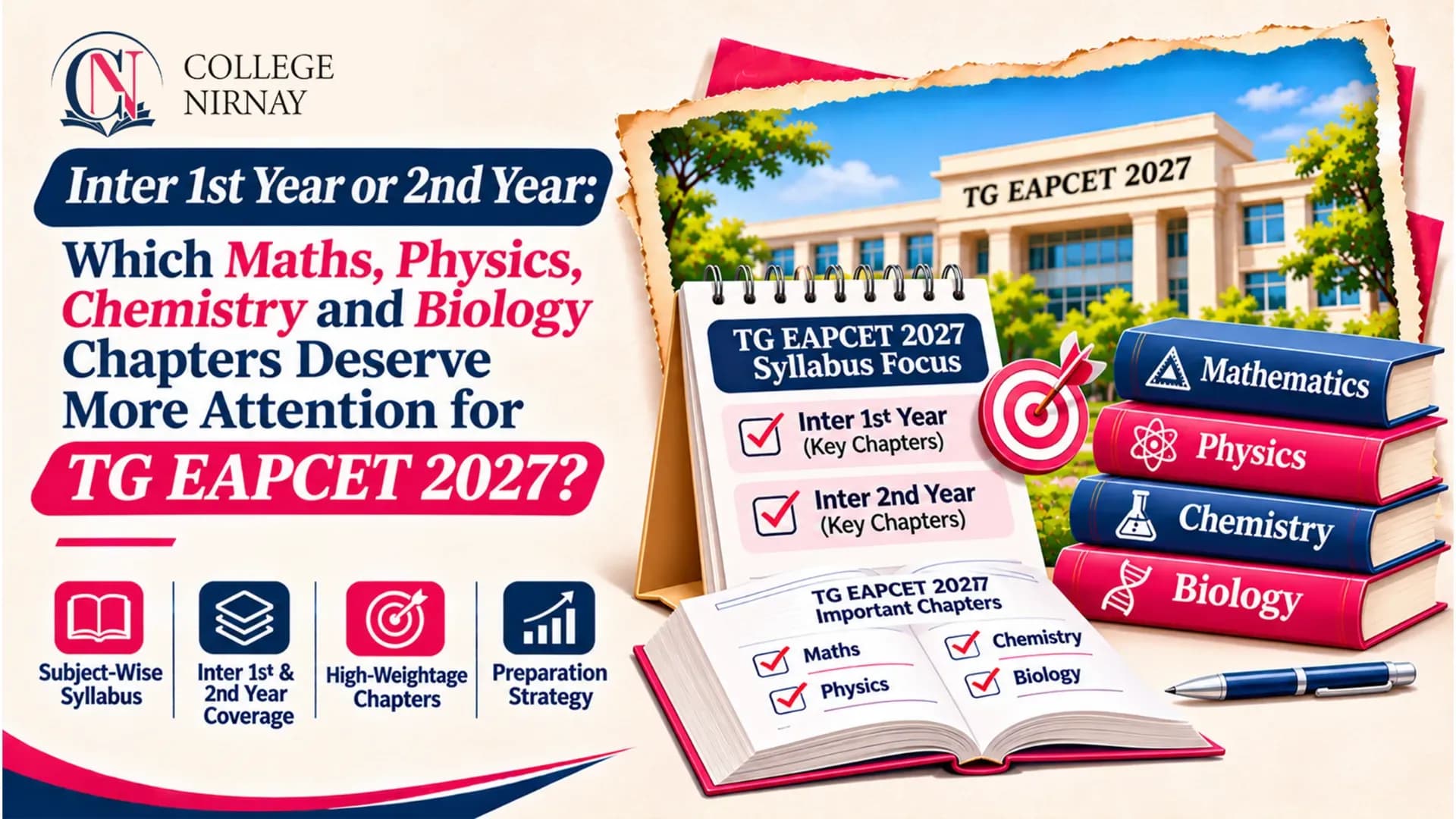
Should you spend more time revising Intermediate first-year chapters or focus on second-year topics to improve your TG EAPCET score? This is one of the most important preparation decisions for students appearing in the Telangana Engineering, Agriculture and Pharmacy Common Entrance Test.
The TG EAPCET 2027 syllabus is expected to cover concepts from both years of Intermediate education. However, effective preparation requires more than completing textbooks. Students must understand conceptual dependencies, question-solving requirements, revision frequency and their individual strengths and weaknesses.
While the TG EAPCET Intermediate 1st Year syllabus builds foundations in algebra, mechanics, chemical bonding and biological diversity, the TG EAPCET Intermediate 2nd Year syllabus introduces advanced applications such as integration, electricity, electrochemistry, genetics and biotechnology.
This detailed guide provides a TG EAPCET Intermediate syllabus comparison, explains the TG EAPCET 2027 important chapters and helps MPC and BiPC students develop a balanced preparation strategy without depending entirely on predicted chapter weightage.
The 2026 examination covered the complete prescribed Intermediate first-year and second-year syllabus. Candidates should use this as a provisional preparation reference until the official 2027 syllabus is published. The chapter priorities and suggested schedules in this article are preparation recommendations rather than officially announced question distributions.
TG EAPCET 2027 Syllabus Overview: Why Both Intermediate Years Matter
The TG EAPCET examination evaluates a student's understanding of Intermediate-level science and mathematics. Unlike an examination restricted to final-year topics, its previous syllabus framework covered both years of Intermediate education.
Students following the TG EAPCET MPC syllabus 2027 should prepare Mathematics, Physics and Chemistry, while students following the TG EAPCET BiPC syllabus 2027 should prepare Botany, Zoology, Physics and Chemistry for the Agriculture and Pharmacy examination stream.
Understanding the subject distribution is particularly important because the TG EAPCET Engineering syllabus 2027 and TG EAPCET Agriculture and Pharmacy syllabus require different preparation priorities.
| Subject | Engineering | Agriculture & Pharmacy |
|---|---|---|
| Mathematics | 80 Questions | Not Included |
| Physics | 40 Questions | 40 Questions |
| Chemistry | 40 Questions | 40 Questions |
| Botany | Not Included | 40 Questions |
| Zoology | Not Included | 40 Questions |
| Total | 160 Questions | 160 Questions |
Reference: TG EAPCET 2026 examination pattern. Final subject distribution for 2027 should be checked after the official information booklet is released.
Intermediate First Year
- Builds fundamental subject knowledge.
- Develops algebraic and mathematical skills.
- Introduces mechanics and thermal physics.
- Establishes chemical and biological foundations.
- Supports understanding of advanced chapters.
Intermediate Second Year
- Extends previously learned concepts.
- Develops advanced mathematical applications.
- Introduces electricity and modern physics.
- Expands organic and physical chemistry.
- Explores genetics and biological processes.
Mathematics: Should Engineering Aspirants Prioritise First-Year or Second-Year Chapters?
Mathematics accounted for half of the Engineering paper in the previous examination pattern. Therefore, students identifying TG EAPCET Mathematics important topics should focus on building calculation speed, recognising question patterns and applying mathematical concepts accurately.
First-year algebra, trigonometry and coordinate geometry often provide the foundation for advanced second-year problems. Preparing the second year without revisiting these fundamentals can increase calculation errors and reduce solving speed.
| Mathematics Area | First-Year Focus | Second-Year Focus | Revision Approach |
|---|---|---|---|
| Algebra | Functions, induction, matrices | Complex numbers, quadratic expressions, equations | Formula application and algebraic accuracy |
| Trigonometry | Trigonometric ratios, equations, inverse functions | Applications in advanced chapters | Revise identities regularly |
| Coordinate Geometry | Straight lines, pair of straight lines, basic 3D geometry | Circles, parabola, ellipse, hyperbola | Practise diagrams and standard equations |
| Calculus | Limits, continuity, differentiation | Integration, definite integrals, differential equations | Solve connected chapters sequentially |
| Vector Algebra | Vector addition and products | Revision and application of vector concepts | Focus on dot and cross products |
| Probability | Supporting algebra and logical skills | Permutations, combinations, probability and distributions | Practise case-based calculations |
First-Year Mathematics Chapters Worth Revising
Second-Year Mathematics Chapters Worth Revising
Example: Why First-Year Calculus Cannot Be Ignored
A student who understands that the derivative of x³ is 3x² can more easily recognise the corresponding integration relationship.
Integration: ∫3x² dx = x³ + C
This illustrates how first-year knowledge supports second-year problem solving. The best way to prepare TG EAPCET Mathematics important topics is to revise connected concepts rather than treating both academic years as independent subjects.
Physics: Mechanics or Electricity? Which Chapters Need More Revision?
Physics is common to both Engineering and Agriculture and Pharmacy examination streams. Students looking for TG EAPCET Physics important chapters should maintain a balance between conceptual understanding, numerical practice and formula revision.
First-year Physics establishes the fundamentals of motion, force, energy and thermal processes. Second-year Physics introduces electrical circuits, electromagnetism, optics and modern physics, which require different problem-solving approaches.
| First-Year Chapter Group | Second-Year Chapter Group | Preparation Requirement |
|---|---|---|
| Units and Measurements | Modern Physics | Units, dimensions and formula accuracy |
| Motion in a Straight Line and Plane | Electric Charges and Fields | Vectors and direction-based calculations |
| Laws of Motion | Current Electricity | Conceptual and numerical practice |
| Work, Energy and Power | Electrostatic Potential and Capacitance | Energy relationships and equations |
| Rotational Motion and Gravitation | Moving Charges and Magnetism | Multi-concept problem solving |
| Oscillations | Waves, Optics and Alternating Current | Graphs, periodic motion and mathematical relations |
| Thermodynamics and Properties of Matter | Atoms, Nuclei and Semiconductor Electronics | Definitions, equations and applications |
How to Prioritise Physics Chapters
Foundation Chapters
- Units and Measurements
- Kinematics
- Laws of Motion
- Work, Energy and Power
- Gravitation
Application Chapters
- Current Electricity
- Electrostatics
- Magnetism
- Electromagnetic Induction
- Ray and Wave Optics
Formula Revision Chapters
- Thermodynamics
- Oscillations and Waves
- Dual Nature of Radiation
- Atoms and Nuclei
- Semiconductor Electronics
Sample Physics Question
A 12 V battery is connected across a resistance of 4 Ω. What current flows through the circuit?
I = V/R = 12/4 = 3 A
Even a simple electricity question requires correct formula selection, arithmetic and unit awareness. Students should prepare TG EAPCET Physics important chapters through both timed numerical practice and conceptual revision.
Chemistry: Physical, Organic and Inorganic Chemistry Across Both Years
Chemistry preparation requires three different skills: numerical calculation, conceptual application and factual recall. Students identifying TG EAPCET Chemistry important topics should distribute their study time among Physical, Organic and Inorganic Chemistry rather than focusing on only one branch.
First-year concepts such as atomic structure, periodic classification, chemical bonding, stoichiometry and organic chemistry fundamentals help students understand reactions and advanced chemical processes introduced in the second year.
| Chemistry Branch | First-Year Focus | Second-Year Focus | Revision Method |
|---|---|---|---|
| Physical Chemistry | Atomic structure, stoichiometry, states of matter, thermodynamics, equilibrium | Solutions, electrochemistry, chemical kinetics, solid state and surface chemistry | Daily numerical practice |
| Inorganic Chemistry | Periodicity, chemical bonding, hydrogen, s-block and introductory p-block elements | Further p-block chemistry, d- and f-block elements, coordination compounds and metallurgy | Comparison charts and active recall |
| Organic Chemistry | Basic principles, nomenclature, isomerism and hydrocarbons | Halo compounds, alcohols, phenols, ethers, carbonyl compounds, carboxylic acids and amines | Reaction maps and mechanism practice |
| Applied Chemistry | Environmental chemistry | Biomolecules, polymers and chemistry in everyday life | Textbook facts and examples |
Three-Step Chemistry Preparation Method
Build the Foundation
Revise mole concept, atomic structure, periodic trends, chemical bonding and basic organic principles before moving towards advanced topics.
Connect the Concepts
Use first-year fundamentals to understand electrochemistry, coordination compounds and organic reaction sequences.
Test Your Recall
Solve mixed MCQs, revise chemical equations, practise reaction conversions and maintain a notebook of recurring mistakes.
Sample Chemistry Question
How many moles are present in 18 grams of water if its molar mass is 18 g/mol?
Number of moles = Mass / Molar mass = 18/18 = 1 mol
This first-year concept remains useful when solving second-year questions involving solutions, chemical kinetics and electrochemistry. Consequently, TG EAPCET Chemistry important topics should be revised through connected chapter groups.
Biology: How Botany and Zoology Preparation Should Differ for BiPC Students
Biology accounted for 80 questions in the previous Agriculture and Pharmacy examination pattern, divided equally between Botany and Zoology. Therefore, students preparing the TG EAPCET Biology important chapters should give appropriate attention to both branches.
The TG EAPCET Botany syllabus 2027 is expected to include plant diversity, cell biology, plant physiology, reproduction, inheritance and biotechnology concepts. Similarly, the TG EAPCET Zoology syllabus 2027 is expected to cover animal diversity, structural organisation, human physiology, genetics and related biological applications.
Botany: Intermediate First Year vs Second Year
| First-Year Botany | Second-Year Botany | Key Revision Skill |
|---|---|---|
| Diversity in the Living World | Microbiology | Classification and characteristics |
| Plant Morphology | Plant Physiology | Structures and functions |
| Plant Anatomy | Transport in Plants and Mineral Nutrition | Diagram-based learning |
| Cell Structure and Function | Photosynthesis and Respiration | Process-based understanding |
| Reproduction in Plants | Genetics and Molecular Biology | Sequence and inheritance relationships |
| Ecology and Biological Organisation | Biotechnology and Plant Growth | Applications and terminology |
Zoology: Intermediate First Year vs Second Year
| First-Year Zoology | Second-Year Zoology | Key Revision Skill |
|---|---|---|
| Animal Diversity | Human Anatomy and Physiology | Classification and organ functions |
| Structural Organisation in Animals | Digestion, Respiration and Circulation | Organ systems and biological processes |
| Invertebrate Diversity | Excretion and Locomotion | Structure-function relationships |
| Chordate Diversity | Neural and Endocrine Coordination | Regulation and control systems |
| Animal Models and Biological Organisation | Human Reproduction and Genetics | Diagrams and inheritance problems |
| Ecology and Environment | Evolution and Applied Biology | Conceptual relationships and applications |
The tables provide broad chapter groupings for preparation. Students should match individual topics and subtopics against the final stream-specific 2027 syllabus.
Biology Chapters That Benefit From Repeated Revision
Botany Revision
- Plant Classification
- Cell Structure and Biomolecules
- Plant Anatomy and Morphology
- Photosynthesis and Respiration
- Plant Reproduction
- Genetics and Molecular Biology
- Biotechnology
Zoology Revision
- Animal Kingdom
- Animal Structural Organisation
- Human Physiology
- Neural and Hormonal Coordination
- Human Reproduction
- Inheritance and Genetics
- Evolution and Applied Biology
Example: Genetics Requires Practice, Not Just Memorisation
Consider a Mendelian monohybrid cross between two heterozygous parents, Tt × Tt, where T represents a dominant allele.
| Alleles | T | t |
|---|---|---|
| T | TT | Tt |
| t | Tt | tt |
Probability of the recessive phenotype = 1/4 = 25%, assuming complete dominance.
Students preparing TG EAPCET Biology important chapters should combine textbook reading, diagrams, active recall and application-based questions rather than depending entirely on memorisation.
First Year vs Second Year: Which Syllabus Deserves More Attention?
The TG EAPCET first year vs second year syllabus debate cannot be resolved using a single percentage applicable to every student. Preparation priorities should depend on diagnostic test performance, conceptual weaknesses, revision requirements and remaining preparation time.
Although students frequently search for TG EAPCET chapter wise weightage 2027 and lists of TG EAPCET high weightage chapters, predicted question distributions should not be treated as guaranteed examination rules.
Complete syllabus coverage does not necessarily mean equal numbers of questions from both years. It means students should be prepared for all topics included in the prescribed syllabus.
Suggested Study-Time Distribution Based on Preparation Level
Students With Weak First-Year Fundamentals
Students With Balanced Preparation
Students With Incomplete Second-Year Preparation
These percentages represent suggested study-time allocations, not official syllabus weightage or expected question distribution.
How First-Year Chapters Support Second-Year Topics
| Subject | Foundation Concept | Advanced Application |
|---|---|---|
| Mathematics | Limits and Differentiation | Integration and Differential Equations |
| Physics | Vectors and Laws of Motion | Electric and Magnetic Forces |
| Chemistry | Mole Concept and Equilibrium | Solutions and Electrochemistry |
| Organic Chemistry | Basic Organic Principles | Reaction Mechanisms and Functional Groups |
| Botany | Cell Structure and Biomolecules | Molecular Biology and Biotechnology |
| Zoology | Animal Tissues and Organisation | Human Physiology and Organ Systems |
How to Identify Your Personal High-Priority Chapters
Rather than relying entirely on TG EAPCET high weightage chapters published in unofficial preparation guides, students should create an individual priority list using timed chapter tests and previous-year questions.
| Chapter Test Accuracy | Preparation Status | Recommended Action |
|---|---|---|
| Below 60% | Foundation Requires Improvement | Relearn concepts and solve basic questions. |
| 60%–79% | Partially Prepared | Practise application questions and review mistakes. |
| 80% and Above | Relatively Strong | Maintain accuracy through timed revision. |
This TG EAPCET Intermediate syllabus comparison helps students identify whether they need additional first-year revision, second-year practice or balanced preparation. The objective should be improving overall examination readiness rather than completing one academic year at the expense of the other.
TG EAPCET 2027 Revision Plan for MPC and BiPC Students
An effective TG EAPCET subject wise preparation strategy should combine first-year foundation revision, second-year application practice, chapter tests, previous-year questions and full-length mock examinations.
The following TG EAPCET 2027 revision plan is designed as a flexible study schedule that students can adjust according to their Intermediate board examinations, coaching classes and individual preparation levels.
Suggested Daily Schedule for MPC Students
| Study Activity | Duration | Primary Objective |
|---|---|---|
| Mathematics | 150 Minutes | Concepts, formulas and numerical practice |
| Physics | 75 Minutes | Conceptual and formula-based questions |
| Chemistry | 75 Minutes | Reactions, theory and numericals |
| Mixed MCQ Practice | 40 Minutes | Speed and accuracy |
| Error Analysis | 20 Minutes | Correct recurring mistakes |
| Total Study Time | 6 Hours | Excluding Breaks |
Suggested Daily Schedule for BiPC Students
| Study Activity | Duration | Primary Objective |
|---|---|---|
| Botany | 90 Minutes | Plant physiology, diagrams and terminology |
| Zoology | 90 Minutes | Human physiology, genetics and classification |
| Physics | 65 Minutes | Formula application and numericals |
| Chemistry | 65 Minutes | Conceptual revision and reactions |
| Mixed MCQ Practice | 30 Minutes | Improve question-solving speed |
| Error Analysis | 20 Minutes | Revise incorrect answers |
| Total Study Time | 6 Hours | Excluding Breaks |
12-Week TG EAPCET Preparation Roadmap
Foundation Recovery
- Take diagnostic subject tests.
- Revise weak first-year chapters.
- Prepare formula and concept notes.
- Practise basic MCQs.
Second-Year Consolidation
- Complete pending advanced chapters.
- Connect first-year concepts.
- Attempt chapter-wise tests.
- Revise important diagrams and reactions.
Mixed Practice
- Solve previous-year questions.
- Practise mixed-year question sets.
- Take timed subject tests.
- Analyse calculation and recall errors.
Final Examination Readiness
- Attempt full-length mock tests.
- Revise weak chapters.
- Improve question selection.
- Maintain consistent sleep and revision routines.
Use the 1–2–7–14–30 Day Revision Method
Studying a chapter once does not guarantee long-term retention. Students can use a spaced revision schedule to revisit concepts before forgetting them.
Concept Learning
Quick Recall
Chapter Test
Mixed Practice
Retention Test
How to Estimate Chapter-Wise Weightage Using Previous Papers
Students researching TG EAPCET chapter wise weightage 2027 can create a historical question-frequency tracker using previous examination papers from multiple shifts. This approach provides a more meaningful preparation reference than relying on unsupported predictions.
- Collect previous-year question papers and reliable answer keys.
- Identify the primary chapter associated with each question.
- Separate questions into first-year and second-year topic groups.
- Record chapter frequency across multiple papers.
- Calculate personal accuracy for each chapter.
- Prioritise frequently encountered topics where accuracy is low.
- Continue revising the remaining prescribed syllabus.
| Chapter | Academic Year | Questions Attempted | Correct Answers | Accuracy |
|---|---|---|---|---|
| Differentiation | First Year | 20 | 15 | 75% |
| Integration | Second Year | 20 | 10 | 50% |
| Chemical Bonding | First Year | 20 | 16 | 80% |
| Current Electricity | Second Year | 20 | 12 | 60% |
The above figures are illustrative practice-test results, not actual previous-year question frequencies.
10 Syllabus Preparation Mistakes to Avoid
- Ignoring the complete first-year syllabus while preparing second-year chapters.
- Treating unofficial chapter-weightage predictions as confirmed examination rules.
- Memorising Mathematics formulas without solving application-based questions.
- Studying Physics theory without practising numerical calculations.
- Skipping basic organic chemistry before learning advanced reactions.
- Giving excessive attention to Botany while neglecting Zoology, or vice versa.
- Avoiding difficult chapters because they require additional preparation time.
- Attempting mock examinations without analysing incorrect answers.
- Failing to revise previously completed chapters.
- Using outdated syllabus documents without checking official 2027 updates.
Your TG EAPCET subject wise preparation strategy should prioritise weak fundamentals, connected advanced topics and consistent revision. Complete syllabus coverage combined with targeted practice is more reliable than selectively preparing chapters based on expected question frequency.
Frequently Asked Questions About TG EAPCET Syllabus 2027
1. Does TG EAPCET 2027 cover both Intermediate first-year and second-year chapters?
The TG EAPCET 2027 syllabus is expected to follow both years of Intermediate education. The previous 2026 syllabus covered the complete prescribed curriculum of both years. Students should verify the final 2027 notification before excluding any topic.
2. Is the first-year syllabus more important than the second-year syllabus?
Neither year should be considered universally more important. The TG EAPCET first year vs second year syllabus comparison depends on conceptual connections, preparation levels and the final examination requirements.
3. Can I skip Intermediate first-year chapters for TG EAPCET?
Skipping the TG EAPCET Intermediate 1st Year syllabus is not advisable because first-year concepts may appear directly in questions and also support advanced second-year topics.
4. Which second-year chapters should I revise first?
Begin with chapters in the TG EAPCET Intermediate 2nd Year syllabus where your preparation is weakest. Calculus, electricity, advanced organic chemistry, plant physiology and genetics are useful example areas, depending on your stream.
5. What are the most important chapters for TG EAPCET 2027?
TG EAPCET 2027 important chapters for individual students should be identified using syllabus coverage, diagnostic tests and previous-year questions. No selected chapter list guarantees a particular examination score.
6. Which subjects are included in the MPC examination?
The TG EAPCET MPC syllabus 2027 is expected to include Mathematics, Physics and Chemistry, subject to the final official Engineering syllabus.
7. Which subjects are included in the BiPC examination?
The TG EAPCET BiPC syllabus 2027 is expected to include Botany, Zoology, Physics and Chemistry for the Agriculture and Pharmacy stream.
8. How many Mathematics questions are expected in Engineering?
The previous Engineering pattern included 80 Mathematics questions out of 160 total questions. Candidates preparing the TG EAPCET Engineering syllabus 2027 should verify whether this distribution continues in the final notification.
9. Are Botany and Zoology equally important?
Yes, under the previous examination pattern, Botany and Zoology each contributed 40 questions. The TG EAPCET Agriculture and Pharmacy syllabus should therefore be prepared with appropriate attention to both Biology branches.
10. Which Botany topics require regular revision?
Students preparing the TG EAPCET Botany syllabus 2027 should regularly revise plant diversity, morphology, anatomy, cell biology, plant physiology, genetics and biotechnology according to the final prescribed syllabus.
11. Which Zoology topics should BiPC students prioritise?
Animal diversity, human physiology, reproduction, inheritance and evolution are useful revision areas within the expected TG EAPCET Zoology syllabus 2027 framework. Students should also cover the remaining prescribed chapters.
12. Is Mathematics more difficult in the second year?
Second-year Mathematics introduces advanced applications such as integration, probability and conic sections. Difficulty depends on individual preparation and familiarity with first-year mathematical foundations.
13. Is Mechanics or Modern Physics more important?
Both should be prepared. Mechanics establishes fundamental problem-solving abilities, while Modern Physics introduces different conceptual and numerical applications. Students should prioritise topics based on accuracy and syllabus coverage.
14. Can I study second-year Organic Chemistry without first-year basics?
It is not recommended. Basic organic chemistry concepts such as nomenclature, isomerism, electronic effects and reaction principles are important for understanding advanced organic reactions.
15. Are Intermediate textbooks enough for TG EAPCET preparation?
Intermediate textbooks provide an important conceptual foundation. Students should supplement them with objective questions, previous-year papers, timed practice and full-length mock examinations.
16. Can previous-year question papers predict the exact 2027 syllabus weightage?
No. Previous-year question papers help identify historical trends and recurring concepts, but the exact number of questions from each chapter can vary across examinations and shifts.
17. Should I complete the entire syllabus before attempting mock tests?
Students can begin chapter-wise and subject-wise tests during syllabus preparation. Full-length mock tests become increasingly useful as overall syllabus coverage improves.
18. How often should I revise completed chapters?
Students can revisit a completed chapter after one day, one week, two weeks and one month, adjusting revision frequency according to memory retention and practice-test performance.
19. Is a 12-week preparation schedule enough for TG EAPCET?
A 12-week schedule can support structured revision, particularly for students who have already studied most Intermediate chapters. Students with substantial syllabus gaps may require additional preparation time.
20. Where can I check the complete TG EAPCET syllabus?
Candidates should check the official TG EAPCET website for the final syllabus and information booklet. They can also explore the detailed syllabus guide available on College Nirnay for subject-wise preparation information.
Final Verdict: Prepare Both Years, but Prioritise Your Weaknesses
Preparing for TG EAPCET does not require choosing between Intermediate first-year and second-year chapters. Instead, students should understand how the two academic years complement each other and distribute their preparation time according to individual learning requirements.
Engineering aspirants should maintain consistent Mathematics practice alongside Physics and Chemistry, while Agriculture and Pharmacy aspirants should balance Botany and Zoology without neglecting the remaining subjects.
A structured TG EAPCET 2027 revision plan that includes complete syllabus coverage, concept-based learning, previous-year question practice, spaced revision and regular mock-test analysis can help students build stronger examination readiness.
Rather than asking which academic year can be skipped, students should ask which chapters currently prevent them from answering questions accurately. Addressing those weaknesses while maintaining their stronger topics is a practical approach to improving overall performance.
Syllabus References and Useful Resources
- Official TG EAPCET Examination Website
- TG EAPCET 2026 Engineering Syllabus Document
- TG EAPCET 2026 Agriculture and Pharmacy Syllabus Document
- TG EAPCET Exam Pattern and Question Distribution
The 2026 syllabus documents are provided as historical preparation references. The final 2027 official notification will take precedence over previous examination documents and preparation recommendations.
Prepare Smarter for TG EAPCET 2027
Explore detailed syllabus information, examination patterns, eligibility requirements, application updates and previous-year questions on College Nirnay.
Explore Complete TG EAPCET Syllabus