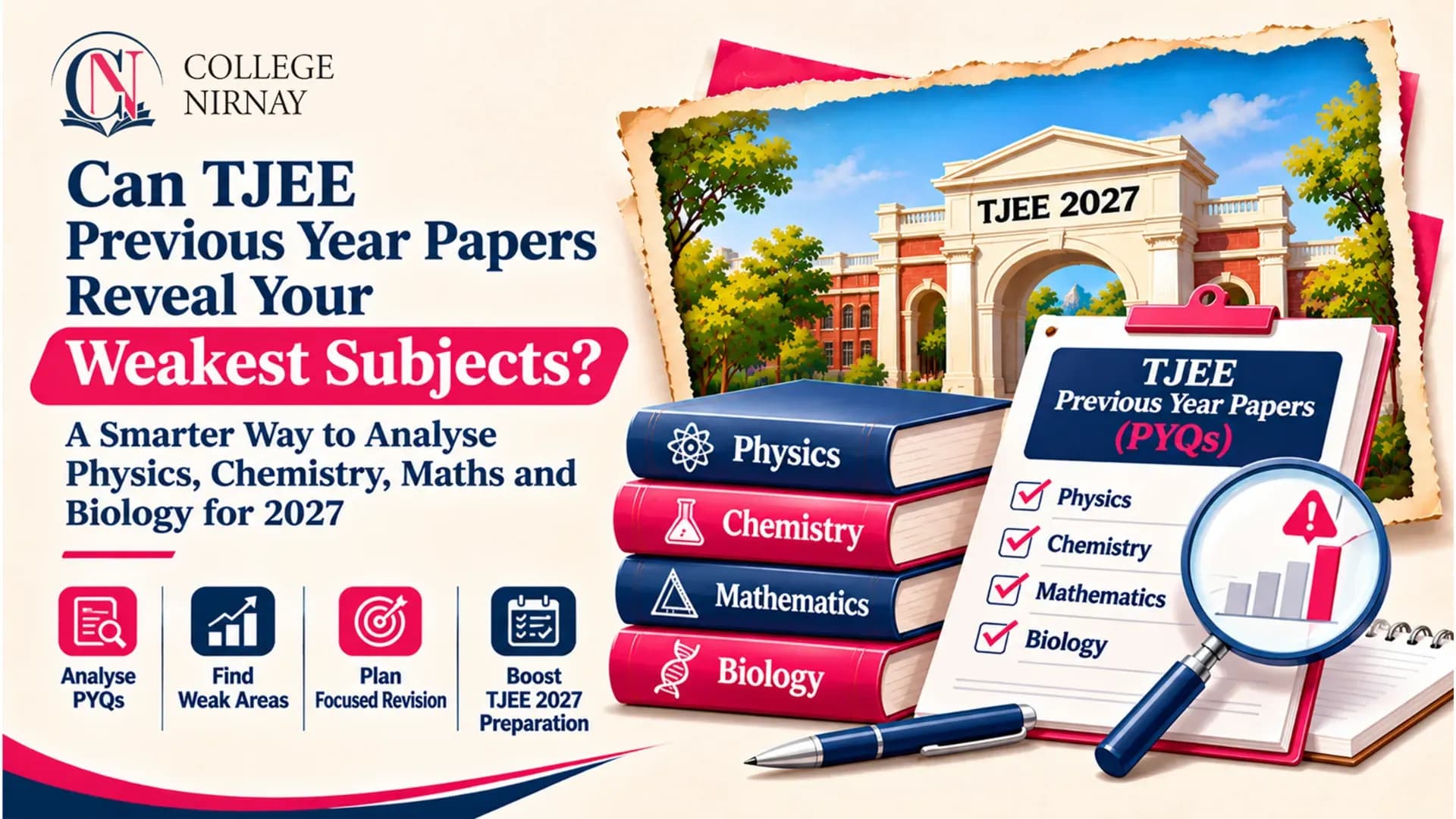
Can TJEE Previous Year Papers Reveal Your Weakest Subjects? A Smarter Way to Analyse Physics, Chemistry, Maths and Biology for 2027
Solving question papers is an important part of preparing for the Tripura Joint Entrance Examination. However, students preparing with TJEE 2027 previous year question papers should focus on more than simply completing questions and calculating marks. Previous papers can help identify weak chapters, conceptual misunderstandings, calculation errors and ineffective time management.
A systematic TJEE previous year paper analysis allows candidates to understand why they lose marks in Physics, Chemistry, Mathematics and Biology. Instead of allocating equal preparation time to every subject, students can create a personalised study schedule based on their actual performance.
Whether you are practising TJEE PCM previous year papers for engineering-related admissions or TJEE PCB previous year papers for biology-based programmes, identifying your weaknesses early can make your preparation more effective.
This guide explains how to use TJEE PYQs 2027 preparation resources for performance tracking, chapter-level improvement and a structured entrance examination revision plan.
Physics, Chemistry, Maths and Biology
Suggested analysis period
Performance-based revision
Stream-specific practice
Previous year papers can reveal personal weaknesses and historical question patterns, but they cannot guarantee the distribution of questions in the upcoming examination. Candidates must verify the official 2027 syllabus, examination pattern and marking scheme once released by the Tripura Board of Joint Entrance Examination (TBJEE).
Table of Contents
What Are TJEE Previous Year Papers?
Previous year question papers contain questions that appeared in earlier editions of the Tripura Joint Entrance Examination. They help candidates understand the structure of questions, application of syllabus concepts and examination requirements.
Students using TJEE 2027 previous year question papers should select papers relevant to their required subject combination and compare them with the latest prescribed syllabus.
The most useful approach to TJEE previous year question paper practice is to solve questions independently, check answers using reliable answer keys and record the reason behind every incorrect or skipped question.
What Can Students Learn from Previous Papers?
Conceptual Understanding
Identify topics where theoretical understanding is insufficient to solve application-based questions.
Calculation Ability
Recognise arithmetic errors, incorrect formula selection and inefficient numerical methods.
Question Familiarity
Understand how familiar concepts may be presented through different question formats.
Time Management
Discover which subjects and chapters require disproportionate solving time.
Effective TJEE PYQs 2027 preparation therefore involves both question solving and detailed performance evaluation.
Why Subject-Wise PYQ Analysis Matters for TJEE 2027
Students often judge their preparation by the total marks obtained in a mock examination. However, a satisfactory total can hide serious weaknesses in individual subjects.
For example, a candidate may perform well in Chemistry but lose marks in Physics because of numerical mistakes. Another candidate may understand biological concepts but struggle to recall scientific terms accurately.
A detailed TJEE subject wise performance analysis provides a clearer understanding of these differences.
| Subject | Potential Weakness | What to Analyse |
|---|---|---|
| Physics | Formula selection and numerical errors | Concept application, units and calculation speed |
| Chemistry | Reaction confusion and factual recall | Physical, Organic and Inorganic Chemistry separately |
| Mathematics | Lengthy solutions and algebraic mistakes | Accuracy, method selection and solving time |
| Biology | Incorrect terminology and similar options | Concept clarity, diagrams and factual retention |
Students should use TJEE Physics previous year papers to evaluate numerical and conceptual skills, while TJEE Chemistry previous year papers can help distinguish calculation-related weaknesses from reaction-based or memory-related difficulties.
Similarly, TJEE Mathematics previous year papers help evaluate problem-solving efficiency, whereas TJEE Biology previous year papers can reveal gaps in understanding biological processes and retaining factual information.
The purpose of TJEE weakest subject analysis is not merely to identify the subject with the lowest marks. It is to understand the causes of lost marks and uncover the specific TJEE preparation gaps that can be corrected before the examination.
TJEE Chapter-Wise Question Trends and Important Topics
Understanding TJEE chapter wise question trends requires comparing multiple previous papers instead of relying on a single examination year.
Students searching for TJEE important topics 2027 should combine syllabus coverage, historical question frequency and their individual accuracy levels to determine revision priorities.
Subject-Wise Topics to Include in Your PYQ Analysis
| Subject | Suggested Topics to Review | Skills to Evaluate |
|---|---|---|
| Physics | Mechanics, thermodynamics, electricity, magnetism, optics and modern physics | Concept application, formula recall and numerical accuracy |
| Chemistry | Chemical bonding, equilibrium, thermodynamics, electrochemistry, organic reactions and coordination compounds | Reaction understanding, factual recall and numerical calculations |
| Mathematics | Algebra, trigonometry, calculus, coordinate geometry, vectors and probability | Method selection, calculation speed and problem interpretation |
| Biology | Cell biology, plant physiology, human physiology, genetics, reproduction and ecology | Process understanding, terminology and diagram interpretation |
Note: These are suggested revision areas, not verified historical weightage rankings. Include them in preparation only where they are covered by the applicable official TJEE syllabus.
How to Identify Frequently Tested Concepts
- Collect authentic question papers and reliable answer keys from multiple years.
- Assign each question to its relevant syllabus chapter.
- Record the number of questions and available marks from each chapter.
- Separate repeated concepts from identical or closely repeated questions.
- Compare your chapter-wise accuracy with historical question frequency.
- Prioritise chapters where repeated concepts coincide with low personal accuracy.
When reviewing TJEE frequently asked questions from earlier examination cycles, focus on the underlying concepts rather than memorising specific answers.
A well-maintained record of TJEE chapter wise question trends can help students identify personalised revision priorities without assuming that past question distributions will remain unchanged.
Chapter-Wise Analysis Tracker
| Chapter | Questions Found | Correct | Incorrect | Skipped | Revision Priority |
|---|---|---|---|---|---|
| Current Electricity | Record count | Record | Record | Record | Evaluate |
| Chemical Bonding | Record count | Record | Record | Record | Evaluate |
| Calculus | Record count | Record | Record | Record | Evaluate |
| Genetics | Record count | Record | Record | Record | Evaluate |
How to Identify Your Weakest TJEE Subject Using PYQs
Effective TJEE previous year paper analysis requires measurable indicators rather than assumptions about which subject feels difficult.
Five-Step Performance Evaluation Method
Attempt an Unseen Question Paper
Select a paper you have not previously solved and attempt it under appropriate examination-like conditions without consulting notes.
Calculate Subject-Wise Accuracy
Record correct, incorrect and unattempted questions separately for every required subject.
Classify Every Mistake
Identify whether each mistake resulted from a conceptual gap, calculation error, forgotten formula, misreading or insufficient time.
Compare Performance Across Papers
Check at least three independent practice sessions before identifying a consistently weak subject.
Revise and Retest
Repair weak concepts and attempt fresh questions to determine whether the revision has produced measurable improvement.
Important Performance Formulas
Accuracy Percentage
(Correct ÷ Attempted) × 100
Measures the reliability of attempted answers.
Attempt Percentage
(Attempted ÷ Total Questions) × 100
Measures question coverage.
Correct Coverage
(Correct ÷ Total Questions) × 100
Measures correct answers across the entire practice set.
Illustrative Subject-Wise Performance Comparison
The following example uses hypothetical 30-question practice sets to demonstrate TJEE subject wise performance analysis. These figures are not actual candidate results or official 2027 examination data.
| Subject | Attempted | Correct | Incorrect | Skipped | Accuracy | Correct Coverage |
|---|---|---|---|---|---|---|
| Physics | 25 | 15 | 10 | 5 | 60% | 50% |
| Chemistry | 25 | 20 | 5 | 5 | 80% | 66.7% |
| Mathematics | 20 | 14 | 6 | 10 | 70% | 46.7% |
| Biology | 28 | 24 | 4 | 2 | 85.7% | 80% |
Visual Comparison of Accuracy
Illustrative practice data for understanding subject-level accuracy.
Physics has the lowest accuracy at 60%, indicating that the candidate should investigate incorrect answers and conceptual gaps. Mathematics has the lowest correct coverage at 46.7%, suggesting that speed, chapter coverage or both may require attention.
This demonstrates why TJEE weakest subject analysis should consider both accuracy and question coverage. The most effective TJEE accuracy improvement strategy will address the underlying causes of poor performance rather than focusing exclusively on total marks.
Smart Subject-Wise Revision Strategy for TJEE 2027
A personalised TJEE 2027 revision strategy should convert the findings from previous papers into specific learning activities.
Students should revise weak chapters, practise related questions and use fresh assessments to determine whether their performance is improving.
Use TJEE Physics previous year papers to identify chapters where numerical and conceptual questions cause repeated mistakes.
- Prepare chapter-wise formula sheets.
- Revise units and dimensional consistency.
- Practise numerical questions without notes.
- Review graphs and physical interpretations.
- Compare alternative solution methods.
Divide TJEE Chemistry previous year papers into Physical, Organic and Inorganic Chemistry question groups.
- Practise Physical Chemistry calculations.
- Revise reaction conditions and mechanisms.
- Create periodic trend comparison sheets.
- Use active recall for factual information.
- Review incorrect reaction predictions.
Analyse TJEE Mathematics previous year papers to distinguish lengthy calculations from incomplete conceptual understanding.
- Maintain chapter-wise formula notes.
- Practise timed question sets.
- Review algebraic simplification errors.
- Identify efficient solution approaches.
- Repeat difficult question types using fresh examples.
Evaluate TJEE Biology previous year papers to identify weaknesses in factual recall, diagrams and biological processes.
- Revise prescribed textbook concepts.
- Practise labelled diagrams.
- Compare related biological terms.
- Use active recall and spaced repetition.
- Review closely related answer choices.
PCM and PCB Preparation Approaches
For PCM Candidates
Students solving TJEE PCM previous year papers should evaluate Physics, Chemistry and Mathematics independently while maintaining sufficient numerical practice across the relevant subjects.
Prioritise conceptual gaps in Physics, reaction and calculation errors in Chemistry, and question coverage in Mathematics.
For PCB Candidates
Students solving TJEE PCB previous year papers should balance Physics and Chemistry numerical practice with Biology concept revision and active recall.
Do not neglect Physics calculations simply because Biology is a stronger or more familiar subject.
Suggested Four-Week PYQ Revision Plan
| Week | Main Objective | Preparation Activities | Expected Outcome |
|---|---|---|---|
| Week 1 | Diagnostic assessment | Attempt previous papers and classify mistakes. | Identify weak subjects and chapters. |
| Week 2 | Concept repair | Revise weak chapters and solve topic-specific questions. | Reduce repeated conceptual errors. |
| Week 3 | Timed practice | Attempt mixed question sets and practise time allocation. | Improve question coverage and accuracy. |
| Week 4 | Performance verification | Attempt fresh papers and compare diagnostic results. | Measure improvement and adjust revision. |
Suggested Daily Study-Time Distribution
The following distribution is an illustrative starting point for students with five hours available for entrance preparation each day.
Students should adjust this schedule according to school commitments, subject requirements and progress. Combining TJEE mock test analysis with regular chapter revision can help ensure that preparation time is being used effectively.
Common Mistakes Students Make While Solving TJEE PYQs
Previous papers become less useful when students repeatedly solve familiar questions without evaluating the reasons behind their mistakes. Understanding these limitations is essential for an effective revision programme.
| Common Mistake | Why It Affects Preparation | Better Approach |
|---|---|---|
| Memorising answers | Creates familiarity without conceptual understanding. | Solve variations of the same concept. |
| Ignoring incorrect answers | Allows the same mistakes to recur. | Maintain a detailed error notebook. |
| Practising only strong subjects | Leaves important weaknesses unresolved. | Allocate extra study time to weak areas. |
| Ignoring skipped questions | Hides syllabus gaps and speed limitations. | Record why each question was skipped. |
| Checking only total marks | Conceals subject-level performance differences. | Calculate subject-wise accuracy and coverage. |
| Ignoring examination timings | Creates unrealistic practice conditions. | Include timed independent assessments. |
| Assuming questions will repeat | Encourages selective preparation. | Cover the applicable syllabus comprehensively. |
| Using outdated syllabus assumptions | May waste time on irrelevant topics. | Check official 2027 syllabus updates. |
The TJEE question paper difficulty level can vary by year, chapter and a student's preparation. A single difficult practice paper should not be treated as conclusive evidence of poor preparation.
Instead, students should compare multiple assessments, review recurring TJEE preparation gaps and develop a consistent TJEE accuracy improvement strategy based on measurable weaknesses.
PYQ Error Notebook Format
| Subject | Chapter | Error Type | Corrective Action | Retest |
|---|---|---|---|---|
| Physics | Mechanics | Incorrect formula selection | Review formula conditions and practise applications. | After 2 days |
| Chemistry | Organic Chemistry | Forgotten reaction conditions | Prepare reaction summary and recall exercises. | After 2 days |
| Mathematics | Calculus | Excessive solving time | Practise alternative methods with timed questions. | After 3 days |
| Biology | Human Physiology | Confusion between related processes | Create comparison notes and recall questions. | After 2 days |
The entries above are illustrative examples of how students can maintain an error notebook during preparation.
TJEE Previous Year Question Papers 2027 – FAQs
1. Can previous year papers help identify my weakest TJEE subject?
Yes. Comparing accuracy, skipped questions, solving time and repeated mistakes across multiple papers provides evidence of which subjects and chapters require additional preparation.
2. How many years of TJEE papers should I solve for 2027?
Students can begin with three to five years of authentic papers, depending on availability. Prioritise papers relevant to the current syllabus and examination format.
3. How can I identify important TJEE chapters through previous papers?
Record chapter-wise question frequency across multiple papers and compare it with your individual accuracy. This approach helps identify TJEE important topics 2027 for personalised revision without assuming guaranteed weightage.
4. Is Physics the toughest subject in TJEE?
There is no universally toughest subject for every candidate. The TJEE question paper difficulty level depends on question complexity, conceptual understanding, preparation and individual strengths.
5. How should I analyse Chemistry mistakes in TJEE?
Separate mistakes into Physical, Organic and Inorganic Chemistry categories. Identify whether errors arise from calculations, incomplete conceptual understanding, reaction confusion or insufficient factual recall.
6. How can I improve Mathematics accuracy for TJEE 2027?
Practise chapter-specific numerical questions, revise formulas, review algebraic errors and complete timed question sets. Track both accuracy and the proportion of questions solved correctly.
7. What is the best way to revise Biology through TJEE PYQs?
Revise concepts associated with incorrect answers, practise labelled diagrams and compare similar scientific terms. Use active recall to strengthen retention before attempting fresh questions.
8. Do questions from previous TJEE papers repeat?
Similar concepts and question formats may appear across examination years. However, students reviewing TJEE frequently asked questions should not assume that identical questions will appear in 2027.
9. Should I solve previous papers before completing the syllabus?
Yes. Students can solve chapter-specific PYQs after completing individual topics. Full-paper practice becomes more useful once a substantial portion of the applicable syllabus has been covered.
10. What should I record after every TJEE mock test?
A detailed TJEE mock test analysis should include attempted questions, correct and incorrect answers, unattempted questions, subject-wise scores, time management and the causes of mistakes.
11. Should PCM and PCB candidates follow different revision plans?
Yes. PCM candidates should prepare Mathematics alongside Physics and Chemistry, while PCB candidates should focus on Biology alongside Physics and Chemistry. Students must follow the subject requirements of their intended programmes.
12. Is solving previous year papers enough to prepare for TJEE 2027?
No. TJEE previous year question paper practice should be combined with comprehensive syllabus preparation, conceptual learning, textbook revision, fresh questions and timed mock examinations.
13. How can I measure improvement in my weakest subject?
Compare accuracy, correct coverage, error frequency and solving time across independent practice sets of comparable difficulty. Consistent improvement across multiple assessments is more meaningful than one high score.
14. Where can I access information about TJEE previous year papers?
Visit the official TBJEE website at tbjee.nic.in to check available official examination resources. Candidates can also explore the College Nirnay TJEE previous year papers page for preparation guidance.
15. What is the best revision strategy for TJEE 2027?
An effective TJEE 2027 revision strategy combines diagnostic practice, chapter-wise concept repair, timed assessments and regular error analysis. Students should adjust their study schedules according to measurable improvement.
Final Takeaway: Use Previous Papers to Improve, Not Just Practise
Previous year question papers are valuable diagnostic tools for students preparing for the Tripura Joint Entrance Examination. They help reveal whether poor performance results from weak concepts, insufficient revision, calculation mistakes, slow problem-solving or incomplete syllabus coverage.
Rather than solving paper after paper without reflection, students should analyse their performance, maintain an error notebook and dedicate additional time to the chapters that require improvement.
By combining systematic question practice with targeted revision and fresh assessments, candidates can develop a more personalised and effective preparation approach for TJEE 2027.
Strengthen Your TJEE 2027 Preparation
Explore previous year papers, understand question patterns and build a smarter subject-wise revision strategy with College Nirnay.
Explore TJEE Previous Year Papers