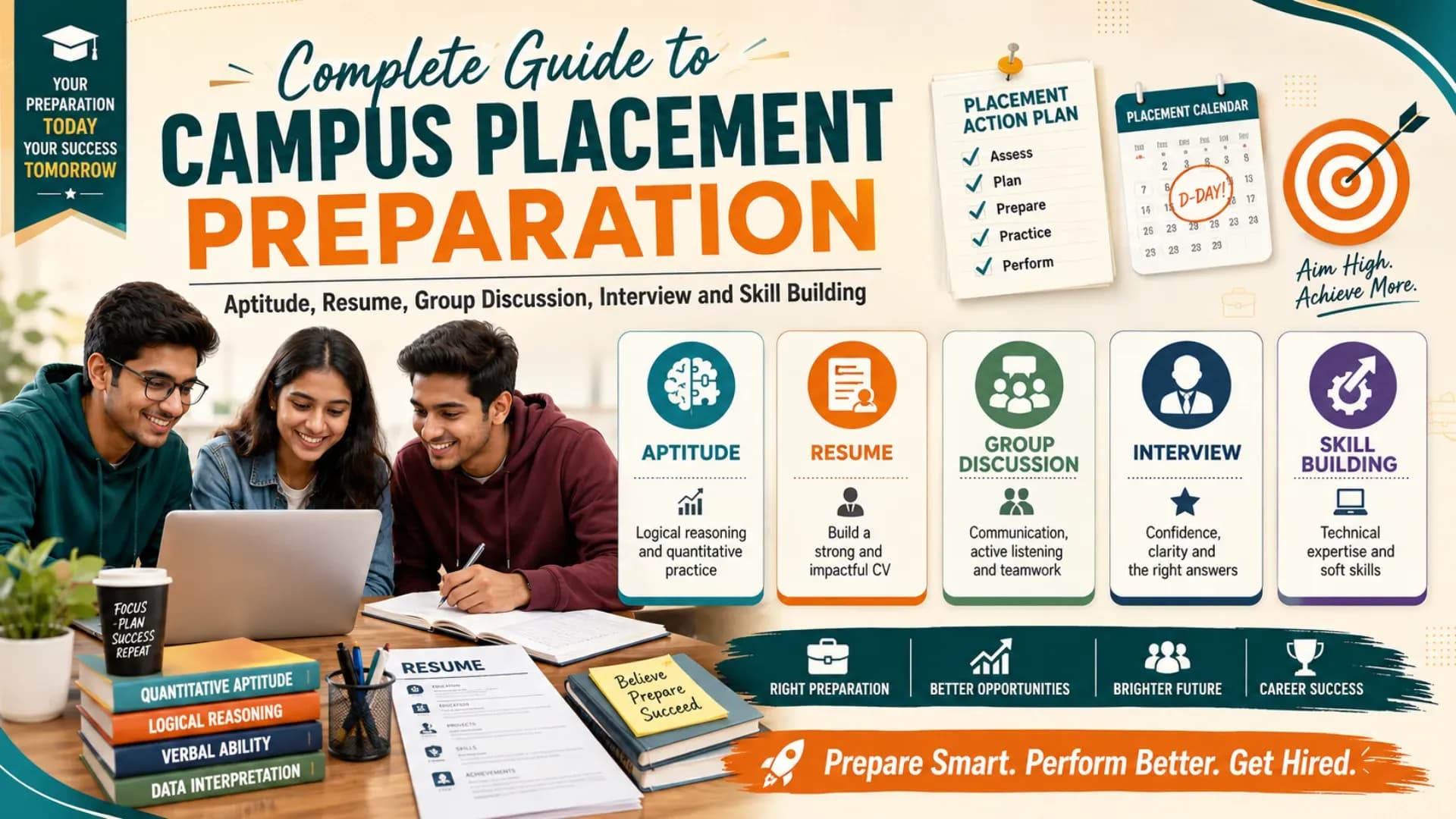
Campus placement preparation is the most consequential academic-adjacent activity in a student's final 1–2 years — and the most consistently underprepared for. This complete placement preparation guide covers every stage of the campus recruitment process: the aptitude test for placements and how to score competitively; how to write a resume for campus placement as a fresher; group discussion preparation techniques that go beyond memorising current affairs; technical interview preparation by domain; common HR interview questions and how to answer them with genuine credibility; the placement skills for students that differentiate offer-holders from the rest; how to build a mock interview for students practice system; communication skills for placements; how to prepare specifically for individual company drives; and the complete campus placement checklist covering everything from pre-placement season to Day 1 joining. This placement training guide is designed for all streams — engineering, management, commerce, and arts — with specific guidance for each stage.
What We Cover
- Campus Recruitment Process — How It Works
- Aptitude Test for Placements — What to Prepare
- Resume for Campus Placement — Fresher Resume Tips
- Group Discussion Preparation — Structure, Topics and Performance
- Technical Interview Preparation — By Domain
- HR Interview Questions — How to Answer With Credibility
- Communication Skills for Placements — What Recruiters Actually Evaluate
- Mock Interview for Students — Building a Practice System
- Company Placement Preparation — How to Research Before Each Drive
- Campus Placement Checklist — Complete Pre-Season Readiness
- FAQs
Campus Recruitment Process — How It Works
Understanding the full campus recruitment process before preparing for any specific stage prevents the most common preparation error: over-investing in one stage while neglecting another. The typical campus recruitment process at Indian colleges:
| Stage | Format | Eliminates | Preparation Priority |
|---|---|---|---|
| Pre-Placement Talk (PPT) | Company presentation to eligible students | No; but informs role expectations | Research the company; prepare 2–3 genuine questions |
| Aptitude Test | Online: Quant, LR, Verbal (60–90 mins) | 50–80% of applicants | Highest elimination stage — start earliest |
| Group Discussion | 8–12 students; 10–20 minutes; assessor observed | 20–40% of those who clear aptitude | Structure, initiation, listening, recovery |
| Technical Interview | 1:1 or panel; 30–60 minutes | Variable; typically 40–60% of GD passers | Domain knowledge + project depth |
| HR Interview | 1:1; 20–40 minutes | Fewer eliminations; offer-type differentiation | Authentic self-presentation; company research |
| Offer | Written offer letter | N/A | Read carefully; clarify role, location, CTC |
The campus recruitment process varies by company: service IT companies (TCS, Infosys, Wipro) typically run 3-stage processes (aptitude → technical → HR); product companies (Google, Microsoft, Swiggy) run 4–6 stage processes including multiple technical rounds; FMCG and consulting firms run GD-heavy processes; PSUs run written exam plus interview. Tailor company placement preparation to the specific format used by your target company.
Aptitude Test for Placements — What to Prepare
The aptitude test for placements is the highest-volume elimination stage in most campus recruitment process flows — and the most predictable. Placement aptitude questions fall into consistent patterns that reward systematic preparation over months more than cramming over days:
- Quantitative Aptitude: the largest component of most aptitude test for placements covering: percentages and profit-loss; ratio-proportion; time-work and time-speed-distance; simple and compound interest; number series; permutation and combination; probability. Placement aptitude questions in quant are typically 10th standard mathematics applied at speed — the difficulty is time pressure, not conceptual complexity. Practice with a timer from Day 1; accuracy without speed is not sufficient for the aptitude test for placements
- Logical Reasoning: blood relations; seating arrangements; syllogisms; data sufficiency; coding-decoding; input-output. LR placement aptitude questions reward pattern recognition more than calculation — practice with varied question types rather than repeating the same type
- Verbal Ability: reading comprehension; error spotting; fill-in-the-blanks (grammar); para-jumbles; vocabulary (synonyms, antonyms, analogies). Verbal is the section most improved by daily reading — 20 minutes of English-medium reading (business news, essays, editorials) for 3 months produces measurable improvement in both speed and accuracy on verbal placement aptitude questions
- Coding test (for CS/IT companies): companies like TCS, Infosys, Wipro, Cognizant add a basic coding section — typically 1–2 problems solvable in Python/Java/C++ in 30–45 minutes. The standard is not competitive programming; it is clean, correct code that solves a straightforward problem. Practice 5–10 standard patterns: string manipulation, array operations, basic sorting, simple recursion
- Resources for placement aptitude questions: IndiaBix (largest free Indian aptitude question bank); R.S. Aggarwal (quantitative aptitude textbook standard); previous year TCS/Infosys/Wipro aptitude papers (pattern-specific); CareerRide and Freshersworld for company-specific placement aptitude questions
Timeline: begin aptitude test for placements preparation at least 6 months before your campus placement season starts. 45 minutes per day of consistent practice across 6 months produces a fundamentally different aptitude profile than 3 weeks of intensive study before the drive.
Resume for Campus Placement — Fresher Resume Tips
The resume for campus placement is your first impression — and the document that determines whether you get to the aptitude test. Fresher resume tips that make a specific, measurable difference:
- One page, always: the resume for campus placement for a fresher must be one page. Recruiters at campus drives review hundreds of CVs in hours; a two-page fresher resume signals poor self-editing, not richer experience. Every line must earn its place
- Quantify everything: "Led a team for the annual tech fest" is weak. "Led a 12-member team for TechXcel 2025; event attracted 800+ participants and ₹2.5 lakh in sponsorship" is strong. Quantification is the single most impactful of all fresher resume tips — it converts vague claims into specific evidence. Apply it to projects, leadership roles, academic achievements, and extracurricular contributions on the resume for campus placement
- Projects section is the hero for freshers: the absence of work experience makes the Projects section the primary evidence section of any resume for campus placement. Each project entry should specify: project name, technologies/tools used, what was built, and the outcome or metric. 2–3 strong project entries are better than 5 weak ones
- Skills section — honest and specific: list only skills you can demonstrate in the interview. Claiming Python "expertise" when you have completed one course invites a 10-minute technical probe that exposes the gap. "Python (intermediate — data analysis and automation projects)" is honest and specific; "Python (Expert)" on a fresher resume is a liability
- ATS-friendly format: most large companies run the resume for campus placement through Applicant Tracking Systems before human review. Use standard fonts (Calibri, Arial, Times New Roman); avoid tables, columns, headers/footers for key content, and images; use keywords from the job description in the skills and projects sections. A visually beautiful CV that fails ATS parsing never reaches a human
- Action verbs, present or past tense consistently: "Developed a web application..." not "Was involved in the development of..."; "Led the team" not "Was the team lead for...". The fresher resume tips on language are about directness and ownership — every line should start with a strong action verb and describe your contribution specifically
Group Discussion Preparation — Structure, Topics and Performance
Group discussion preparation is misunderstood by most students as "know a lot about current affairs." Knowing current affairs is necessary but not sufficient — the group discussion preparation that actually differentiates candidates addresses structure, initiation, listening, and recovery:
- What assessors actually measure: content (knowledge and logic of arguments); communication (clarity, listening, response to others); leadership (ability to guide the group, initiate, summarise, manage aggression); participation (consistent contribution without dominating); and composure (how you handle disagreement, interruption, and silence). Group discussion preparation must address all five — not just content
- The initiation advantage: opening a GD with a structured 30-second statement that defines the topic, presents the central tension, and invites structured exploration ("Today's topic has two dimensions — X and Y. On the X side...") immediately positions you as a structured thinker and gives you the first mover advantage. Prepare 3–4 generic opening structures in your group discussion preparation that can be applied to most topic types: social issues, business cases, abstract topics, and factual debates
- The summary and synthesis move: in the final 2–3 minutes of a GD, there is typically a natural pause or wind-down. Stepping in to summarise the key points made by the group — accurately and fairly, including views contrary to your own — demonstrates listening and leadership simultaneously. This is one of the highest-impact group discussion preparation moves for candidates who have not dominated the discussion but have listened well
- What kills GD performance: interrupting aggressively; speaking only to avoid silence rather than to contribute substance; knowing only one side of the topic; going quiet for the middle 10 minutes after an initial contribution; and ignoring what others say (making contributions that do not respond to the conversation already happening)
- GD topics for practice: practice with a peer group of 5–8 students covering: social media regulation; electric vehicles in India; NEP 2020; LGBTQ rights and the law; brain drain; AI and job displacement; women in STEM; startup vs corporate career; Make in India. For each topic, prepare to argue both sides — group discussion preparation that only builds one-sided knowledge fails when the GD moves in an unexpected direction
Technical Interview Preparation — By Domain
Technical interview preparation is the stage where most elimination decisions are made. The topics assessed in the technical interview preparation are directly mapped to the role — and predictable well in advance:
CS/IT — Technical Interview Preparation
- Data Structures and Algorithms (DSA): arrays, linked lists, stacks, queues, trees, graphs, sorting and searching algorithms, dynamic programming, recursion. LeetCode (Easy and Medium problems); GeeksforGeeks; company-specific problem lists. For service companies (TCS, Infosys) — basic DSA; for product companies (Amazon, Flipkart) — medium-hard DSA is standard
- Operating Systems: process management; memory management; deadlocks; file systems. Technical interview preparation for OS typically covers conceptual questions rather than implementation
- DBMS: SQL queries (joins, aggregation, subqueries, window functions); normalisation (1NF, 2NF, 3NF, BCNF); ACID properties; indexing. SQL is the most commonly tested technical skill after DSA for CS students
- Computer Networks: OSI model; TCP/IP; HTTP/HTTPS; DNS; load balancing basics. Conceptual questions — know the protocols and their functions
- OOPS: inheritance, polymorphism, encapsulation, abstraction with code examples. Interview question: "Explain polymorphism with a real-world example and implement it in [language]"
Core Engineering (Mechanical, Civil, Electrical, ECE) — Technical Interview Preparation
- Core subject revision: 5–7 key subjects from the programme; understand concepts and their engineering applications — not just definitions
- Project deep-dive: every college placement interview for core engineering will include 10–15 minutes on the candidate's academic project; know the problem statement, methodology, results, and limitations inside out
- PSU-specific technical preparation: GATE-level conceptual knowledge for PSU roles (BHEL, HPCL, NTPC) — these require the deepest technical interview preparation of any category
Management/Commerce — Technical Interview Preparation
- Finance roles: P&L statement reading; balance sheet interpretation; basic valuation (DCF, P/E); financial ratios; SEBI basics. CFA Level 1 study material is the gold standard for technical interview preparation for finance placements
- Marketing roles: 4Ps; segmentation; brand management frameworks; digital marketing metrics; case-study discussion ability
- Analytics roles: Excel (intermediate-advanced); SQL basics; Python/R basics; statistics (mean, SD, regression, hypothesis testing)
HR Interview Questions — How to Answer With Credibility
The HR interview questions stage is where most students either significantly improve or hurt their candidacy — because it requires authentic self-presentation rather than technical knowledge. The most common HR interview questions and what actually makes an answer credible:
- "Tell me about yourself": 90 seconds; covers education, relevant skills or experiences, and why this company. Not a CV recitation — a curated narrative. The best answer to this most common of HR interview questions ends with a connection to the role: "...and that is why I am particularly interested in [company]'s [specific programme/product]"
- "Why this company?": requires genuine research — not "it is a great company." Specific: "I know you launched [product] in [year] and are expanding into [area] — that specific intersection of [domain] and [approach] aligns directly with the skills I built in [project/internship]"
- "What are your strengths?": one strength, with a specific real-world example (STAR format: Situation, Task, Action, Result). Not three abstract adjectives — one demonstrated capability
- "What is your greatest weakness?": the only acceptable form of this answer is a genuine (not strategically chosen) weakness with a specific action you are taking to address it. "I struggle with public speaking, so I joined [club] and have completed 8 speeches this year" is credible; "I work too hard" is not
- "Where do you see yourself in 5 years?": ambitious but realistic; connected to the role you are applying for; demonstrates thought about your career trajectory. Do not say "in your position" and do not say "I am not sure yet"
- "Why should we hire you?": three specific differentiators — a skill, an experience, and a quality — each tied to what this company and role specifically need. This is the summary of your entire campus placement preparation argument made explicit
- "Do you have any questions for us?": always prepare 2–3 genuine questions — about the training programme, the team structure, the project you will be assigned, or the growth path for someone in this role. HR interview questions stages that end with "no questions" leave a flat final impression
Communication Skills for Placements — What Recruiters Actually Evaluate
Communication skills for placements are among the top 3 selection criteria at almost every company — and are assessed differently at each stage. What communication skills for placements actually means in practice:
- In the GD: clarity of expression (can you say what you mean without wandering?); listening and response (do you actually respond to what others said, or just deliver prepared points?); fluency (English proficiency at the level appropriate for the role — not accent, but coherence and range of expression)
- In the technical interview: the ability to think aloud while solving a problem ("I am first going to consider the edge cases..."); clarity when explaining a project; ability to say "I am not sure" and immediately pivot to what you do know rather than padding with incoherence
- In the HR interview: appropriate register (professional without being robotic); eye contact and composure; answering the question asked (not a related but different question); confident delivery of uncertain answers ("I have not encountered this specific situation, but based on my experience in [X], I would approach it by...")
- Building communication skills for placements: daily reading in English (20 minutes); one group discussion practice with peers per week starting 3 months before placement season; at least 3 mock interview for students sessions with seniors or placement cell before your first drive; recording yourself answering HR interview questions and reviewing the playback — discomfort with your own voice and delivery is common and the playback is the most honest feedback available
Related Article:
Complete Guide to College Internships — Types, Application Process and Career Benefits
Mock Interview for Students — Building a Practice System
A mock interview for students practice system is the single most effective intervention available for job preparation for freshers entering placement season. The research on interview performance is unambiguous: performance in real interviews is directly proportional to the number of practice interviews completed before them — not to the number of interview tips read. Building an effective mock interview for students system:
- Who to practice with: seniors who have recently cleared placements (best — they know the current format); placement cell-facilitated mock sessions (available at most colleges in the month before season); peers at the same preparation level (good for volume, lower quality of feedback); LinkedIn-based alumni outreach for mock sessions (underutilised but effective — most alumni are willing)
- Technical mock interview for students: conduct on a shared coding platform (HackerRank, Replit) or whiteboard; cover 2–3 DSA problems or domain technical questions per session; include one project deep-dive; the interviewer should probe with "Why did you choose this approach?" and "What's the time complexity?" — the depth questions are more diagnostic than the surface question
- HR mock interview for students: conduct in formal dress; seated setup; 20–30 minutes; cover all 7 standard HR interview questions listed above; end with the "Do you have questions for us?" stage; the interviewer should note: eye contact, answer structure, unnecessary filler words (um, like, basically), and answer length (too short = underprepared; too long = poor self-editing)
- Record and review: video record at least 2 mock interview for students sessions and review them. The gap between how you think you come across and how you actually come across on camera is usually significant and immediately actionable. Three specific things to check: do you make eye contact with the interviewer or look away when thinking; do your answers have structure (beginning, middle, end) or trail off; and what is your answer to "tell me about yourself" — is it a narrative or a CV reading?
- Volume target: complete a minimum of 5 mock interviews before your first real drive. Ideally 8–10. Students who enter their first real drive without any mock interview for students practice are, in effect, using their first real opportunity as their first practice session — this is extremely inefficient and often unnecessary given the mock infrastructure available at most colleges
Company Placement Preparation — How to Research Before Each Drive
Company placement preparation — researching each company before its specific drive — is the differentiator between candidates who clear GD and HR stages and those who are eliminated despite solid technical performance. Generic candidates fail company-specific stages; prepared candidates convert them:
- What to know before any company drive: what the company does (product / service / sector); recent news (last 3–6 months — launches, expansions, acquisitions, controversies); the specific role you are applying for (read the JD carefully; identify which of your skills match each requirement); the company's stated values and culture (annual reports, Glassdoor, LinkedIn); and 2–3 genuine questions to ask the HR about the role or company
- Sources for company placement preparation: company website (About Us, Products, Newsroom); LinkedIn company page (recent updates, employee posts); Glassdoor (interview experience reports from previous candidates at your college — extremely valuable); AmbitionBox (India-specific salary and review data); Moneycontrol or Economic Times for listed companies (financial performance, recent news); previous year placement experience shared by seniors — ask specifically about the question types and stages
- Glassdoor interview reports specifically: Glassdoor has interview experience reports submitted by candidates who interviewed at almost every major company. These reports often include specific questions asked, the number of rounds, and the difficulty level — filtering by "Fresher" or "Campus" gives the most relevant data for company placement preparation as a student. This intelligence is freely available and almost no students use it systematically
- Company-specific aptitude pattern: TCS, Infosys, Wipro, Cognizant, Capgemini — each company's aptitude test for placements has a known pattern. TCS NQT, Infosys InfyTQ, Wipro NLTH — these are documented and past papers are available on Freshersworld and PrepInsta. Company placement preparation that includes company-specific aptitude practice dramatically improves conversion rates compared to generic aptitude preparation alone
Campus Placement Checklist — Complete Pre-Season Readiness
The complete campus placement checklist — organised by preparation stage:
6 Months Before Placement Season — Foundation
- Begin daily aptitude practice (45 mins/day) — Quant, LR, Verbal
- Build/update resume for campus placement — one page, quantified, ATS-friendly
- Complete or initiate 1–2 portfolio projects relevant to target role
- Start DSA or domain technical preparation based on target companies
- Identify target companies and research their campus recruitment process
3 Months Before Placement Season — Acceleration
- Register with placement cell; confirm CGPA eligibility for target companies
- Begin weekly group discussion practice sessions with peers
- Start HR interview preparation — prepare answers for all 7 standard HR interview questions
- Research 5–10 target companies in depth for company placement preparation
- Complete first 2–3 mock interview for students sessions with seniors
- Get resume reviewed by placement cell, senior, or faculty
1 Month Before Placement Season — Final Sprint
- Complete 5–10 total mock interview for students sessions (technical + HR)
- Review all core technical subjects; revise projects for deep-dive questions
- Practice company-specific aptitude papers for each target drive
- Research each company in detail 48 hours before its PPT/drive
- Prepare formal interview attire — ironed; clean; footwear; documents organised
- Finalise resume — print 10 copies; digital copy accessible on phone
During Placement Season — Drive-Day Protocol
- Arrive 30 minutes before the PPT; carry original documents and 5 resume copies
- At the PPT: take notes; identify 2 questions to ask; note the interviewer names if visible
- After aptitude test: do not discuss answers with peers — move mental energy to the next stage
- Before GD: know the topic if pre-announced; prepare opening and potential summary
- Before interview: review your resume, key projects, and company research one final time
- After each drive: note what went well and what to improve — this is the placement training guide data point that improves subsequent drives
FAQs
Q1. When should I start campus placement preparation?
Campus placement preparation should start at least 6 months before your college's placement season — for most engineering and management programmes, this means starting at the beginning of the 7th semester or the end of the 6th. The aptitude test for placements preparation specifically needs 4–6 months of daily practice to show competitive scores. Starting a placement preparation guide with 3 weeks to go produces inadequate results at the highest-elimination stage of the campus recruitment process.
Q2. What is the best way to prepare for aptitude tests?
The best aptitude test for placements preparation is daily timed practice with company-specific paper patterns. Start with IndiaBix for general placement aptitude questions; move to company-specific papers (TCS NQT, Infosys InfyTQ, etc.) 2 months before season. 45 minutes of daily practice beats 3 hours of weekend practice — consistency and volume are the key variables. Add a basic coding component if targeting IT companies.
Q3. How do I write a good resume as a fresher?
The strongest resume for campus placement as a fresher: one page; strong Projects section (2–3 projects with outcomes quantified); honest and specific Skills section; Leadership/Extracurricular with quantified contributions; ATS-friendly format. Apply the top fresher resume tips: quantify everything, use action verbs, match keywords from the JD, and have the resume reviewed by at least 2 people before the season starts.
Q4. How should I prepare for group discussions?
Group discussion preparation requires both knowledge and technique. Knowledge: current affairs, social issues, business topics — read daily; prepare both sides of each topic. Technique: opening structure, summary move, active listening, composure under interruption. Practice in groups of 6–8 with a peer observer. The most common GD failure is over-emphasis on content and under-preparation for the process dynamics of a real group discussion preparation scenario.
Q5. How many mock interviews should I do before placement season?
A minimum of 5 mock interview for students sessions — ideally 8–10 — before the first real drive. Include both technical and HR mock formats. At least 2 should be video-recorded for self-review. The mock interview for students volume target is not about perfection — it is about making the first real interview your 6th or 7th interview experience, not your first. The anxiety and performance gap between these two situations is significant and closes only through practice.
Q6. What is the most common reason freshers fail at the college placement interview stage?
The three most common reasons for failure at the college placement interview stage: (1) claiming skills on the resume for campus placement that cannot be demonstrated when probed in the technical round; (2) lack of genuine company research — "Why this company?" answered generically is a leading HR rejection signal; and (3) inability to articulate project work with depth — the college placement interview always goes deep on whatever you claim as your strongest project. Know your projects inside out.
Related Articles and Guides
This placement preparation guide has covered the complete arc of campus placement preparation — from the aptitude test for placements through resume, GD, technical and HR stages to the final campus placement checklist. The core message: campus placement preparation is a months-long process, not a weeks-long sprint; this placement preparation guide works only when acted on 6 months before season, not 6 days before. Placement skills for students — aptitude speed, GD composure, interview articulation, company research habits — are the compounded result of daily investment; the placement skills for students that separate offer-holders from the rest are not innate, they are built. Every placement skills for students dimension in this guide can be developed with 3–6 months of consistent practice. Job preparation for freshers looks daunting because it covers so many dimensions simultaneously — but job preparation for freshers structured sequentially (aptitude first, resume second, GD third, interview fourth) becomes manageable and trackable. Treat job preparation for freshers as a project with milestones — not a vague intention. The campus placement checklist in this guide gives you exactly that structure; use the campus placement checklist to audit your readiness at 6 months, 3 months, and 1 month before season. The placement training guide principle that overrides all others: volume of practice. Students who clear competitive drives are not significantly smarter than those who do not — they have typically done 3× more timed aptitude practice, 2× more GD sessions, and 5× more mock interviews. The placement training guide only works when the practice it prescribes is actually completed.